
[STUDY GUIDE] • HIGH-YIELD PRACTICE & REVIEW EDITION
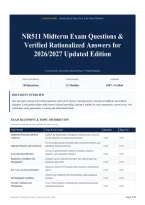
NR511 Midterm Exam Questions &
Verified Rationalized Answers for
2026/2027 Updated Edition
Comprehensive Examination Question Bank • Concept Mapping
TOTAL QUESTIONS EXAM TOPICS ANSWERS
140 Questions 12 Modules 100% Verified
DOCUMENT OVERVIEW
This document contains 140 verified questions with correct answers, focusing on key concepts in healthcare and medical
education. Each question aligns with essential clinical knowledge, making it suitable for exam preparation, course review, and
certification study, particularly in nursing and allied health fields.
EXAM BLUEPRINT & TOPIC DISTRIBUTION
Systematic breakdown of subject domains and exam coverage.
Topic Module Scope & Core Focus Questions Share (%)
Diagnostic Reasoning and Data Explores the fundamentals of diagnostic reasoning, data collection,
Collection and the importance of medical documentation. 12 Qs 8.6%
Covers common infectious diseases, their clinical presentations, and
Infectious Diseases and Treatments appropriate treatment protocols. 12 Qs 8.6%
Focuses on gastrointestinal conditions, including symptoms,
Gastrointestinal Disorders diagnosis, and management strategies. 12 Qs 8.6%
Respiratory Conditions and Examines various respiratory disorders, their clinical signs, and
Management therapeutic approaches. 12 Qs 8.6%
Discusses common ENT disorders, their symptoms, and treatment
Ear, Nose, and Throat Disorders options. 12 Qs 8.6%
Analyzes skin conditions, their characteristics, and management
Dermatological Conditions strategies. 12 Qs 8.6%
Chronic Conditions and Covers chronic diseases, including their symptoms and long-term
Management management strategies. 12 Qs 8.6%
Confidential • Student Study Edition • Practice & Review Guide Page 1 of 50
,STUDENT STUDY & MASTERY EDITION PRACTICE & REVIEW GUIDE
Pharmacology and Treatment Explores pharmacological treatments and the mechanisms of action
Protocols of various medications. 12 Qs 8.6%
Emphasizes the importance of comprehensive history-taking and
History and Physical Examination physical examination in clinical practice. 11 Qs 7.9%
Examines clinical guidelines for various conditions and the
Clinical Guidelines and Patient Care implications for patient care. 11 Qs 7.9%
Focuses on the diagnosis and management of acute medical
Acute Conditions and Interventions conditions and emergencies. 11 Qs 7.9%
Medical Ethics and Professional Discusses ethical considerations and professional practice standards
Practice in healthcare. 11 Qs 7.9%
Total Exam Coverage 12 Integrated Topic Modules 140 Qs 100.0%
TOPIC 1: DIAGNOSTIC REASONING AND DATA COLLECTION
12 Questions • 8.6% of Exam • Explores the fundamentals of diagnostic reasoning, data collection, and the importance of medical documentation.
QUESTION 1
Define diagnostic reasoning
Answer: Reflective thinking because the process involves questioning one's thinking to determine if all possible avenues
have been explored and if the conclusions that are being drawn are based on evidence.
Seen as a kind of critical thinking.
QUESTION 2
What is subjective data?
Answer: Anything the patient tells you or complains of regarding their symptoms Chief complaint HPI ROS.
QUESTION 3
Identify components of HPI
Answer: Specifically related to the chief complaint only Detailed breakdown of CC OLDCARTS.
Confidential • Student Study Edition • Practice & Review Guide Page 2 of 50
,STUDENT STUDY & MASTERY EDITION PRACTICE & REVIEW GUIDE
QUESTION 4
Describe the components of medical decision making in E&M coding.
Answer: Risk, data, diagnosis
The more time and consideration involved in dealing with a pt, the higher the reimbursement from the payer.
Documentation must reflect MDM.
QUESTION 5
Discuss minimum of three purposes of the written history and physical in relation to the
importance of documentation.
Answer: Important reference document that gives concise info about the pt's hx and exam findings Outlines a plan for
addressing issues that prompted the visit. Info should be presented in a logical fashion that prominently features all data
relevant to the pt's condition.
Is a means of communicating info to all providers involved in pt's care Is a medical-legal document Is essential in order to
accurately code and bill for services.
QUESTION 6
What are the three components required in determining an outpatient, office visit E&M code?
Answer: Plan of service
Type of service
Patient status.
QUESTION 7
T/F
The majority of dyspnea complaints are due to cardiac or pulmonary decompensation.
Answer: True.
Confidential • Student Study Edition • Practice & Review Guide Page 3 of 50
, STUDENT STUDY & MASTERY EDITION PRACTICE & REVIEW GUIDE
QUESTION 8
What are common characteristics associated with blepharitis, chalzion, and hordeolum.
Answer: Blepharitis: irritation, burning, itching, scales, redness.
If lice is cause: reddish brown crust in lashes (not white or clear as typically seen).
Chalzion: mass in mid-portion of upper lid away from margin. Usually not painful or tender. Slightly red, swollen.
Hordeolum: usually on outside of lid, abscess on lid margin. Redness, swelling, painful.
QUESTION 9
What are subjective and objective findings with influenza?
Answer: Subjective:
Cough
Sore throat
HA
Fatigue
Muscle/body aches
Sometimes n/v/d
Chills
Objective:
Fever
Rhinorrhea w/productive phlegm occasionally discolored Occasionally red eyes Sometimes tachy.
QUESTION 10
Treatment of IBS with abd pain:
Answer: Bentyl, tricyclic antidepressants.
QUESTION 11
T/F
Patients with > 3 Centor criteria can be empirically diagnosed with GABHS and treated without
further testing.
Answer: True.
Confidential • Student Study Edition • Practice & Review Guide Page 4 of 50
NR511 Midterm Exam Questions &
Verified Rationalized Answers for
2026/2027 Updated Edition
Comprehensive Examination Question Bank • Concept Mapping
TOTAL QUESTIONS EXAM TOPICS ANSWERS
140 Questions 12 Modules 100% Verified
DOCUMENT OVERVIEW
This document contains 140 verified questions with correct answers, focusing on key concepts in healthcare and medical
education. Each question aligns with essential clinical knowledge, making it suitable for exam preparation, course review, and
certification study, particularly in nursing and allied health fields.
EXAM BLUEPRINT & TOPIC DISTRIBUTION
Systematic breakdown of subject domains and exam coverage.
Topic Module Scope & Core Focus Questions Share (%)
Diagnostic Reasoning and Data Explores the fundamentals of diagnostic reasoning, data collection,
Collection and the importance of medical documentation. 12 Qs 8.6%
Covers common infectious diseases, their clinical presentations, and
Infectious Diseases and Treatments appropriate treatment protocols. 12 Qs 8.6%
Focuses on gastrointestinal conditions, including symptoms,
Gastrointestinal Disorders diagnosis, and management strategies. 12 Qs 8.6%
Respiratory Conditions and Examines various respiratory disorders, their clinical signs, and
Management therapeutic approaches. 12 Qs 8.6%
Discusses common ENT disorders, their symptoms, and treatment
Ear, Nose, and Throat Disorders options. 12 Qs 8.6%
Analyzes skin conditions, their characteristics, and management
Dermatological Conditions strategies. 12 Qs 8.6%
Chronic Conditions and Covers chronic diseases, including their symptoms and long-term
Management management strategies. 12 Qs 8.6%
Confidential • Student Study Edition • Practice & Review Guide Page 1 of 50
,STUDENT STUDY & MASTERY EDITION PRACTICE & REVIEW GUIDE
Pharmacology and Treatment Explores pharmacological treatments and the mechanisms of action
Protocols of various medications. 12 Qs 8.6%
Emphasizes the importance of comprehensive history-taking and
History and Physical Examination physical examination in clinical practice. 11 Qs 7.9%
Examines clinical guidelines for various conditions and the
Clinical Guidelines and Patient Care implications for patient care. 11 Qs 7.9%
Focuses on the diagnosis and management of acute medical
Acute Conditions and Interventions conditions and emergencies. 11 Qs 7.9%
Medical Ethics and Professional Discusses ethical considerations and professional practice standards
Practice in healthcare. 11 Qs 7.9%
Total Exam Coverage 12 Integrated Topic Modules 140 Qs 100.0%
TOPIC 1: DIAGNOSTIC REASONING AND DATA COLLECTION
12 Questions • 8.6% of Exam • Explores the fundamentals of diagnostic reasoning, data collection, and the importance of medical documentation.
QUESTION 1
Define diagnostic reasoning
Answer: Reflective thinking because the process involves questioning one's thinking to determine if all possible avenues
have been explored and if the conclusions that are being drawn are based on evidence.
Seen as a kind of critical thinking.
QUESTION 2
What is subjective data?
Answer: Anything the patient tells you or complains of regarding their symptoms Chief complaint HPI ROS.
QUESTION 3
Identify components of HPI
Answer: Specifically related to the chief complaint only Detailed breakdown of CC OLDCARTS.
Confidential • Student Study Edition • Practice & Review Guide Page 2 of 50
,STUDENT STUDY & MASTERY EDITION PRACTICE & REVIEW GUIDE
QUESTION 4
Describe the components of medical decision making in E&M coding.
Answer: Risk, data, diagnosis
The more time and consideration involved in dealing with a pt, the higher the reimbursement from the payer.
Documentation must reflect MDM.
QUESTION 5
Discuss minimum of three purposes of the written history and physical in relation to the
importance of documentation.
Answer: Important reference document that gives concise info about the pt's hx and exam findings Outlines a plan for
addressing issues that prompted the visit. Info should be presented in a logical fashion that prominently features all data
relevant to the pt's condition.
Is a means of communicating info to all providers involved in pt's care Is a medical-legal document Is essential in order to
accurately code and bill for services.
QUESTION 6
What are the three components required in determining an outpatient, office visit E&M code?
Answer: Plan of service
Type of service
Patient status.
QUESTION 7
T/F
The majority of dyspnea complaints are due to cardiac or pulmonary decompensation.
Answer: True.
Confidential • Student Study Edition • Practice & Review Guide Page 3 of 50
, STUDENT STUDY & MASTERY EDITION PRACTICE & REVIEW GUIDE
QUESTION 8
What are common characteristics associated with blepharitis, chalzion, and hordeolum.
Answer: Blepharitis: irritation, burning, itching, scales, redness.
If lice is cause: reddish brown crust in lashes (not white or clear as typically seen).
Chalzion: mass in mid-portion of upper lid away from margin. Usually not painful or tender. Slightly red, swollen.
Hordeolum: usually on outside of lid, abscess on lid margin. Redness, swelling, painful.
QUESTION 9
What are subjective and objective findings with influenza?
Answer: Subjective:
Cough
Sore throat
HA
Fatigue
Muscle/body aches
Sometimes n/v/d
Chills
Objective:
Fever
Rhinorrhea w/productive phlegm occasionally discolored Occasionally red eyes Sometimes tachy.
QUESTION 10
Treatment of IBS with abd pain:
Answer: Bentyl, tricyclic antidepressants.
QUESTION 11
T/F
Patients with > 3 Centor criteria can be empirically diagnosed with GABHS and treated without
further testing.
Answer: True.
Confidential • Student Study Edition • Practice & Review Guide Page 4 of 50


