
[STUDY GUIDE] • HIGH-YIELD PRACTICE & REVIEW EDITION
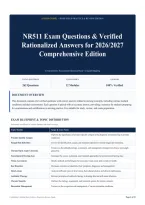
NR511 Exam Questions & Verified
Rationalized Answers for 2026/2027
Comprehensive Edition
Comprehensive Examination Question Bank • Concept Mapping
TOTAL QUESTIONS EXAM TOPICS ANSWERS
262 Questions 12 Modules 100% Verified
DOCUMENT OVERVIEW
This document contains 262 verified questions with correct answers related to nursing concepts, including various medical
conditions and their assessments. Each question is paired with an accurate answer, providing a resource for students preparing
for examinations and certifications in nursing practice. It is suitable for study, review, and exam preparation.
EXAM BLUEPRINT & TOPIC DISTRIBUTION
Systematic breakdown of subject domains and exam coverage.
Topic Module Scope & Core Focus
Explores the significance of prostate-specific antigen in the diagnosis and monitoring of prostate
Prostate Specific Antigen conditions.
Fungal Skin Infections Covers the identification, causes, and treatment options for various fungal skin infections.
Focuses on the pathophysiology, assessment, and management strategies for chronic open-angle
Chronic Open-Angle Glaucoma glaucoma.
Sensorineural Hearing Loss Examines the causes, symptoms, and treatment approaches for sensorineural hearing loss.
Vision Assessment Details methods and techniques for assessing visual acuity and overall eye health.
Ear Disorders Discusses common ear disorders, their symptoms, diagnosis, and management.
Skin Lesions Analyzes different types of skin lesions, their characteristics, and clinical implications.
Antibiotic Therapy Reviews principles of antibiotic therapy in treating skin and soft tissue infections.
Chronic Sinusitis Outlines the etiology, assessment, and treatment options for chronic sinusitis.
Dermatitis Management Focuses on the recognition and management of various dermatitis conditions.
Confidential • Student Study Edition • Practice & Review Guide Page 1 of 53
,STUDENT STUDY & MASTERY EDITION PRACTICE & REVIEW GUIDE
Pediatric Ear Health Highlights common pediatric ear issues and their assessment in children.
Skin Cancer Recognition Covers the assessment and identification of various types of skin cancer.
Total Exam Coverage 12 Integrated Topic Modules • 262 Examination Questions
HIGH-YIELD: QUESTIONS & VERIFIED ANSWERS
Complete Examination Questions • 262 Questions • Sequential Exam Layout
QUESTION 1
When looking under the microscope to diagnose an intravaginal infection, you see a cluster of
small and oval to round shapes. What do you suspect they are?
Answer: Spores.
QUESTION 2
Which test(s) provide data relevant to the chief complaint: Fever
Answer: CBC.
QUESTION 3
In a patient who has anisocoria, the nurse would expect to observe:
Answer: Pupils of unequal size.
QUESTION 4
After a mastoidectomy, the most important complication for the nurse to assess for is:
Answer: Fever.
Confidential • Student Study Edition • Practice & Review Guide Page 2 of 53
,STUDENT STUDY & MASTERY EDITION PRACTICE & REVIEW GUIDE
QUESTION 5
A client was assessed as having normal intraocular pressure. The nurse would document this
clients pressure as being:
Answer: 15 MmHg 3 mmHg.
-Normal intraocular pressure is about 15 mmHg 3 mmHg. An intraocular pressure of 5 mmHg would be too low. A
pressure of 30 to 50 mmHg would be considered critical.
QUESTION 6
The nurse is performing the diagnostic positions test. Normal findings would be which of these
results?
Answer: Parallel movement of both eyes.
QUESTION 7
When assessing the corneal reflex, the nurse realizes this reflex is a function of which cranial
nerve (CN)?
Answer: CN V.
QUESTION 8
A client is experiencing elevated fluid-filled lesions on the skin. The nurse would document these
lesions as being:
Answer: Vesicles.
QUESTION 9
Which of the following statements about performing cryosurgery for actinic keratosis is true?
Answer: The 'freeze balls' should be approximately one-and-a-half times as wide as they are deep.
Confidential • Student Study Edition • Practice & Review Guide Page 3 of 53
, STUDENT STUDY & MASTERY EDITION PRACTICE & REVIEW GUIDE
QUESTION 10
An example of a primary skin lesion is a/an:
Answer: Bulla.
QUESTION 11
A 16-year-old client is being prescribed a medication to treat acute sinusitis. The nurse realizes
that this client should not be prescribed:
Answer: Ciprofloxacin.
QUESTION 12
Which of the following statements is accurate when you are removing a seborrheic keratosis
lesion using liquid nitrogen?
Answer: Use gel foam to control bleeding.
QUESTION 13
In which of the following situations would referral to a specialist be needed for sinusitis?
Answer: All of the above.
QUESTION 14
A 31-year-old patient tells the nurse that he has noticed pain in his left ear when people speak
loudly to
him. The nurse knows that this finding:
Answer: Is a characteristic of recruitment.
QUESTION 15
· Assessment findings of fungal skin infections:
Answer: O papular rash with satellite lesions.
Confidential • Student Study Edition • Practice & Review Guide Page 4 of 53
NR511 Exam Questions & Verified
Rationalized Answers for 2026/2027
Comprehensive Edition
Comprehensive Examination Question Bank • Concept Mapping
TOTAL QUESTIONS EXAM TOPICS ANSWERS
262 Questions 12 Modules 100% Verified
DOCUMENT OVERVIEW
This document contains 262 verified questions with correct answers related to nursing concepts, including various medical
conditions and their assessments. Each question is paired with an accurate answer, providing a resource for students preparing
for examinations and certifications in nursing practice. It is suitable for study, review, and exam preparation.
EXAM BLUEPRINT & TOPIC DISTRIBUTION
Systematic breakdown of subject domains and exam coverage.
Topic Module Scope & Core Focus
Explores the significance of prostate-specific antigen in the diagnosis and monitoring of prostate
Prostate Specific Antigen conditions.
Fungal Skin Infections Covers the identification, causes, and treatment options for various fungal skin infections.
Focuses on the pathophysiology, assessment, and management strategies for chronic open-angle
Chronic Open-Angle Glaucoma glaucoma.
Sensorineural Hearing Loss Examines the causes, symptoms, and treatment approaches for sensorineural hearing loss.
Vision Assessment Details methods and techniques for assessing visual acuity and overall eye health.
Ear Disorders Discusses common ear disorders, their symptoms, diagnosis, and management.
Skin Lesions Analyzes different types of skin lesions, their characteristics, and clinical implications.
Antibiotic Therapy Reviews principles of antibiotic therapy in treating skin and soft tissue infections.
Chronic Sinusitis Outlines the etiology, assessment, and treatment options for chronic sinusitis.
Dermatitis Management Focuses on the recognition and management of various dermatitis conditions.
Confidential • Student Study Edition • Practice & Review Guide Page 1 of 53
,STUDENT STUDY & MASTERY EDITION PRACTICE & REVIEW GUIDE
Pediatric Ear Health Highlights common pediatric ear issues and their assessment in children.
Skin Cancer Recognition Covers the assessment and identification of various types of skin cancer.
Total Exam Coverage 12 Integrated Topic Modules • 262 Examination Questions
HIGH-YIELD: QUESTIONS & VERIFIED ANSWERS
Complete Examination Questions • 262 Questions • Sequential Exam Layout
QUESTION 1
When looking under the microscope to diagnose an intravaginal infection, you see a cluster of
small and oval to round shapes. What do you suspect they are?
Answer: Spores.
QUESTION 2
Which test(s) provide data relevant to the chief complaint: Fever
Answer: CBC.
QUESTION 3
In a patient who has anisocoria, the nurse would expect to observe:
Answer: Pupils of unequal size.
QUESTION 4
After a mastoidectomy, the most important complication for the nurse to assess for is:
Answer: Fever.
Confidential • Student Study Edition • Practice & Review Guide Page 2 of 53
,STUDENT STUDY & MASTERY EDITION PRACTICE & REVIEW GUIDE
QUESTION 5
A client was assessed as having normal intraocular pressure. The nurse would document this
clients pressure as being:
Answer: 15 MmHg 3 mmHg.
-Normal intraocular pressure is about 15 mmHg 3 mmHg. An intraocular pressure of 5 mmHg would be too low. A
pressure of 30 to 50 mmHg would be considered critical.
QUESTION 6
The nurse is performing the diagnostic positions test. Normal findings would be which of these
results?
Answer: Parallel movement of both eyes.
QUESTION 7
When assessing the corneal reflex, the nurse realizes this reflex is a function of which cranial
nerve (CN)?
Answer: CN V.
QUESTION 8
A client is experiencing elevated fluid-filled lesions on the skin. The nurse would document these
lesions as being:
Answer: Vesicles.
QUESTION 9
Which of the following statements about performing cryosurgery for actinic keratosis is true?
Answer: The 'freeze balls' should be approximately one-and-a-half times as wide as they are deep.
Confidential • Student Study Edition • Practice & Review Guide Page 3 of 53
, STUDENT STUDY & MASTERY EDITION PRACTICE & REVIEW GUIDE
QUESTION 10
An example of a primary skin lesion is a/an:
Answer: Bulla.
QUESTION 11
A 16-year-old client is being prescribed a medication to treat acute sinusitis. The nurse realizes
that this client should not be prescribed:
Answer: Ciprofloxacin.
QUESTION 12
Which of the following statements is accurate when you are removing a seborrheic keratosis
lesion using liquid nitrogen?
Answer: Use gel foam to control bleeding.
QUESTION 13
In which of the following situations would referral to a specialist be needed for sinusitis?
Answer: All of the above.
QUESTION 14
A 31-year-old patient tells the nurse that he has noticed pain in his left ear when people speak
loudly to
him. The nurse knows that this finding:
Answer: Is a characteristic of recruitment.
QUESTION 15
· Assessment findings of fungal skin infections:
Answer: O papular rash with satellite lesions.
Confidential • Student Study Edition • Practice & Review Guide Page 4 of 53


