
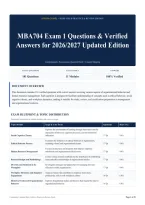
[STUDY GUIDE] • HIGH-YIELD PRACTICE & REVIEW EDITION
MBA704 Exam 1 Questions & Verified
Answers for 2026/2027 Updated Edition
Comprehensive Examination Question Bank • Concept Mapping
TOTAL QUESTIONS EXAM TOPICS ANSWERS
181 Questions 11 Modules 100% Verified
DOCUMENT OVERVIEW
This document contains 181 verified questions with correct answers covering various aspects of organizational behavior and
human resource management. Each question is designed to facilitate understanding of concepts such as ethical behavior, social
cognitive theory, and workplace dynamics, making it suitable for study, review, and certification preparation in management
and organizational contexts.
EXAM BLUEPRINT & TOPIC DISTRIBUTION
Systematic breakdown of subject domains and exam coverage.
Topic Module Scope & Core Focus Questions Share (%)
Explores the mechanisms of learning through observation and the
interaction of behavior, cognitive processes, and environmental
Social Cognitive Theory influences. 17 Qs 9.4%
Examines the influences on ethical behavior in organizations,
Ethical Behavior Factors including cultural and organizational factors. 17 Qs 9.4%
Focuses on practices and programs that enhance employee
Human Resource Management satisfaction and organizational effectiveness. 17 Qs 9.4%
Covers various research methods and the importance of establishing
Research Design and Methodology cause-and-effect relationships in organizational studies. 17 Qs 9.4%
Diversity and Inclusion in the Investigates strategies and approaches for managing diversity
Workplace effectively within organizations. 17 Qs 9.4%
Workplace Dynamics and Employee Analyzes factors that contribute to employee motivation,
Engagement productivity, and overall workplace culture. 16 Qs 8.8%
Historical Context of Organizational Explores foundational studies and theories that shaped the field of
Behavior organizational behavior. 16 Qs 8.8%
Confidential • Student Study Edition • Practice & Review Guide Page 1 of 39
,STUDENT STUDY & MASTERY EDITION PRACTICE & REVIEW GUIDE
Corporate Social Responsibility Looks at the role of ethical practices and sustainability in business
(CSR) operations. 16 Qs 8.8%
Leadership Styles and Examines different leadership approaches and their impact on
Organizational Effectiveness organizational success. 16 Qs 8.8%
Employee Benefits and Work-Life Discusses innovative programs that promote work-life balance and
Balance employee well-being. 16 Qs 8.8%
Identifies current challenges facing managers, including ethical
Challenges in Modern Management dilemmas and employee engagement issues. 16 Qs 8.8%
Total Exam Coverage 11 Integrated Topic Modules 181 Qs 100.0%
TOPIC 1: SOCIAL COGNITIVE THEORY
17 Questions • 9.4% of Exam • Explores the mechanisms of learning through observation and the interaction of behavior, cognitive processes, and
environmental influences.
QUESTION 1
What organization uses this program?
"Joy Gang" charged with creating happiness in the workplace. This group plans birthday and
anniversary celebrations and creates other joyful events
Answer: Ben and jerry's.
QUESTION 2
Employees learn by observing the performance of referent (peers or supervisors) and credible
others (high performers), and the consequences they receive for their actions (what they get for
it).
Answer: Observational (bandura social cognitive theory)
QUESTION 3
True or false: Recent studies have found that cultural differences (by country, race/ethnicity, and
religion) affected the attitudes, perceptions and behaviors of managers toward planning, profit
and other related business concerns.
Answer: True.
Confidential • Student Study Edition • Practice & Review Guide Page 2 of 39
,STUDENT STUDY & MASTERY EDITION PRACTICE & REVIEW GUIDE
QUESTION 4
The person and the environmental situation do not function as independent units but, in
conjunction with the behavior itself, reciprocally interact to determine ____.
Answer: Behavior.
QUESTION 5
What are the four reasons for cross-cultural complexity?
Answer: • People are influenced by multiple cultures (national, regional, organizational, functional, and
professional)
• People from same country have different values, beliefs, and behaviors
• People may adjust their behaviors to deal with foreigners and not reflect their own culture
• Simple cultural categorizations (e.g.--time important to Americans) may not be good predictors of behavior.
QUESTION 6
____ learning takes the position that behavior can best be explained in terms of a continuous
reciprocal interaction among cognitive, behavioral, and environmental determinants.
Answer: Social.
QUESTION 7
What are the two individual approaches to managing diversity?
Answer: Learning and empathy.
QUESTION 8
Employees reflect back on their actions (how did I do?) and perceptually determine how strongly
they believe they can successfully accomplish the task in the future given the context (0 - 100%
certainty).
Answer: Self-reflective (bandura social cognitive theory)
Confidential • Student Study Edition • Practice & Review Guide Page 3 of 39
, STUDENT STUDY & MASTERY EDITION PRACTICE & REVIEW GUIDE
QUESTION 9
____ influences come from ethical codes, role models, policies and practices, and reward and
punishment systems.
Answer: Organizational.
QUESTION 10
• Manipulation of independent variables to measure their effect on, or the change in, dependent
variables, while everything else is held constant or controlled
Answer: Experimental design.
QUESTION 11
•. Use hard facts and empirical evidence to make decisions
•. Make organizational decisions informed by social science and organizational research
Answer: Evidence-based management.
QUESTION 12
The purpose of the ____ program is to help support members of a diverse group in their jobs,
socialize them in the cultural values of the organization, and pragmatically help their chances for
development and advancement.
Answer: Mentor.
QUESTION 13
What are the three ob theoretical frameworks
Answer: Cognitive, behavioristic, and social cognitive.
Confidential • Student Study Edition • Practice & Review Guide Page 4 of 39
MBA704 Exam 1 Questions & Verified
Answers for 2026/2027 Updated Edition
Comprehensive Examination Question Bank • Concept Mapping
TOTAL QUESTIONS EXAM TOPICS ANSWERS
181 Questions 11 Modules 100% Verified
DOCUMENT OVERVIEW
This document contains 181 verified questions with correct answers covering various aspects of organizational behavior and
human resource management. Each question is designed to facilitate understanding of concepts such as ethical behavior, social
cognitive theory, and workplace dynamics, making it suitable for study, review, and certification preparation in management
and organizational contexts.
EXAM BLUEPRINT & TOPIC DISTRIBUTION
Systematic breakdown of subject domains and exam coverage.
Topic Module Scope & Core Focus Questions Share (%)
Explores the mechanisms of learning through observation and the
interaction of behavior, cognitive processes, and environmental
Social Cognitive Theory influences. 17 Qs 9.4%
Examines the influences on ethical behavior in organizations,
Ethical Behavior Factors including cultural and organizational factors. 17 Qs 9.4%
Focuses on practices and programs that enhance employee
Human Resource Management satisfaction and organizational effectiveness. 17 Qs 9.4%
Covers various research methods and the importance of establishing
Research Design and Methodology cause-and-effect relationships in organizational studies. 17 Qs 9.4%
Diversity and Inclusion in the Investigates strategies and approaches for managing diversity
Workplace effectively within organizations. 17 Qs 9.4%
Workplace Dynamics and Employee Analyzes factors that contribute to employee motivation,
Engagement productivity, and overall workplace culture. 16 Qs 8.8%
Historical Context of Organizational Explores foundational studies and theories that shaped the field of
Behavior organizational behavior. 16 Qs 8.8%
Confidential • Student Study Edition • Practice & Review Guide Page 1 of 39
,STUDENT STUDY & MASTERY EDITION PRACTICE & REVIEW GUIDE
Corporate Social Responsibility Looks at the role of ethical practices and sustainability in business
(CSR) operations. 16 Qs 8.8%
Leadership Styles and Examines different leadership approaches and their impact on
Organizational Effectiveness organizational success. 16 Qs 8.8%
Employee Benefits and Work-Life Discusses innovative programs that promote work-life balance and
Balance employee well-being. 16 Qs 8.8%
Identifies current challenges facing managers, including ethical
Challenges in Modern Management dilemmas and employee engagement issues. 16 Qs 8.8%
Total Exam Coverage 11 Integrated Topic Modules 181 Qs 100.0%
TOPIC 1: SOCIAL COGNITIVE THEORY
17 Questions • 9.4% of Exam • Explores the mechanisms of learning through observation and the interaction of behavior, cognitive processes, and
environmental influences.
QUESTION 1
What organization uses this program?
"Joy Gang" charged with creating happiness in the workplace. This group plans birthday and
anniversary celebrations and creates other joyful events
Answer: Ben and jerry's.
QUESTION 2
Employees learn by observing the performance of referent (peers or supervisors) and credible
others (high performers), and the consequences they receive for their actions (what they get for
it).
Answer: Observational (bandura social cognitive theory)
QUESTION 3
True or false: Recent studies have found that cultural differences (by country, race/ethnicity, and
religion) affected the attitudes, perceptions and behaviors of managers toward planning, profit
and other related business concerns.
Answer: True.
Confidential • Student Study Edition • Practice & Review Guide Page 2 of 39
,STUDENT STUDY & MASTERY EDITION PRACTICE & REVIEW GUIDE
QUESTION 4
The person and the environmental situation do not function as independent units but, in
conjunction with the behavior itself, reciprocally interact to determine ____.
Answer: Behavior.
QUESTION 5
What are the four reasons for cross-cultural complexity?
Answer: • People are influenced by multiple cultures (national, regional, organizational, functional, and
professional)
• People from same country have different values, beliefs, and behaviors
• People may adjust their behaviors to deal with foreigners and not reflect their own culture
• Simple cultural categorizations (e.g.--time important to Americans) may not be good predictors of behavior.
QUESTION 6
____ learning takes the position that behavior can best be explained in terms of a continuous
reciprocal interaction among cognitive, behavioral, and environmental determinants.
Answer: Social.
QUESTION 7
What are the two individual approaches to managing diversity?
Answer: Learning and empathy.
QUESTION 8
Employees reflect back on their actions (how did I do?) and perceptually determine how strongly
they believe they can successfully accomplish the task in the future given the context (0 - 100%
certainty).
Answer: Self-reflective (bandura social cognitive theory)
Confidential • Student Study Edition • Practice & Review Guide Page 3 of 39
, STUDENT STUDY & MASTERY EDITION PRACTICE & REVIEW GUIDE
QUESTION 9
____ influences come from ethical codes, role models, policies and practices, and reward and
punishment systems.
Answer: Organizational.
QUESTION 10
• Manipulation of independent variables to measure their effect on, or the change in, dependent
variables, while everything else is held constant or controlled
Answer: Experimental design.
QUESTION 11
•. Use hard facts and empirical evidence to make decisions
•. Make organizational decisions informed by social science and organizational research
Answer: Evidence-based management.
QUESTION 12
The purpose of the ____ program is to help support members of a diverse group in their jobs,
socialize them in the cultural values of the organization, and pragmatically help their chances for
development and advancement.
Answer: Mentor.
QUESTION 13
What are the three ob theoretical frameworks
Answer: Cognitive, behavioristic, and social cognitive.
Confidential • Student Study Edition • Practice & Review Guide Page 4 of 39


