
[STUDY GUIDE] • HIGH-YIELD PRACTICE & REVIEW EDITION
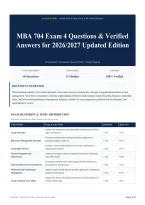
MBA 704 Exam 4 Questions & Verified
Answers for 2026/2027 Updated Edition
Comprehensive Examination Question Bank • Concept Mapping
TOTAL QUESTIONS EXAM TOPICS ANSWERS
154 Questions 12 Modules 100% Verified
DOCUMENT OVERVIEW
This document contains 154 verified questions with correct answers covering key concepts in organizational behavior and
management. Each item is designed to facilitate understanding of theories and strategies related to group dynamics, leadership
styles, and behavioral performance management, making it suitable for exam preparation, professional development, and
comprehensive review.
EXAM BLUEPRINT & TOPIC DISTRIBUTION
Systematic breakdown of subject domains and exam coverage.
Topic Module Scope & Core Focus Questions Share (%)
Explores the interactions and relationships within groups and their
Group Dynamics impact on behavior. 15 Qs 9.7%
Focuses on reinforcement strategies and their application in
Behavioral Management Strategies managing employee behavior. 13 Qs 8.4%
Examines various leadership theories and their application in
Leadership Theories organizational settings. 13 Qs 8.4%
Team Development and Analyzes the stages of team development and factors influencing
Effectiveness team effectiveness. 13 Qs 8.4%
Investigates informal roles within groups and their influence on
Informal Roles and Group Behavior group behavior and dynamics. 13 Qs 8.4%
Motivation and Performance Addresses motivational theories and their application in enhancing
Management employee performance. 13 Qs 8.4%
Explores the factors affecting group cohesion and the dynamics of
Group Cohesion and Conflict conflict within teams. 13 Qs 8.4%
Confidential • Student Study Edition • Practice & Review Guide Page 1 of 32
,STUDENT STUDY & MASTERY EDITION PRACTICE & REVIEW GUIDE
Focuses on the challenges of role conflict in organizations and
Role Conflict and Management strategies for effective management. 13 Qs 8.4%
Examines different leadership styles and their effectiveness in
Leadership Styles and Effectiveness various organizational contexts. 12 Qs 7.8%
Explores the concepts of social learning and cognition in the context
Social Learning and Cognition of organizational behavior. 12 Qs 7.8%
Discusses the criteria for organizational effectiveness and the role of
Organizational Effectiveness groups in achieving goals. 12 Qs 7.8%
Group Formation and Development Analyzes various models and theories related to group formation
Models and development. 12 Qs 7.8%
Total Exam Coverage 12 Integrated Topic Modules 154 Qs 100.0%
TOPIC 1: GROUP DYNAMICS
15 Questions • 9.7% of Exam • Explores the interactions and relationships within groups and their impact on behavior.
QUESTION 1
Group
Answer: Members motivated to join
Functions as unified unit of interacting people Members contribute in various amounts Agrees and disagrees through
various forms of interaction.
QUESTION 2
Group Dynamics
Answer: Interactions and forces among group members in social situations Focuses on internal nature of groups, how
they form, their structure and processes, and how they function and affect members, the group, and the organization.
QUESTION 3
Propinquity
Answer: People affiliate with one another due to spatial or geographical proximity.
Confidential • Student Study Edition • Practice & Review Guide Page 2 of 32
,STUDENT STUDY & MASTERY EDITION PRACTICE & REVIEW GUIDE
QUESTION 4
Balance Theory
Answer: People are attracted to one another on the basis of similar attitudes toward common objectives and goals.
QUESTION 5
Storming
Answer: Second stage
Often emotionally charged stage
Characterized by conflict about roles and duties.
QUESTION 6
Performing
Answer: Fourth stage
Fully functioning stage
Members focused on effective task completion.
QUESTION 7
Group Formation
Answer: Economics
Security
Social
Punctuated Equilibrium Model.
QUESTION 8
Security
Answer: Individuals join group for united front.
Confidential • Student Study Edition • Practice & Review Guide Page 3 of 32
, STUDENT STUDY & MASTERY EDITION PRACTICE & REVIEW GUIDE
QUESTION 9
Punctuated Equilibrium Model
Answer: Target or mission set that is not easily altered because of inertia; characterized by equilibrium Recognition that
tactics must change for mission achievement; characterized by punctuated bursts of activity to complete task.
QUESTION 10
Membership Groups
Answer: Those that individuals belong to.
QUESTION 11
In-Groups/Out-Groups
Answer: Those that have or share dominant values and those that are outside looking in.
QUESTION 12
Task Interdependence
Answer: How closely group members work together.
QUESTION 13
Outcome Interdependence
Answer: Whether /how group is rewarded.
QUESTION 14
Informal Groups
Answer: "Oughts" of behavior
Prescriptions for acceptable behavior determined by the group Position that has expectations evolving from established
norms.
Confidential • Student Study Edition • Practice & Review Guide Page 4 of 32
MBA 704 Exam 4 Questions & Verified
Answers for 2026/2027 Updated Edition
Comprehensive Examination Question Bank • Concept Mapping
TOTAL QUESTIONS EXAM TOPICS ANSWERS
154 Questions 12 Modules 100% Verified
DOCUMENT OVERVIEW
This document contains 154 verified questions with correct answers covering key concepts in organizational behavior and
management. Each item is designed to facilitate understanding of theories and strategies related to group dynamics, leadership
styles, and behavioral performance management, making it suitable for exam preparation, professional development, and
comprehensive review.
EXAM BLUEPRINT & TOPIC DISTRIBUTION
Systematic breakdown of subject domains and exam coverage.
Topic Module Scope & Core Focus Questions Share (%)
Explores the interactions and relationships within groups and their
Group Dynamics impact on behavior. 15 Qs 9.7%
Focuses on reinforcement strategies and their application in
Behavioral Management Strategies managing employee behavior. 13 Qs 8.4%
Examines various leadership theories and their application in
Leadership Theories organizational settings. 13 Qs 8.4%
Team Development and Analyzes the stages of team development and factors influencing
Effectiveness team effectiveness. 13 Qs 8.4%
Investigates informal roles within groups and their influence on
Informal Roles and Group Behavior group behavior and dynamics. 13 Qs 8.4%
Motivation and Performance Addresses motivational theories and their application in enhancing
Management employee performance. 13 Qs 8.4%
Explores the factors affecting group cohesion and the dynamics of
Group Cohesion and Conflict conflict within teams. 13 Qs 8.4%
Confidential • Student Study Edition • Practice & Review Guide Page 1 of 32
,STUDENT STUDY & MASTERY EDITION PRACTICE & REVIEW GUIDE
Focuses on the challenges of role conflict in organizations and
Role Conflict and Management strategies for effective management. 13 Qs 8.4%
Examines different leadership styles and their effectiveness in
Leadership Styles and Effectiveness various organizational contexts. 12 Qs 7.8%
Explores the concepts of social learning and cognition in the context
Social Learning and Cognition of organizational behavior. 12 Qs 7.8%
Discusses the criteria for organizational effectiveness and the role of
Organizational Effectiveness groups in achieving goals. 12 Qs 7.8%
Group Formation and Development Analyzes various models and theories related to group formation
Models and development. 12 Qs 7.8%
Total Exam Coverage 12 Integrated Topic Modules 154 Qs 100.0%
TOPIC 1: GROUP DYNAMICS
15 Questions • 9.7% of Exam • Explores the interactions and relationships within groups and their impact on behavior.
QUESTION 1
Group
Answer: Members motivated to join
Functions as unified unit of interacting people Members contribute in various amounts Agrees and disagrees through
various forms of interaction.
QUESTION 2
Group Dynamics
Answer: Interactions and forces among group members in social situations Focuses on internal nature of groups, how
they form, their structure and processes, and how they function and affect members, the group, and the organization.
QUESTION 3
Propinquity
Answer: People affiliate with one another due to spatial or geographical proximity.
Confidential • Student Study Edition • Practice & Review Guide Page 2 of 32
,STUDENT STUDY & MASTERY EDITION PRACTICE & REVIEW GUIDE
QUESTION 4
Balance Theory
Answer: People are attracted to one another on the basis of similar attitudes toward common objectives and goals.
QUESTION 5
Storming
Answer: Second stage
Often emotionally charged stage
Characterized by conflict about roles and duties.
QUESTION 6
Performing
Answer: Fourth stage
Fully functioning stage
Members focused on effective task completion.
QUESTION 7
Group Formation
Answer: Economics
Security
Social
Punctuated Equilibrium Model.
QUESTION 8
Security
Answer: Individuals join group for united front.
Confidential • Student Study Edition • Practice & Review Guide Page 3 of 32
, STUDENT STUDY & MASTERY EDITION PRACTICE & REVIEW GUIDE
QUESTION 9
Punctuated Equilibrium Model
Answer: Target or mission set that is not easily altered because of inertia; characterized by equilibrium Recognition that
tactics must change for mission achievement; characterized by punctuated bursts of activity to complete task.
QUESTION 10
Membership Groups
Answer: Those that individuals belong to.
QUESTION 11
In-Groups/Out-Groups
Answer: Those that have or share dominant values and those that are outside looking in.
QUESTION 12
Task Interdependence
Answer: How closely group members work together.
QUESTION 13
Outcome Interdependence
Answer: Whether /how group is rewarded.
QUESTION 14
Informal Groups
Answer: "Oughts" of behavior
Prescriptions for acceptable behavior determined by the group Position that has expectations evolving from established
norms.
Confidential • Student Study Edition • Practice & Review Guide Page 4 of 32


