
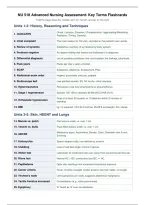
NU 518 Advanced Nursing Assessment: Key Terms Flashcards
Fold the page down the middle: term on the left, answer on the right
Units 1-2: History, Reasoning and Techniques
Onset, Location, Duration, Characteristics, Aggravating/Alleviating,
1. OLDCARTS
Radiation, Timing, Severity.
2. Chief complaint The main reason for the visit, recorded in the patient's own words.
3. Review of systems Subjective inventory of symptoms by body system.
4. Pertinent negative An absent finding that lowers the likelihood of a diagnosis.
5. Differential diagnosis List of possible conditions that could explain the findings, prioritized.
6. Pack-years Packs per day x years smoked.
7. SOAP Subjective, Objective, Assessment, Plan.
8. Abdominal exam order Inspect, auscultate, percuss, palpate.
9. Stethoscope bell Low-pitched sounds: S3, S4, bruits, mitral stenosis.
10. Hyperresonance Percussion note over emphysema or pneumothorax.
11. Stage 1 hypertension Systolic 130-139 or diastolic 80-89 (ACC/AHA 2017).
Drop of at least 20 systolic or 10 diastolic within 3 minutes of
12. Orthostatic hypotension
standing.
13. BMI kg / m squared; 18.5-24.9 normal, 25-29.9 overweight, 30+ obese.
Units 3-5: Skin, HEENT and Lungs
14. Macule vs. patch Flat lesions under vs. over 1 cm.
15. Vesicle vs. bulla Fluid-filled lesions under vs. over 1 cm.
Melanoma signs: Asymmetry, Border, Color, Diameter over 6 mm,
16. ABCDE
Evolving.
17. Koilonychia Spoon-shaped nails; iron-deficiency anemia.
18. Clubbing Loss of nail-bed angle; chronic hypoxia.
19. Weber test Lateralizes to conductive-loss ear; away from sensorineural-loss ear.
20. Rinne test Normal AC > BC; conductive loss BC >= AC.
21. Papilledema Optic disc swelling from increased intracranial pressure.
22. Centor criteria Fever, tonsillar exudate, tender anterior cervical nodes, no cough.
23. Virchow's node Left supraclavicular node; suggests abdominal malignancy.
24. Tactile fremitus increased Consolidation (e.g., lobar pneumonia).
25. Egophony 'E' heard as 'A' over consolidation.
Fold the page down the middle: term on the left, answer on the right
Units 1-2: History, Reasoning and Techniques
Onset, Location, Duration, Characteristics, Aggravating/Alleviating,
1. OLDCARTS
Radiation, Timing, Severity.
2. Chief complaint The main reason for the visit, recorded in the patient's own words.
3. Review of systems Subjective inventory of symptoms by body system.
4. Pertinent negative An absent finding that lowers the likelihood of a diagnosis.
5. Differential diagnosis List of possible conditions that could explain the findings, prioritized.
6. Pack-years Packs per day x years smoked.
7. SOAP Subjective, Objective, Assessment, Plan.
8. Abdominal exam order Inspect, auscultate, percuss, palpate.
9. Stethoscope bell Low-pitched sounds: S3, S4, bruits, mitral stenosis.
10. Hyperresonance Percussion note over emphysema or pneumothorax.
11. Stage 1 hypertension Systolic 130-139 or diastolic 80-89 (ACC/AHA 2017).
Drop of at least 20 systolic or 10 diastolic within 3 minutes of
12. Orthostatic hypotension
standing.
13. BMI kg / m squared; 18.5-24.9 normal, 25-29.9 overweight, 30+ obese.
Units 3-5: Skin, HEENT and Lungs
14. Macule vs. patch Flat lesions under vs. over 1 cm.
15. Vesicle vs. bulla Fluid-filled lesions under vs. over 1 cm.
Melanoma signs: Asymmetry, Border, Color, Diameter over 6 mm,
16. ABCDE
Evolving.
17. Koilonychia Spoon-shaped nails; iron-deficiency anemia.
18. Clubbing Loss of nail-bed angle; chronic hypoxia.
19. Weber test Lateralizes to conductive-loss ear; away from sensorineural-loss ear.
20. Rinne test Normal AC > BC; conductive loss BC >= AC.
21. Papilledema Optic disc swelling from increased intracranial pressure.
22. Centor criteria Fever, tonsillar exudate, tender anterior cervical nodes, no cough.
23. Virchow's node Left supraclavicular node; suggests abdominal malignancy.
24. Tactile fremitus increased Consolidation (e.g., lobar pneumonia).
25. Egophony 'E' heard as 'A' over consolidation.


