
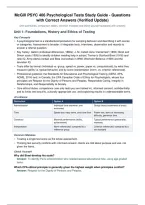
McGill PSYC 406 Psychological Tests Study Guide - Questions
with Correct Answers (Verified Update)
Unit summaries, comparison tables, common mistakes and check-yourself questions with answers
Unit 1: Foundations, History and Ethics of Testing
Key Concepts
• A psychological test is a standardized procedure for sampling behavior and describing it with scores
or categories. Assessment is broader: it integrates tests, interviews, observation and records to
answer a referral question.
• Key history: Galton (individual differences, 1880s); J. M. Cattell coins 'mental test' (1890); Binet and
Simon scale (1905) to identify children needing help in school; Terman's Stanford-Binet (1916) and
ratio IQ; Army Alpha (verbal) and Beta (nonverbal) in WWI; Wechsler-Bellevue (1939) and the
deviation IQ.
• Tests differ by format (individual vs. group, speed vs. power, paper vs. computerized), by what they
measure (ability vs. typical behavior) and by score interpretation (norm- vs. criterion-referenced).
• Professional guidance: the Standards for Educational and Psychological Testing (AERA, APA,
NCME, 2014) and, in Canada, the CPA Canadian Code of Ethics for Psychologists, whose four
principles are Respect for the Dignity of Persons and Peoples, Responsible Caring, Integrity in
Relationships, and Responsibility to Society.
• Core ethical duties: competence (use only tests you are trained in), informed consent, confidentiality
and its limits, test security, culturally appropriate use, and explaining results in understandable terms.
At a Glance
Distinction Option A Option B
Administration Individual (one examiner, one Group (many examinees at once)
examinee)
Time Speed test: easy items, strict time limit Power test: items of increasing
difficulty, generous time
Construct Maximal performance (ability, Typical performance (personality,
achievement) interests)
Interpretation Norm-referenced: compared to a Criterion-referenced: compared to a
reference group set standard
Common Mistakes
• Treating a single test score as the whole assessment.
• Thinking test security conflicts with informed consent; clients are told about purpose and use, not
given the items.
Check Yourself
Why did Binet develop his scale?
Answer: To identify Paris schoolchildren who needed special educational help, using age-graded
tasks.
Which CPA ethical principle is generally given the highest weight when principles conflict?
Answer: Respect for the Dignity of Persons and Peoples.
, Unit 2: Statistics for Testing
Key Concepts
• Scales of measurement: nominal (categories), ordinal (rank order), interval (equal intervals, no true
zero), ratio (true zero). Most test scores are treated as interval.
• Central tendency: mean, median, mode. Variability: range, variance, standard deviation (SD).
• In a normal distribution about 68% of scores fall within 1 SD of the mean, 95% within 2 SD and 99.7%
within 3 SD. Skew: positive (tail to the right, e.g., a very hard test) or negative (tail to the left, e.g., a
very easy test).
• Correlation (r from -1 to +1) shows the direction and strength of a linear relationship; r squared
(coefficient of determination) is the proportion of shared variance. Correlation does not show
causation.
• Correlation types: Pearson r (two continuous variables), Spearman rho (ranks), point-biserial (one
dichotomous, one continuous), phi (two dichotomous).
• Regression uses one variable to predict another; the standard error of estimate (SEE) = SDy x sqrt(1
- r squared) shows prediction error.
At a Glance
Statistic Formula / rule Example
z-score z = (X - M) / SD X = 65, M = 50, SD = 10: z = 1.5
T-score T = 50 + 10z z = 1.5: T = 65
Deviation IQ IQ = 100 + 15z z = -1: IQ = 85
Percentile (normal curve) z = 0: 50th; z = 1: 84th; z = 2: about z = -1: 16th percentile
98th
Coefficient of determination r squared r = .60: 36% shared variance
Standard error of estimate SDy x sqrt(1 - r squared) SDy = 10, r = .60: SEE = 8
Common Mistakes
• Reading a positive skew as 'most people scored high'; in a positive skew most scores pile up at the
LOW end.
• Interpreting r = .50 as '50% explained'; it is 25% (r squared).
Check Yourself
A score is 1 SD below the mean. What is its percentile rank?
Answer: About the 16th percentile.
A test has M = 100, SD = 15. What T-score corresponds to a score of 130?
Answer: z = 2, so T = 70.
with Correct Answers (Verified Update)
Unit summaries, comparison tables, common mistakes and check-yourself questions with answers
Unit 1: Foundations, History and Ethics of Testing
Key Concepts
• A psychological test is a standardized procedure for sampling behavior and describing it with scores
or categories. Assessment is broader: it integrates tests, interviews, observation and records to
answer a referral question.
• Key history: Galton (individual differences, 1880s); J. M. Cattell coins 'mental test' (1890); Binet and
Simon scale (1905) to identify children needing help in school; Terman's Stanford-Binet (1916) and
ratio IQ; Army Alpha (verbal) and Beta (nonverbal) in WWI; Wechsler-Bellevue (1939) and the
deviation IQ.
• Tests differ by format (individual vs. group, speed vs. power, paper vs. computerized), by what they
measure (ability vs. typical behavior) and by score interpretation (norm- vs. criterion-referenced).
• Professional guidance: the Standards for Educational and Psychological Testing (AERA, APA,
NCME, 2014) and, in Canada, the CPA Canadian Code of Ethics for Psychologists, whose four
principles are Respect for the Dignity of Persons and Peoples, Responsible Caring, Integrity in
Relationships, and Responsibility to Society.
• Core ethical duties: competence (use only tests you are trained in), informed consent, confidentiality
and its limits, test security, culturally appropriate use, and explaining results in understandable terms.
At a Glance
Distinction Option A Option B
Administration Individual (one examiner, one Group (many examinees at once)
examinee)
Time Speed test: easy items, strict time limit Power test: items of increasing
difficulty, generous time
Construct Maximal performance (ability, Typical performance (personality,
achievement) interests)
Interpretation Norm-referenced: compared to a Criterion-referenced: compared to a
reference group set standard
Common Mistakes
• Treating a single test score as the whole assessment.
• Thinking test security conflicts with informed consent; clients are told about purpose and use, not
given the items.
Check Yourself
Why did Binet develop his scale?
Answer: To identify Paris schoolchildren who needed special educational help, using age-graded
tasks.
Which CPA ethical principle is generally given the highest weight when principles conflict?
Answer: Respect for the Dignity of Persons and Peoples.
, Unit 2: Statistics for Testing
Key Concepts
• Scales of measurement: nominal (categories), ordinal (rank order), interval (equal intervals, no true
zero), ratio (true zero). Most test scores are treated as interval.
• Central tendency: mean, median, mode. Variability: range, variance, standard deviation (SD).
• In a normal distribution about 68% of scores fall within 1 SD of the mean, 95% within 2 SD and 99.7%
within 3 SD. Skew: positive (tail to the right, e.g., a very hard test) or negative (tail to the left, e.g., a
very easy test).
• Correlation (r from -1 to +1) shows the direction and strength of a linear relationship; r squared
(coefficient of determination) is the proportion of shared variance. Correlation does not show
causation.
• Correlation types: Pearson r (two continuous variables), Spearman rho (ranks), point-biserial (one
dichotomous, one continuous), phi (two dichotomous).
• Regression uses one variable to predict another; the standard error of estimate (SEE) = SDy x sqrt(1
- r squared) shows prediction error.
At a Glance
Statistic Formula / rule Example
z-score z = (X - M) / SD X = 65, M = 50, SD = 10: z = 1.5
T-score T = 50 + 10z z = 1.5: T = 65
Deviation IQ IQ = 100 + 15z z = -1: IQ = 85
Percentile (normal curve) z = 0: 50th; z = 1: 84th; z = 2: about z = -1: 16th percentile
98th
Coefficient of determination r squared r = .60: 36% shared variance
Standard error of estimate SDy x sqrt(1 - r squared) SDy = 10, r = .60: SEE = 8
Common Mistakes
• Reading a positive skew as 'most people scored high'; in a positive skew most scores pile up at the
LOW end.
• Interpreting r = .50 as '50% explained'; it is 25% (r squared).
Check Yourself
A score is 1 SD below the mean. What is its percentile rank?
Answer: About the 16th percentile.
A test has M = 100, SD = 15. What T-score corresponds to a score of 130?
Answer: z = 2, so T = 70.


