
• Wrong document? Swap it for free
  • Written by students who passed
  • Immediately available after payment
  • Read online or as PDF
Sell
Where do you study
Your language
Document preview thumbnail
Preview 2 out of 15 pages
Exam (elaborations)

NU 110/ Integrated Human Sciences (NU-110) Exam 1 (V2) | Complete Questions & Answers | Latest Updated 2026/2027 | Galen College.

Document preview thumbnail
Preview 2 out of 15 pages

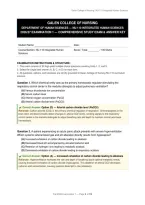
NU 110/ Integrated Human Sciences (NU-110) Exam 1 (V2) | Complete Questions & Answers | Latest Updated 2026/2027 | Galen College. Which chemical entity acts as the primary homeostatic regulator stimulating the respiratory control center in the medulla oblongata to adjust pulmonary ventilation? A. Venous bicarbonate ion concentration B. Serum sodium level C. Arterial oxygen concentration (PaO₂) D. Arterial carbon dioxide level (PaCO₂) A patient experiencing an acute panic attack presents with severe hyperventilation. Which systemic arterial blood gas and pH alteration directly results from hypocapnia? A. Increased exhalation of carbon dioxide leading to alkalosis B. Decreased blood pH accompanied by elevated carbonic acid C. Retention of hydrogen ions leading to metabolic acidosis D. Decreased exhalation of carbon dioxide leading to respiratory acidosis Hypoventilation causes insufficient movement of air into and out of the alveoli. What immediate chemical shift occurs in the blood stream as a result of hypoventilation? A. Blood CO₂ levels increase, causing respiratory acidosis B. Blood CO₂ levels decrease, causing alkalosis C. Blood pH rises rapidly due to loss of hydrogen ions D. Bicarbonate ions are completely eliminated by the lungs In the chemical pathway of carbon dioxide transport, which enzyme catalyzes the reversible conversion of carbon dioxide and water into carbonic acid within red blood cells? A. Creatine kinase B. Acetylcholinesterase C. Carbonic anhydrase D. Lactate dehydrogenase Following the enzymatic formation of carbonic acid (H₂CO₃) in systemic capillaries, into which two ions does carbonic acid immediately dissociate? A. Calcium ions and phosphate ions B. Potassium ions and hydroxyl ions C. Sodium ions and chloride ions D. Hydrogen ions and bicarbonate ions Anatomically, the laryngopharynx serves as a shared conduit for air, liquids, and solids. Into which anterior and posterior structures does the laryngopharynx open? A. Anteriorly into the oropharynx and posteriorly into the bronchi B. Anteriorly into the nasopharynx and posteriorly into the trachea C. Anteriorly into the larynx and posteriorly into the esophagus D. Anteriorly into the esophagus and posteriorly into the glottis The trachea (windpipe) extends from the inferior edge of the larynx downward into which central anatomical division of the thoracic cavity? A. Pelvic cavity B. Pleural cavity C. Mediastinum D. Peritoneal cavity Which combination of skeletal structures and cartilage forms the superior, inferior, and anterior portions of the nasal septum? A. Superiorly the thin plate of the ethmoid bone, inferiorly the vomer, anteriorly hyaline cartilage B. Superiorly the nasal bone, inferiorly the mandible, anteriorly adipose tissue C. Superiorly the sphenoid bone, inferiorly the maxilla, anteriorly elastic cartilage D. Superiorly the palatine bone, inferiorly the lacrimal bone, anteriorly fibrocartilage Which neural structure located superior to the brain stem acts to increase the rate and depth of pulmonary ventilation in direct response to emotional stress or pain? A. Cerebellum B. Hypothalamus C. Thalamus D. Basal ganglia During physical exercise, sensory receptors located in muscles and joints send rapid feedback to adjust breathing to meet increased metabolic demands. What are these sensory receptors called? A. Thermoreceptors B. Baroreceptors C. Proprioceptors D. Nociceptors A patient undergoes spirometry evaluation. Which respiratory volume represents the standard quantity of air inhaled and exhaled during quiet, relaxed, normal breathing? A. Inspiratory Reserve Volume B. Tidal Volume C. Residual Volume D. Vital Capacity What clinical term defines the maximum total volume of air that a surgical patient can forcefully exhale after taking a maximum, forced inhalation? A. Total Lung Capacity B. Functional Residual Capacity C. Vital Capacity D. Residual Volume Histologically, adjacent cardiac muscle cells are joined end-to-end by specialized membrane structures that permit rapid electrical signal transmission. What are these structures called? A. Intercalated disks B. Neuromuscular junctions C. Tight junctions D. Synaptic clefts During external gas exchange in the pulmonary circuit, by which cellular transport process do oxygen molecules cross the alveolar wall and pulmonary capillary endothelium? A. Facilitated filtration via carrier proteins B. Primary endocytosis C. Active transport requiring ATP D. Simple diffusion down a partial pressure gradient Surfactant is a lipid-protein complex secreted by specialized alveolar epithelial cells. What is its essential physiological function in maintaining pulmonary compliance? A. Binds oxygen molecules for transport to the left atrium B. Stimulates smooth muscle contraction in terminal bronchioles C. Increases mucus viscosity to trap inhaled pathogens D. Reduces the surface tension of fluid lining the alveoli to prevent alveolar collapse What exact proportion of oxygen transported within systemic arterial blood is bound to hemoglobin molecules inside circulating erythrocytes? A. 98.5% B. 50.0% C. 75.0% D. 100.0% In adult skeletal structure, where does active hematopoiesis (red blood cell formation) take place within long bone histology? A. Red bone marrow within spongy bone and medullary cavities B. Yellow bone marrow in the diaphysis C. Dense periosteum covering the bone exterior D. Articular hyaline cartilage at the epiphysis Hemoglobin is an iron-containing protein located inside red blood cells. In addition to gas transport, how does oxygenated hemoglobin affect tissue appearance? A. Imparts a dark brown pigment to skin cells B. Protects deep dermal layers from ultraviolet radiation C. Causes yellowish discoloration of sclera and mucous membranes D. Gives a bright red color to blood and contributes to normal skin coloration The wall of blood vessels is composed of three functional tunics. Which tissue type forms the smooth, frictionless inner lining (endothelium) of all blood vessels? A. Smooth involuntary muscle B. Dense irregular connective tissue C. Simple squamous epithelial cells D. Stratified squamous epithelium Which structural tunic of an arterial wall contains smooth involuntary muscle cells responsible for regulating blood vessel diameter through vasoconstriction and vasodilation? A. Outer tunic (tunica adventitia) B. Middle tunic (tunica media) C. Inner tunic (endothelium) D. Subcutaneous layer In cardiovascular assessment, Cardiac Output (CO) is a key measure of heart function. Which mathematical formula correctly defines Cardiac Output? A. Cardiac Output = Blood Pressure ÷ Heart Rate B. Cardiac Output = Tidal Volume × Respiratory Rate C. Cardiac Output = Heart Rate × Stroke Volume D. Cardiac Output = Systolic Pressure − Diastolic Pressure What clinical parameter represents the specific volume of blood ejected from a ventricle during a single contraction cycle? A. Stroke volume B. End-diastolic volume C. Total lung capacity D. Pulse pressure When systemic arterioles undergo vasodilation, what immediate change occurs regarding internal lumen diameter and blood pressure? A. Lumen diameter increases and blood pressure decreases B. Lumen diameter decreases and blood pressure increases C. Lumen diameter expands causing instant arterial rupture D. Lumen diameter remains unchanged while heart rate doubles During cardiac cycle dynamics, peak arterial blood pressure (systolic pressure) directly reflects which physical event in the left side of the heart? A. Contraction of the left ventricle B. Relaxation of the left atrium C. Passive filling of the right atrium D. Closure of the pulmonic semilunar valve A nurse records a patient's blood pressure as 120/80 mmHg. What is the patient's calculated pulse pressure? A. 1.5 mmHg B. 40 mmHg C. 200 mmHg D. 96 mmHg Which human body organ system serves as the primary physical barrier acting as the body's first line of defense against microbial infection and dehydration? A. Musculoskeletal system B. Integumentary system C. Lymphatic system D. Endocrine system The epidermis is the outermost layer of skin. Which physiological characteristic and protective protein distinguish the epidermis from deeper skin layers? A. It contains adipose tissue and large blood vessels B. It is highly vascular and contains abundant collagen C. It consists of smooth muscle fibers that produce sebum D. It is avascular and packed with keratin protein for water resistance and protection Which anatomical layer forms the thin, smooth interior epithelial lining of the heart's chambers and valves? A. Myocardium B. Endocardium C. Epicardium D. Pericardium Because the thick muscular myocardium cannot receive adequate nourishment directly from blood flowing through heart chambers, which specialized arterial network supplies it with blood? A. Coronary arteries B. Carotid arteries C. Iliac arteries D. Subclavian arteries What is the structural sac composed of fibrous and serous membranes that encloses and protects the heart within the mediastinum? A. Pericardium B. Pleural sac C. Peritoneum D. Joint capsule Each lung is enclosed within a continuous double-layered serous sac. What exists between the visceral and parietal pleura to prevent membrane friction during respiration? A. Dense fibrous connective tissue B. Pleural space containing a thin film of lubricating fluid C. Thick mucus secreted by goblet cells D. Adipose tissue cushion Sebaceous glands are saclike exocrine glands located in the dermis. Where do their ducts empty, and what is the functional purpose of their secretion (sebum)? A. Into hair follicles to lubricate skin and hair and prevent drying B. Into lymphatic ducts to transport white blood cells C. Directly onto skin pores to release salty water for cooling D. Into blood capillaries to regulate blood glucose Unlike eccrine sweat glands distributed across the body, where are specialized apocrine sweat glands specifically concentrated in humans? A. Dorsal surfaces of arms and legs B. Scalp and forehead only C. Palms of hands and soles of feet D. Armpits (axillae) and groin regions When core body temperature rises above set point, how do cutaneous blood vessels and sweat glands coordinate homeostatic thermoregulation? A. Cutaneous vessels constrict while hair arrector pili muscles contract to trap air B. Cutaneous blood vessels constrict and sweat glands stop secreting C. Cutaneous blood vessels dilate to radiate heat and sweat glands secrete sweat for evaporative cooling D. Subcutaneous adipose tissue dissolves to dissipate heat Melanin is the skin's primary pigment produced by melanocytes in the epidermis. What is its main biological function? A. Transports oxygen molecules across dermal capillaries B. Synthesizes vitamin D upon exposure to rain C. Provides brown/dark skin color and protects deeper tissues from harmful ultraviolet (UV) radiation D. Lubricates the epidermal surface to prevent friction Skeletal muscle organizational hierarchy includes several connective tissue sheaths. Which sheath specifically surrounds each muscle fascicle (group of fibers)? A. Epimysium B. Perimysium C. Endomysium D. Deep fascia Which deepest connective tissue layer encloses individual muscle fibers within a muscle fascicle? A. Endomysium B. Tendon C. Epimysium D. Perimysium At the neuromuscular junction, which neurotransmitter chemical is released from somatic motor neurons to stimulate muscle fiber contraction? A. Norepinephrine B. Acetylcholine (ACh) C. Serotonin D. Dopamine What microscopic structural unit containing overlapping actin and myosin filaments serves as the functional unit of contraction inside a skeletal muscle myofibril? A. Fascicle B. Motor unit C. Intercalated disk D. Sarcomere Skeletal muscles are attached to bones by tough, flexible bands of dense fibrous connective tissue. What are these attachment structures called? A. Ligaments B. Bursae C. Aponeuroses D. Tendons Which functional class of joints is freely movable and characterized by a joint cavity lined with a synovial membrane that secretes lubricating synovial fluid? A. Fibrous suture B. Amphiarthrosis C. Diarthrosis (Synovial joint) D. Synarthrosis Bones forming a synarthrosis joint are held together so tightly by fibrous connective tissue that no movement is permitted. Which of the following is an example? A. Sutures between cranial bones B. Intervertebral disks C. Pubic symphysis D. Knee joint Joints connected by cartilage that permit slight movement under mechanical stress, such as the pubic symphysis and intervertebral joints, belong to which functional class? A. Synarthrosis B. Synovial hinge C. Amphiarthrosis D. Diarthrosis Which specific anatomical movement bends the foot upward at the ankle joint, narrowing the angle between the leg and the top (dorsum) of the foot? A. Plantar flexion B. Dorsiflexion C. Eversion D. Pronation Anatomy students review facial muscles. Which circular skeletal muscle encircles the mouth opening to close, compress, and pucker the lips? A. Zygomaticus major B. Orbicularis oris C. Masseter D. Orbicularis oculi Which facial muscle completely encircles the eye orbit, functioning specifically to close the eyelids during blinking and squinting? A. Temporalis B. Orbicularis oris C. Orbicularis oculi D. Frontalis Which somatic nerve originating from cervical spinal cord nerves (C3-C5) provides motor innervation to the diaphragm, the chief muscle of respiration? A. Sciatic nerve B. Radial nerve C. Phrenic nerve D. Vagus nerve Inside the cardiac ventricles, heavy fibrous cords attach the flaps of atrioventricular valves to papillary muscles, preventing valve prolapse during systole. What are these cords called? A. Purkinje fibers B. Chordae tendineae C. Intercalated disks D. Pectinate muscles A nurse auscultates a patient's heart sounds. The first heart sound (S1 or “Lub”) is produced directly by which mechanical cardiac event? A. Closure of semilunar valves B. Closure of the atrioventricular (AV) valves (Tricuspid and Mitral) C. Contraction of the atria D. Opening of the aortic valve The second heart sound (S2 or “Dub”) marks the beginning of ventricular diastole. What mechanical closure produces the S2 sound? A. Opening of the mitral valve B. Contraction of the papillary muscles C. Closure of the tricuspid valve D. Closure of the semilunar valves (Pulmonic and Aortic)

Content preview

Galen College of Nursing | NU-110 Integrated Human Sciences


GALEN COLLEGE OF NURSING
DEPARTMENT OF HUMAN SCIENCES — NU-110 INTEGRATED HUMAN SCIENCES
2026/27 EXAMINATION 1 — COMPREHENSIVE STUDY EXAM & ANSWER KEY


Student Name: ___________________________ Date:
Course/Section: NU-110 Integrated Human Score / Total: ________ / 100 Marks
Sciences


EXAMINATION INSTRUCTIONS & STRUCTURE:
1. This exam consists of 50 high-yield multiple-choice questions covering Units 1, 2, and 3.
2. Select the single best answer (A, B, C, or D) for each item.
4. All questions, options, and rationales are strictly grounded in Galen College of Nursing NU-110 curriculum
sources.

Question 1. Which chemical entity acts as the primary homeostatic regulator stimulating the
respiratory control center in the medulla oblongata to adjust pulmonary ventilation?
(A) Venous bicarbonate ion concentration
(B) Serum sodium level
(C) Arterial oxygen concentration (PaO2)
(D) Arterial carbon dioxide level (PaCO2)

✔ Correct Answer: Option (D) — Arterial carbon dioxide level (PaCO2)
Rationale: Carbon dioxide (CO2) is the primary chemical regulator of respiration. Chemoreceptors in the
brain stem and blood vessels detect changes in arterial CO2 levels, sending signals to the respiratory
control center in the medulla oblongata to adjust breathing rate and depth to maintain normal acid-base
homeostasis.


Question 2. A patient experiencing an acute panic attack presents with severe hyperventilation.
Which systemic arterial blood gas and pH alteration directly results from hypocapnia?
(A) Increased exhalation of carbon dioxide leading to alkalosis
(B) Decreased blood pH accompanied by elevated carbonic acid
(C) Retention of hydrogen ions leading to metabolic acidosis
(D) Decreased exhalation of carbon dioxide leading to respiratory acidosis

✔ Correct Answer: Option (A) — Increased exhalation of carbon dioxide leading to alkalosis
Rationale: Hyperventilation increases the rate and depth of breathing above optimal metabolic needs,
causing excessive exhalation of carbon dioxide (hypocapnia). This depletion of arterial CO2 decreases
carbonic acid concentration, causing systemic blood pH to rise (alkalosis).


Fall 2026 Examination 1 — Page 1 of 15

, Galen College of Nursing | NU-110 Integrated Human Sciences


Question 3. Hypoventilation causes insufficient movement of air into and out of the alveoli. What
immediate chemical shift occurs in the blood stream as a result of hypoventilation?
(A) Blood CO2 levels increase, causing respiratory acidosis
(B) Blood CO2 levels decrease, causing alkalosis
(C) Blood pH rises rapidly due to loss of hydrogen ions
(D) Bicarbonate ions are completely eliminated by the lungs

✔ Correct Answer: Option (A) — Blood CO2 levels increase, causing respiratory acidosis
Rationale: Hypoventilation occurs when pulmonary ventilation is inadequate to meet metabolic needs.
Carbon dioxide accumulates in the alveoli and bloodstream, forming carbonic acid and increasing hydrogen
ion concentration, which lowers blood pH and produces respiratory acidosis.


Question 4. In the chemical pathway of carbon dioxide transport, which enzyme catalyzes the
reversible conversion of carbon dioxide and water into carbonic acid within red blood cells?
(A) Creatine kinase
(B) Acetylcholinesterase
(C) Carbonic anhydrase
(D) Lactate dehydrogenase

✔ Correct Answer: Option (C) — Carbonic anhydrase
Rationale: Carbonic anhydrase is the enzyme inside erythrocytes that rapidly converts dissolved carbon
dioxide and water into carbonic acid (H2CO3), facilitating CO2 transport from metabolic tissues to the lungs.


Question 5. Following the enzymatic formation of carbonic acid (H2CO3) in systemic capillaries, into
which two ions does carbonic acid immediately dissociate?
(A) Calcium ions and phosphate ions
(B) Potassium ions and hydroxyl ions
(C) Sodium ions and chloride ions
(D) Hydrogen ions and bicarbonate ions

✔ Correct Answer: Option (D) — Hydrogen ions and bicarbonate ions
Rationale: Carbonic acid spontaneously separates into hydrogen ions (H+) and bicarbonate ions (HCO3-).
Bicarbonate diffuses into the plasma as the principal buffer carrying CO2 back to the lungs for elimination.


Question 6. Anatomically, the laryngopharynx serves as a shared conduit for air, liquids, and solids.
Into which anterior and posterior structures does the laryngopharynx open?
(A) Anteriorly into the oropharynx and posteriorly into the bronchi
(B) Anteriorly into the nasopharynx and posteriorly into the trachea
(C) Anteriorly into the larynx and posteriorly into the esophagus
(D) Anteriorly into the esophagus and posteriorly into the glottis

✔ Correct Answer: Option (C) — Anteriorly into the larynx and posteriorly into the esophagus
Rationale: The laryngopharynx is the inferior portion of the pharynx that branches anteriorly into the larynx
(voice box) to conduct air into the trachea, and posteriorly into the esophagus to direct food and liquids into


Fall 2026 Examination 1 — Page 2 of 15

Document information

Uploaded on
October 13, 2026
Number of pages
15
Written in
2026/2027
Type
Exam (elaborations)
Contains
Questions & answers
$16.49

Wrong document? Swap it for free Within 14 days of purchase and before downloading, you can choose a different document. You can simply spend the amount again.
Written by students who passed
Immediately available after payment
Read online or as PDF

Seller avatar
Reputation scores are based on the amount of documents a seller has sold for a fee and the reviews they have received for those documents. There are three levels: Bronze, Silver and Gold. The better the reputation, the more your can rely on the quality of the sellers work.
MindCraft
3.9
(57)
Sold
475
Followers
11
Items
3028
Last sold
13 hours ago


Why students choose Stuvia

Created by fellow students, verified by reviews

Quality you can trust: written by students who passed their tests and reviewed by others who've used these notes.

Didn't get what you expected? Choose another document

No worries! You can instantly pick a different document that better fits what you're looking for.

Pay as you like, start learning right away

No subscription, no commitments. Pay the way you're used to via credit card and download your PDF document instantly.

Student with book image

“Bought, downloaded, and aced it. It really can be that simple.”

Alisha Student

Working on your references?

Create accurate citations in APA, MLA and Harvard with our free citation generator.

Working on your references?

Frequently asked questions

