
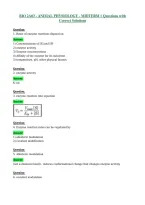
BIO 2A03 - ANIMAL PHYSIOLOGY - MIDTERM 1 Questions with
Correct Solutions
Question:
1. Rates of enzyme reactions depend on
Answer:
1) Concentrations of [S] and [P]
2) enzyme activity
3) Enzyme concentrations
4) Affinity of the enzyme for its substrate
5) temperature, pH, other physical factors
Question:
2. enzyme activity
Answer:
K cat
Question:
3. enzyme reaction rate equation
Answer:
Question:
4. Enzyme reaction rates can be regulated by
Answer:
1) allosteric modulation
2) covalent modification
Question:
5. Allosteric modulation
Answer:
(not a chemical bond) - induces conformational change that changes enzyme activity
Question:
6. covalent modulation
, Answer:
addition of a chemical group to an enzyme that causes altered activity
- usually catalyzed by other enzymes
- ex: phosphorylation
Question:
7. energy metabolism
Answer:
pathways needed to convert energy in food to ATP
Question:
8. two processes supporting ATP production
Answer:
1) substrate level phosphorylation - (absence of O2 - glycolysis)
2) oxidative phosphorylation (presence of O2 - in mitochondria
Question:
9. by product of ATP synthesis and hydrolysis
Answer:
heat
Question:
10. glycolysis provides how many ATP and NADH molecules?
Answer:
2, 2
Question:
11. 1 glucose =
Answer:
2 molecules of pyruvate
Question:
12. glycolysis occurs in the?
Answer:
Cytosol
Question:
13. in order for pyruvate to enter the Krebs cycle it must be converted into what in what step?
Correct Solutions
Question:
1. Rates of enzyme reactions depend on
Answer:
1) Concentrations of [S] and [P]
2) enzyme activity
3) Enzyme concentrations
4) Affinity of the enzyme for its substrate
5) temperature, pH, other physical factors
Question:
2. enzyme activity
Answer:
K cat
Question:
3. enzyme reaction rate equation
Answer:
Question:
4. Enzyme reaction rates can be regulated by
Answer:
1) allosteric modulation
2) covalent modification
Question:
5. Allosteric modulation
Answer:
(not a chemical bond) - induces conformational change that changes enzyme activity
Question:
6. covalent modulation
, Answer:
addition of a chemical group to an enzyme that causes altered activity
- usually catalyzed by other enzymes
- ex: phosphorylation
Question:
7. energy metabolism
Answer:
pathways needed to convert energy in food to ATP
Question:
8. two processes supporting ATP production
Answer:
1) substrate level phosphorylation - (absence of O2 - glycolysis)
2) oxidative phosphorylation (presence of O2 - in mitochondria
Question:
9. by product of ATP synthesis and hydrolysis
Answer:
heat
Question:
10. glycolysis provides how many ATP and NADH molecules?
Answer:
2, 2
Question:
11. 1 glucose =
Answer:
2 molecules of pyruvate
Question:
12. glycolysis occurs in the?
Answer:
Cytosol
Question:
13. in order for pyruvate to enter the Krebs cycle it must be converted into what in what step?


