
BIO 2A03 TEST 1 Questions with Correct Solutions
Question:
1. 5 factors rates of reaction depend on
Answer:
[S] and [P], enzyme activity (Kcat), [E], affinity of enzyme for substrate, temperature/pH
Question:
2. Vmax=
Answer:
Kcat*[E]
Question:
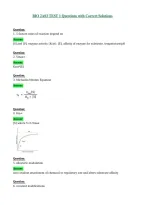
3. Michaelis-Menten Equation
Answer:
Question:
4. Km=
Answer:
[S] where V=1/2max
Question:
5. allosteric modulation
Answer:
non-covalent attachment of chemical to regulatory site and alters substrate affinity
Question:
6. covalent modifications
,Answer:
chemical reactions that change enzyme activity (ex. phopshorylation, kinases)
Question:
7. steps of glucose oxidation
Answer:
glycolysis, linking step, Kreb's cycle, oxidative phosphorylation
Question:
8. glycolysis (location, products, #of enzymes)
Answer:
creates 2 pyruvates, 2 NADH and 2ATP, in cytosol, multi-step with 10 enzymes
Question:
9. linking step (location, products, enzyme involved)
Answer:
mitochondria, creates acetyl coA, NADH and CO2, catalyzed by pyruvate dehydrogenase
Question:
10. Kreb's Cycle (location, reactants, products, # of enzymes involved)
Answer:
in mitochondrial matrix, uses 3 NAD+, 1 FAD, 3 H2O, 1 ADP and acetyl coA to make 3 NADH,
1 FADH, 2 CO2 and 1ATP, involves 8 enzymes
Question:
11. oxidative phosphorylation (general mechanism)
Answer:
NADH and FADH deliver electrons to ETC, reduces O2 to H2O and energy is used to pump
protons out of matrix into intermembrane space then move back with concentration gradient
back into matrix via ATP synthase
Question:
12. respiromes
Answer:
super complexes of proteins in the ETC
Question:
13. anaerobic respiration
, Answer:
glycolysis, then reaction of pyruvate with lactate dehydrogenase, produces lactic acid, 2 ATP
and NAD+
Question:
14. uncoupling
Answer:
decreased ATP production due to proton slip, used in weight loss pharmaceuticals and brown
adipose tissue
Question:
15. 3 types of cell communication
Answer:
hormones, neurotransmitters, autocrine/paracrine agents
Question:
16. 4 factors of signal transduction pathways
Answer:
specificity, amplification, desensitisation/adaptation, integration
Question:
17. number of bound receptors depends on
Answer:
[messenger], # of receptors, receptor affinity for messenger
Question:
18. characteristics of intracellular receptors
Answer:
bind to lipophilic chemical agents, act as TF, less common
Question:
19. characteristics of membrane-bound receptors and the 3 types
Answer:
bind to lipophobic messengers, types: channel-linked, enzyme-linked, G-protein linked
Question:
20. secondary messengers function to
Answer:
amplify signal from 1st messenger
Question:
1. 5 factors rates of reaction depend on
Answer:
[S] and [P], enzyme activity (Kcat), [E], affinity of enzyme for substrate, temperature/pH
Question:
2. Vmax=
Answer:
Kcat*[E]
Question:
3. Michaelis-Menten Equation
Answer:
Question:
4. Km=
Answer:
[S] where V=1/2max
Question:
5. allosteric modulation
Answer:
non-covalent attachment of chemical to regulatory site and alters substrate affinity
Question:
6. covalent modifications
,Answer:
chemical reactions that change enzyme activity (ex. phopshorylation, kinases)
Question:
7. steps of glucose oxidation
Answer:
glycolysis, linking step, Kreb's cycle, oxidative phosphorylation
Question:
8. glycolysis (location, products, #of enzymes)
Answer:
creates 2 pyruvates, 2 NADH and 2ATP, in cytosol, multi-step with 10 enzymes
Question:
9. linking step (location, products, enzyme involved)
Answer:
mitochondria, creates acetyl coA, NADH and CO2, catalyzed by pyruvate dehydrogenase
Question:
10. Kreb's Cycle (location, reactants, products, # of enzymes involved)
Answer:
in mitochondrial matrix, uses 3 NAD+, 1 FAD, 3 H2O, 1 ADP and acetyl coA to make 3 NADH,
1 FADH, 2 CO2 and 1ATP, involves 8 enzymes
Question:
11. oxidative phosphorylation (general mechanism)
Answer:
NADH and FADH deliver electrons to ETC, reduces O2 to H2O and energy is used to pump
protons out of matrix into intermembrane space then move back with concentration gradient
back into matrix via ATP synthase
Question:
12. respiromes
Answer:
super complexes of proteins in the ETC
Question:
13. anaerobic respiration
, Answer:
glycolysis, then reaction of pyruvate with lactate dehydrogenase, produces lactic acid, 2 ATP
and NAD+
Question:
14. uncoupling
Answer:
decreased ATP production due to proton slip, used in weight loss pharmaceuticals and brown
adipose tissue
Question:
15. 3 types of cell communication
Answer:
hormones, neurotransmitters, autocrine/paracrine agents
Question:
16. 4 factors of signal transduction pathways
Answer:
specificity, amplification, desensitisation/adaptation, integration
Question:
17. number of bound receptors depends on
Answer:
[messenger], # of receptors, receptor affinity for messenger
Question:
18. characteristics of intracellular receptors
Answer:
bind to lipophilic chemical agents, act as TF, less common
Question:
19. characteristics of membrane-bound receptors and the 3 types
Answer:
bind to lipophobic messengers, types: channel-linked, enzyme-linked, G-protein linked
Question:
20. secondary messengers function to
Answer:
amplify signal from 1st messenger


