
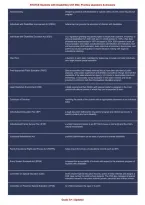
NYSTCE Students with Disabilities CST 060 | Practice Questions & Answers
mainstreaming integrating students with disabilities or special needs into the overall educational
program
Individuals with Disabilities Improvement Act (IDEIA) federal law that governs the education of children with disabilities
Individuals with Disabilities Education Act (IDEA) U.S. legislation granting educational rights to people with cognitive, emotional, or
physical disabilities from birth until age 21; initially passed in 1975, it has been
amended and reauthorized in 1997 and again in 2004. IDEA operates under six
basic principles: zero reject, nondiscriminatory identification and evaluation, free
and appropriate public education, least restrictive environment, due process, and
parent and student participation in shared decision making with regard to
educational planning.
Child Find A function of each state, mandated by federal law, to locate and refer individuals
who might require special education
Free Appropriate Public Education (FAPE) Special education and related services that (a) have been provided at public
expense, under public supervision and direction and without charge; (b) meet the
standards of the state educational agency; (c) include an appropriate preschool,
elementary, or secondary school education in the state involved; and (d) are
provided in conformity with the individualized education program
Least Restrictive Environment (LRE) a legal requirement that children with special needs be assigned to the most
general educational context in which they can be expected to learn
Continuum of Services matching the needs of the student with an appropriate placement on an individual
basis
Individualized Education Plan (IEP) a legal document defining the educational program and related services for a
specific student who has a disability
Individualized Family Service Plan (IFSP) a written document similar to an IEP that focuses on the family and the child's
natural environment
Vocational Rehabilitation Act prohibits discrimination on the basis of physical or mental disabilities
Family Educational Rights and Privacy Act (FERPA) helps ensure the privacy of educational records such as IEPs
Every Student Succeeds Act (ESSA) increases the accountability of schools with respect to the academic progress of
students with disabilities
Committee on Special Education (CSE) stores student special education records, opens all initial referrals and assigns a
CSE case number for public school students. The CSE also manages all special
education issues for non-public schools (private, parochial) and charter schools
Committee on Preschool Special Education (CPSE) for children between the ages of 3 and 5
Grade A+ | Updated
, NYSTCE Students with Disabilities CST 060 | Practice Questions & Answers
Procedural Safeguards provisions of IDEA designed to protect students and parents in the special
education process
Due Process refers to principles that attempt to guarantee the rights of citizens
due process hearing A procedure to resolve a conflict between school and family over the evaluation,
program, or placement of a student with a disability
age of majority the designated age at which an individual is recognized as an adult
prereferral assessment to help students who are struggling in the general education setting before referring
them for special education assessment
Response to Intervention (RTI) an educational strategy intended to help children who demonstrate below-average
achievement in early grades, using special intervention
self-reflection the process of becoming aware of and analyzing one's own thoughts, feelings, and
behaviors
What Works Clearinghouse (WWC) __________________ is an example of a US government website that provides
information about scientifically based research of relevance to instructional practice.
US Department of Education A government agency that oversees education and federal student aid in the United
States
Office of Special Education and Rehabilitative Services offers programs, services, and a variety of resources that promote inclusion, equity,
(OSERS) and opportunity for students with disabilities
Council for Exceptional Children An organization that was founded in 1922 to advocate for all children with
disabilities is called the
receptive language ability to comprehend speech
expressive language the ability to use sounds, signs, or symbols to communicate meaning
Phonology the study of speech sounds in language
phoneme in language, the smallest distinctive sound unit
Grade A+ | Updated
mainstreaming integrating students with disabilities or special needs into the overall educational
program
Individuals with Disabilities Improvement Act (IDEIA) federal law that governs the education of children with disabilities
Individuals with Disabilities Education Act (IDEA) U.S. legislation granting educational rights to people with cognitive, emotional, or
physical disabilities from birth until age 21; initially passed in 1975, it has been
amended and reauthorized in 1997 and again in 2004. IDEA operates under six
basic principles: zero reject, nondiscriminatory identification and evaluation, free
and appropriate public education, least restrictive environment, due process, and
parent and student participation in shared decision making with regard to
educational planning.
Child Find A function of each state, mandated by federal law, to locate and refer individuals
who might require special education
Free Appropriate Public Education (FAPE) Special education and related services that (a) have been provided at public
expense, under public supervision and direction and without charge; (b) meet the
standards of the state educational agency; (c) include an appropriate preschool,
elementary, or secondary school education in the state involved; and (d) are
provided in conformity with the individualized education program
Least Restrictive Environment (LRE) a legal requirement that children with special needs be assigned to the most
general educational context in which they can be expected to learn
Continuum of Services matching the needs of the student with an appropriate placement on an individual
basis
Individualized Education Plan (IEP) a legal document defining the educational program and related services for a
specific student who has a disability
Individualized Family Service Plan (IFSP) a written document similar to an IEP that focuses on the family and the child's
natural environment
Vocational Rehabilitation Act prohibits discrimination on the basis of physical or mental disabilities
Family Educational Rights and Privacy Act (FERPA) helps ensure the privacy of educational records such as IEPs
Every Student Succeeds Act (ESSA) increases the accountability of schools with respect to the academic progress of
students with disabilities
Committee on Special Education (CSE) stores student special education records, opens all initial referrals and assigns a
CSE case number for public school students. The CSE also manages all special
education issues for non-public schools (private, parochial) and charter schools
Committee on Preschool Special Education (CPSE) for children between the ages of 3 and 5
Grade A+ | Updated
, NYSTCE Students with Disabilities CST 060 | Practice Questions & Answers
Procedural Safeguards provisions of IDEA designed to protect students and parents in the special
education process
Due Process refers to principles that attempt to guarantee the rights of citizens
due process hearing A procedure to resolve a conflict between school and family over the evaluation,
program, or placement of a student with a disability
age of majority the designated age at which an individual is recognized as an adult
prereferral assessment to help students who are struggling in the general education setting before referring
them for special education assessment
Response to Intervention (RTI) an educational strategy intended to help children who demonstrate below-average
achievement in early grades, using special intervention
self-reflection the process of becoming aware of and analyzing one's own thoughts, feelings, and
behaviors
What Works Clearinghouse (WWC) __________________ is an example of a US government website that provides
information about scientifically based research of relevance to instructional practice.
US Department of Education A government agency that oversees education and federal student aid in the United
States
Office of Special Education and Rehabilitative Services offers programs, services, and a variety of resources that promote inclusion, equity,
(OSERS) and opportunity for students with disabilities
Council for Exceptional Children An organization that was founded in 1922 to advocate for all children with
disabilities is called the
receptive language ability to comprehend speech
expressive language the ability to use sounds, signs, or symbols to communicate meaning
Phonology the study of speech sounds in language
phoneme in language, the smallest distinctive sound unit
Grade A+ | Updated


