
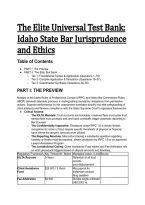
The Elite Universal Test Bank:
Idaho State Bar Jurisprudence
and Ethics
Table of Contents
● PART I: The Preview
● PART II: The Elite Test Bank
○ Tier 1: Foundational Syntax & Application (Questions 1–18)
○ Tier 2: Complex Application & Simulation (Questions 19–37)
○ Tier 3: Grandmaster Synthesis (Questions 38–55)
PART I: THE PREVIEW
Mastery of the Idaho Rules of Professional Conduct (IRPC) and Idaho Bar Commission Rules
(IBCR) demands absolute precision in distinguishing mandatory obligations from permissive
actions. Superior performance on this assessment translates directly into elite safeguarding of
client interests and flawless compliance with the Idaho Supreme Court's regulatory frameworks.
● Critical Axioms:
○ The IOLTA Mandate: Trust accounts are inviolable; unearned fees must enter trust,
earned fees must promptly exit, and bank overdrafts trigger automatic reporting to
Bar Counsel.
○ The Confidentiality Imperative: Disclosure under IRPC 1.6 is strictly limited;
exceptions for crime or fraud require specific thresholds of physical or financial
harm where the lawyer's services were utilized.
○ The Reporting Absolute: Misconduct raising a substantial question regarding
honesty or fitness must be reported, absent protection by IRPC 1.6 or an approved
Lawyer Assistance Program.
○ The Jurisdictional Ceiling: Client Assistance Fund claims and Fee Arbitration rely
on strict procedural triggers based on dispute amounts and timelines.
Regulatory Framework Key Threshold / Metric Mandated Action / Limit Source
IOLTA Records 5 Years Retention of all trust
records
post-disbursement
Client Assistance $25, Years Max payout for
Fund dishonest conduct;
filing deadline
Fee Arbitration $2,500 Divides single arbitrator
(≤$2,500) vs.
,Regulatory Framework Key Threshold / Metric Mandated Action / Limit Source
three-member panel
MCLE Compliance / 15 30 total hours, 3 ethics,
15 self-study maximum
Serious Crime 14 Days Attorney must
Reporting self-report any serious
conviction to the Bar
PART II: THE ELITE TEST BANK
Tier 1: Foundational Syntax & Application
Q1: An Idaho attorney discovers that a client intends to discharge a highly toxic, illegal pollutant
into a municipal water supply that will cause imminent, severe health complications for
residents. Based on the principles of IRPC 1.6, which action is MOST APPROPRIATE? A) The
attorney must remain silent because the information is protected by attorney-client privilege and
does not involve imminent death. B) The attorney must seek a court order to compel the client
to cease the discharge before revealing any confidential data. C) The attorney may reveal the
information to the extent reasonably necessary to prevent reasonably certain death or
substantial bodily harm. D) The attorney must immediately disclose the information to the
Environmental Protection Agency regardless of the client's intent to proceed.
● Answer: C (The attorney may reveal the information to the extent reasonably necessary to
prevent reasonably certain death or substantial bodily harm.)
● Distractor Analysis:
○ A is incorrect: The exception for physical harm applies to both reasonably certain
death and substantial bodily harm, rendering absolute silence incorrect.
○ B is incorrect: Seeking a court order is a procedural delay not mandated by the
IRPC when immediate harm is threatened.
○ D is incorrect: The rule is permissive, not mandatory, regarding the prevention of
physical harm.
The Mentor's Analysis: IRPC 1.6 fundamentally protects client confidences, but safety overrides
secrecy. The rule provides a permissive exception allowing attorneys to disclose information to
prevent reasonably certain death or substantial bodily harm, circumventing the novice
assumption that such disclosures are strictly mandatory. Professional Intuition: Never confuse
permissive disclosure exceptions with mandatory reporting duties; IRPC 1.6(b) grants discretion,
not a directive.
Q2: An attorney deposits $500 of their own personal funds into their Idaho IOLTA trust account.
The attorney does this solely to ensure that standard monthly bank maintenance fees do not
draw against client funds. Based on the principles of IRPC 1.15, which conclusion is MOST
ACCURATE? A) The attorney has committed a commingling violation because personal funds
may never touch an IOLTA account. B) The attorney has committed a commingling violation
because the amount exceeds the permitted threshold for personal funds. C) The attorney has
acted ethically, as depositing personal funds specifically to pay bank service charges is an
explicit exception to the commingling rule. D) The attorney has acted ethically, provided the
client gave informed, written consent to the commingling.
● Answer: C (The attorney has acted ethically, as depositing personal funds specifically to
pay bank service charges is an explicit exception to the commingling rule.)
● Distractor Analysis:
, ○ A is incorrect: While commingling is generally strictly prohibited, an explicit
exception exists for covering bank charges.
○ B is incorrect: The rule permits funds "reasonably sufficient" to pay charges, without
prescribing a strict statutory dollar limit.
○ D is incorrect: Client consent cannot cure a commingling violation; the exception
relies entirely on the purpose of the deposit, not consent.
The Mentor's Analysis: Trust accounts demand absolute purity, but practicality dictates minor
operational allowances. IRPC 1.15 allows lawyers to deposit personal funds strictly to cover
bank charges, preventing the inadvertent misappropriation of client funds to cover institutional
fees. Professional Intuition: Commingling is the cardinal sin of trust accounting, but shielding
client funds from bank fees is the lone safe harbor.
Q3: An attorney observes opposing counsel knowingly submit a falsified financial affidavit to the
court during a contested divorce proceeding. Based on the principles of IRPC 8.3, what is the
attorney's MANDATORY obligation? A) The attorney should confront opposing counsel privately
and demand a retraction before notifying the tribunal. B) The attorney must report the
misconduct to the appropriate professional authority, as it raises a substantial question
regarding honesty and fitness. C) The attorney must report the misconduct only if the client
provides written, informed consent to do so. D) The attorney may report the misconduct but is
not obligated to unless it results in a criminal conviction.
● Answer: B (The attorney must report the misconduct to the appropriate professional
authority, as it raises a substantial question regarding honesty and fitness.)
● Distractor Analysis:
○ A is incorrect: Confrontation is a tactical choice, not an ethical safe harbor; it does
not replace the mandatory reporting duty.
○ C is incorrect: The duty to report supersedes client consent, provided the report
does not violate IRPC 1.6 confidentiality.
○ D is incorrect: Deliberate falsification of evidence directly implicates honesty and
requires mandatory reporting, regardless of criminal prosecution.
The Mentor's Analysis: Self-regulation of the legal profession requires vigilance. When a lawyer
observes an act that undeniably compromises honesty—such as perjury or falsifying
evidence—reporting is not optional; it is a fundamental duty to the integrity of the tribunal.
Professional Intuition: If the misconduct makes you question a lawyer's baseline honesty, the
duty to report is automatically triggered.
Q4: A newly admitted Active member of the Idaho State Bar is calculating their Mandatory
Continuing Legal Education (MCLE) requirements. Based on the principles of IBCR 402, which
calculation is CORRECT for their reporting cycle? A) 15 credit hours annually, including 1 hour
of ethics. B) 30 credit hours every 3 years, including exactly 2 hours of ethics. C) 30 credit hours
every 3 years, including at least 3 hours of legal ethics or professional responsibility. D) 45 credit
hours every 3 years, with no cap on self-study courses.
● Answer: C (30 credit hours every 3 years, including at least 3 hours of legal ethics or
professional responsibility.)
● Distractor Analysis:
○ A is incorrect: Idaho does not use an annual 15-hour reporting system for standard
compliance.
○ B is incorrect: The ethics requirement is 3 hours, not 2 hours.
○ D is incorrect: The total requirement is 30 hours, and self-study is strictly capped at
15 hours per reporting period.
The Mentor's Analysis: Maintaining competence requires structured, periodic education. Idaho
Idaho State Bar Jurisprudence
and Ethics
Table of Contents
● PART I: The Preview
● PART II: The Elite Test Bank
○ Tier 1: Foundational Syntax & Application (Questions 1–18)
○ Tier 2: Complex Application & Simulation (Questions 19–37)
○ Tier 3: Grandmaster Synthesis (Questions 38–55)
PART I: THE PREVIEW
Mastery of the Idaho Rules of Professional Conduct (IRPC) and Idaho Bar Commission Rules
(IBCR) demands absolute precision in distinguishing mandatory obligations from permissive
actions. Superior performance on this assessment translates directly into elite safeguarding of
client interests and flawless compliance with the Idaho Supreme Court's regulatory frameworks.
● Critical Axioms:
○ The IOLTA Mandate: Trust accounts are inviolable; unearned fees must enter trust,
earned fees must promptly exit, and bank overdrafts trigger automatic reporting to
Bar Counsel.
○ The Confidentiality Imperative: Disclosure under IRPC 1.6 is strictly limited;
exceptions for crime or fraud require specific thresholds of physical or financial
harm where the lawyer's services were utilized.
○ The Reporting Absolute: Misconduct raising a substantial question regarding
honesty or fitness must be reported, absent protection by IRPC 1.6 or an approved
Lawyer Assistance Program.
○ The Jurisdictional Ceiling: Client Assistance Fund claims and Fee Arbitration rely
on strict procedural triggers based on dispute amounts and timelines.
Regulatory Framework Key Threshold / Metric Mandated Action / Limit Source
IOLTA Records 5 Years Retention of all trust
records
post-disbursement
Client Assistance $25, Years Max payout for
Fund dishonest conduct;
filing deadline
Fee Arbitration $2,500 Divides single arbitrator
(≤$2,500) vs.
,Regulatory Framework Key Threshold / Metric Mandated Action / Limit Source
three-member panel
MCLE Compliance / 15 30 total hours, 3 ethics,
15 self-study maximum
Serious Crime 14 Days Attorney must
Reporting self-report any serious
conviction to the Bar
PART II: THE ELITE TEST BANK
Tier 1: Foundational Syntax & Application
Q1: An Idaho attorney discovers that a client intends to discharge a highly toxic, illegal pollutant
into a municipal water supply that will cause imminent, severe health complications for
residents. Based on the principles of IRPC 1.6, which action is MOST APPROPRIATE? A) The
attorney must remain silent because the information is protected by attorney-client privilege and
does not involve imminent death. B) The attorney must seek a court order to compel the client
to cease the discharge before revealing any confidential data. C) The attorney may reveal the
information to the extent reasonably necessary to prevent reasonably certain death or
substantial bodily harm. D) The attorney must immediately disclose the information to the
Environmental Protection Agency regardless of the client's intent to proceed.
● Answer: C (The attorney may reveal the information to the extent reasonably necessary to
prevent reasonably certain death or substantial bodily harm.)
● Distractor Analysis:
○ A is incorrect: The exception for physical harm applies to both reasonably certain
death and substantial bodily harm, rendering absolute silence incorrect.
○ B is incorrect: Seeking a court order is a procedural delay not mandated by the
IRPC when immediate harm is threatened.
○ D is incorrect: The rule is permissive, not mandatory, regarding the prevention of
physical harm.
The Mentor's Analysis: IRPC 1.6 fundamentally protects client confidences, but safety overrides
secrecy. The rule provides a permissive exception allowing attorneys to disclose information to
prevent reasonably certain death or substantial bodily harm, circumventing the novice
assumption that such disclosures are strictly mandatory. Professional Intuition: Never confuse
permissive disclosure exceptions with mandatory reporting duties; IRPC 1.6(b) grants discretion,
not a directive.
Q2: An attorney deposits $500 of their own personal funds into their Idaho IOLTA trust account.
The attorney does this solely to ensure that standard monthly bank maintenance fees do not
draw against client funds. Based on the principles of IRPC 1.15, which conclusion is MOST
ACCURATE? A) The attorney has committed a commingling violation because personal funds
may never touch an IOLTA account. B) The attorney has committed a commingling violation
because the amount exceeds the permitted threshold for personal funds. C) The attorney has
acted ethically, as depositing personal funds specifically to pay bank service charges is an
explicit exception to the commingling rule. D) The attorney has acted ethically, provided the
client gave informed, written consent to the commingling.
● Answer: C (The attorney has acted ethically, as depositing personal funds specifically to
pay bank service charges is an explicit exception to the commingling rule.)
● Distractor Analysis:
, ○ A is incorrect: While commingling is generally strictly prohibited, an explicit
exception exists for covering bank charges.
○ B is incorrect: The rule permits funds "reasonably sufficient" to pay charges, without
prescribing a strict statutory dollar limit.
○ D is incorrect: Client consent cannot cure a commingling violation; the exception
relies entirely on the purpose of the deposit, not consent.
The Mentor's Analysis: Trust accounts demand absolute purity, but practicality dictates minor
operational allowances. IRPC 1.15 allows lawyers to deposit personal funds strictly to cover
bank charges, preventing the inadvertent misappropriation of client funds to cover institutional
fees. Professional Intuition: Commingling is the cardinal sin of trust accounting, but shielding
client funds from bank fees is the lone safe harbor.
Q3: An attorney observes opposing counsel knowingly submit a falsified financial affidavit to the
court during a contested divorce proceeding. Based on the principles of IRPC 8.3, what is the
attorney's MANDATORY obligation? A) The attorney should confront opposing counsel privately
and demand a retraction before notifying the tribunal. B) The attorney must report the
misconduct to the appropriate professional authority, as it raises a substantial question
regarding honesty and fitness. C) The attorney must report the misconduct only if the client
provides written, informed consent to do so. D) The attorney may report the misconduct but is
not obligated to unless it results in a criminal conviction.
● Answer: B (The attorney must report the misconduct to the appropriate professional
authority, as it raises a substantial question regarding honesty and fitness.)
● Distractor Analysis:
○ A is incorrect: Confrontation is a tactical choice, not an ethical safe harbor; it does
not replace the mandatory reporting duty.
○ C is incorrect: The duty to report supersedes client consent, provided the report
does not violate IRPC 1.6 confidentiality.
○ D is incorrect: Deliberate falsification of evidence directly implicates honesty and
requires mandatory reporting, regardless of criminal prosecution.
The Mentor's Analysis: Self-regulation of the legal profession requires vigilance. When a lawyer
observes an act that undeniably compromises honesty—such as perjury or falsifying
evidence—reporting is not optional; it is a fundamental duty to the integrity of the tribunal.
Professional Intuition: If the misconduct makes you question a lawyer's baseline honesty, the
duty to report is automatically triggered.
Q4: A newly admitted Active member of the Idaho State Bar is calculating their Mandatory
Continuing Legal Education (MCLE) requirements. Based on the principles of IBCR 402, which
calculation is CORRECT for their reporting cycle? A) 15 credit hours annually, including 1 hour
of ethics. B) 30 credit hours every 3 years, including exactly 2 hours of ethics. C) 30 credit hours
every 3 years, including at least 3 hours of legal ethics or professional responsibility. D) 45 credit
hours every 3 years, with no cap on self-study courses.
● Answer: C (30 credit hours every 3 years, including at least 3 hours of legal ethics or
professional responsibility.)
● Distractor Analysis:
○ A is incorrect: Idaho does not use an annual 15-hour reporting system for standard
compliance.
○ B is incorrect: The ethics requirement is 3 hours, not 2 hours.
○ D is incorrect: The total requirement is 30 hours, and self-study is strictly capped at
15 hours per reporting period.
The Mentor's Analysis: Maintaining competence requires structured, periodic education. Idaho


