
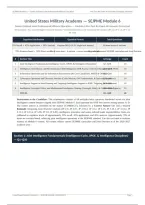
SEJPME Module 6 — Senior Enlisted Joint Professional Military Education Pre-Test Re-Exam • Test-Bank Complete Solutions
United States Military Academy — SEJPME Module 6
Senior Enlisted Joint Professional Military Education — Module 6 Pre-Test Re-Exam All Answers Corrected
60 Questions • Six Joint Intelligence Content Domains • Detailed Rationales with Joint Doctrine Citations (JP 2-0, JP 3-13, JP 3-12,
JP 3-60)
Cognitive Distribution Question Format Total Questions
35% Recall • 45% Application • 20% Analysis 4-option MCQ (A–D, single best answer) 60 items across 6 sections
70% Scenario-based • 30% Direct recallEach item: stem + 4 options + correct answer
Aligned
+ rationale
with current SEJPME curriculum and Joint Doctrine
# Section Title Q Range Count
1 Joint Intelligence Fundamentals (Intelligence Cycle, JIPOE, & Intelligence Disciplines) Q1–Q10 10
2 Intelligence, Surveillance, and Reconnaissance (ISR) Integration (ISR Assets, Collection Management,
Q11–Q20& PED) 10
3 Information Operations and the Information Environment (IO Core Capabilities, MISO, & OPSEC)
Q21–Q30 10
4 Cyberspace Operations and Electronic Warfare (Cyber Mission, EW Fundamentals, & Spectrum
Q31–Q40
Operations) 10
5 Intelligence Support to Joint Planning and Targeting (Intelligence Support to JOPP, Targeting, Q41–Q50
& Assessment) 10
6 Intelligence Oversight, Ethics, and Multinational Intelligence Sharing (Oversight, Ethics, & Coalition
Q51–Q60 Intelligence) 10
TOTAL Q1–Q60 60
Instructions to the Candidate: This examination consists of 60 multiple-choice questions distributed across six joint
intelligence content domains aligned with SEJPME Module 6. Each question has ONE best answer among options A–D.
The correct answer is identified by the marker [CORRECT], followed by a Correct Answer line and a detailed
Rationale integrating Joint Doctrine citations (JP 2-0, JP 2-01, JP 2-01.3, JP 3-12, JP 3-13, JP 3-13.1, JP 3-13.2, JP
3-13.3, JP 3-13.4, JP 3-60, JP 5-0, JP 6-01), intelligence principles, and senior enlisted leader responsibilities. Items are
calibrated to cognitive levels of approximately 35% recall, 45% application, and 20% analysis. Approximately 70% of
items are scenario-based, reflecting joint intelligence operations at the SEJPME standard. Use this test bank to evaluate
mastery of Module 6 content. All content reflects current SEJPME curriculum and Joint Doctrine as of the 2026–2027
academic year.
Section 1: Joint Intelligence Fundamentals (Intelligence Cycle, JIPOE, & Intelligence Disciplines)
— Q1–Q10
United States Military Academy — SEJPME Module 6 (2026/2027) Page 1
,SEJPME Module 6 — Senior Enlisted Joint Professional Military Education Pre-Test Re-Exam • Test-Bank Complete Solutions
Q1. During a joint intelligence operation, an analyst receives raw SIGINT data collected by a national
agency and converts it into a format usable by the J2 staff. Which step of the intelligence cycle does this
activity represent?
A. Planning and Direction
B. Collection
C. Processing [CORRECT]
D. Dissemination
Correct Answer: C
Rationale: Per JP 2-0, Joint Intelligence, the intelligence cycle consists of five steps: Planning and Direction, Collection,
Processing, Analysis and Production, and Dissemination. Processing is the step where raw collected data is converted into
a usable form — including translation, decryption, format conversion, and initial sorting — before analysis can begin.
Collection is the gathering of raw data; Analysis converts processed information into intelligence; Dissemination delivers
finished intelligence to consumers.
Q2. A combatant command J2 receives a commander's Priority Intelligence Requirements (PIRs) following
mission analysis. Which phase of the intelligence cycle does this trigger primarily, and what is its purpose?
A. Dissemination; to push finished intelligence to consumers
B. Planning and Direction; to translate commander's intent into specific collection requirements and
intelligence priorities [CORRECT]
C. Processing; to convert raw data into usable form
D. Analysis and Production; to evaluate intelligence gaps
Correct Answer: B
Rationale: Per JP 2-0, Planning and Direction is the first step of the intelligence cycle, where the J2 translates the
commander's intent, PIRs, and intelligence requirements into specific collection priorities, tasking, and intelligence plans.
This step establishes the framework for all subsequent intelligence activities and ensures the intelligence effort is aligned
with the commander's decision-making needs. PIRs flow from mission analysis in JOPP and drive the entire intelligence
cycle.
Q3. A joint force intelligence cell completes a finished intelligence assessment and forwards it to the J3 for
operational use. The J3 provides feedback that the assessment did not address a key commander's PIR.
Which step of the intelligence cycle was ineffective, and what should occur next?
A. Dissemination failed; the report should be re-sent through a different channel
B. Feedback was ineffective; the J2 must re-enter the Planning and Direction step to refine requirements
[CORRECT]
C. Collection failed; additional assets must be tasked immediately
D. Processing failed; raw data must be re-processed
Correct Answer: B
Rationale: Per JP 2-0, Feedback is an integral part of the intelligence cycle, ensuring intelligence production remains
relevant and actionable. When feedback indicates a PIR was not addressed, the J2 must re-enter Planning and Direction to
refine collection requirements, reprioritize assets, and adjust the intelligence plan. Feedback closes the loop and ensures
continuous improvement of intelligence support to the commander's decision cycle.
United States Military Academy — SEJPME Module 6 (2026/2027) Page 2
, SEJPME Module 6 — Senior Enlisted Joint Professional Military Education Pre-Test Re-Exam • Test-Bank Complete Solutions
Q4. During Joint Intelligence Preparation of the Operational Environment (JIPOE), the J2 staff is
evaluating the terrain, weather, infrastructure, and demographics of a potential area of operations. Which
step of the JIPOE process is being conducted?
A. Step 1: Define the Operational Environment
B. Step 2: Describe the Impact of the Operational Environment [CORRECT]
C. Step 3: Evaluate the Adversary
D. Step 4: Determine Adversary Courses of Action
Correct Answer: B
Rationale: Per JP 2-01.3, JIPOE Step 2 (Describe the Impact of the Operational Environment) analyzes and evaluates the
effects of PMESII-PT variables (Political, Military, Economic, Social, Information, Infrastructure, Physical Environment,
Time) on friendly, adversary, and neutral operations. This step includes detailed terrain, weather, oceanographic, and
demographic analysis to determine how the environment affects courses of action and capabilities.
Q5. A JIPE team is developing models of likely adversary courses of action based on adversary doctrine,
capabilities, and historical patterns. Which JIPE step is being executed, and what is the primary output?
A. Step 2: Describe the Impact of the Operational Environment; outputs terrain analysis
B. Step 4: Determine Adversary Courses of Action; outputs adversary COA models and models of their use
[CORRECT]
C. Step 1: Define the Operational Environment; outputs the area of interest boundaries
D. Step 3: Evaluate the Adversary; outputs adversary order of battle
Correct Answer: B
Rationale: Per JP 2-01.3, JIPE Step 4 (Determine Adversary Courses of Action) identifies and develops adversary COA
models that portray the adversary's likely objectives, doctrinal approach, supporting options, and event templates. This
step synthesizes Steps 1-3 into actionable intelligence products that support friendly force planning and targeting. Outputs
include situational templates, event templates, and event matrices.
Q6. When defining the operational environment in JIPE Step 1, which framework does the J2 use to ensure
comprehensive coverage of all relevant aspects of the environment?
A. The Principles of War
B. PMESII-PT (Political, Military, Economic, Social, Information, Infrastructure, Physical Environment,
Time) [CORRECT]
C. The Intelligence Cycle
D. The Operations Process
Correct Answer: B
Rationale: Per JP 2-01.3, the PMESII-PT framework is used in JIPE Step 1 to define the operational environment
comprehensively across all relevant dimensions. PMESII-PT ensures analysis covers political, military, economic, social,
information, infrastructure, physical environment, and time variables. This framework prevents analysis gaps and supports
holistic understanding of the operational environment. Using PMESII-PT also facilitates intelligence sharing across joint,
interagency, and multinational partners.
United States Military Academy — SEJPME Module 6 (2026/2027) Page 3
United States Military Academy — SEJPME Module 6
Senior Enlisted Joint Professional Military Education — Module 6 Pre-Test Re-Exam All Answers Corrected
60 Questions • Six Joint Intelligence Content Domains • Detailed Rationales with Joint Doctrine Citations (JP 2-0, JP 3-13, JP 3-12,
JP 3-60)
Cognitive Distribution Question Format Total Questions
35% Recall • 45% Application • 20% Analysis 4-option MCQ (A–D, single best answer) 60 items across 6 sections
70% Scenario-based • 30% Direct recallEach item: stem + 4 options + correct answer
Aligned
+ rationale
with current SEJPME curriculum and Joint Doctrine
# Section Title Q Range Count
1 Joint Intelligence Fundamentals (Intelligence Cycle, JIPOE, & Intelligence Disciplines) Q1–Q10 10
2 Intelligence, Surveillance, and Reconnaissance (ISR) Integration (ISR Assets, Collection Management,
Q11–Q20& PED) 10
3 Information Operations and the Information Environment (IO Core Capabilities, MISO, & OPSEC)
Q21–Q30 10
4 Cyberspace Operations and Electronic Warfare (Cyber Mission, EW Fundamentals, & Spectrum
Q31–Q40
Operations) 10
5 Intelligence Support to Joint Planning and Targeting (Intelligence Support to JOPP, Targeting, Q41–Q50
& Assessment) 10
6 Intelligence Oversight, Ethics, and Multinational Intelligence Sharing (Oversight, Ethics, & Coalition
Q51–Q60 Intelligence) 10
TOTAL Q1–Q60 60
Instructions to the Candidate: This examination consists of 60 multiple-choice questions distributed across six joint
intelligence content domains aligned with SEJPME Module 6. Each question has ONE best answer among options A–D.
The correct answer is identified by the marker [CORRECT], followed by a Correct Answer line and a detailed
Rationale integrating Joint Doctrine citations (JP 2-0, JP 2-01, JP 2-01.3, JP 3-12, JP 3-13, JP 3-13.1, JP 3-13.2, JP
3-13.3, JP 3-13.4, JP 3-60, JP 5-0, JP 6-01), intelligence principles, and senior enlisted leader responsibilities. Items are
calibrated to cognitive levels of approximately 35% recall, 45% application, and 20% analysis. Approximately 70% of
items are scenario-based, reflecting joint intelligence operations at the SEJPME standard. Use this test bank to evaluate
mastery of Module 6 content. All content reflects current SEJPME curriculum and Joint Doctrine as of the 2026–2027
academic year.
Section 1: Joint Intelligence Fundamentals (Intelligence Cycle, JIPOE, & Intelligence Disciplines)
— Q1–Q10
United States Military Academy — SEJPME Module 6 (2026/2027) Page 1
,SEJPME Module 6 — Senior Enlisted Joint Professional Military Education Pre-Test Re-Exam • Test-Bank Complete Solutions
Q1. During a joint intelligence operation, an analyst receives raw SIGINT data collected by a national
agency and converts it into a format usable by the J2 staff. Which step of the intelligence cycle does this
activity represent?
A. Planning and Direction
B. Collection
C. Processing [CORRECT]
D. Dissemination
Correct Answer: C
Rationale: Per JP 2-0, Joint Intelligence, the intelligence cycle consists of five steps: Planning and Direction, Collection,
Processing, Analysis and Production, and Dissemination. Processing is the step where raw collected data is converted into
a usable form — including translation, decryption, format conversion, and initial sorting — before analysis can begin.
Collection is the gathering of raw data; Analysis converts processed information into intelligence; Dissemination delivers
finished intelligence to consumers.
Q2. A combatant command J2 receives a commander's Priority Intelligence Requirements (PIRs) following
mission analysis. Which phase of the intelligence cycle does this trigger primarily, and what is its purpose?
A. Dissemination; to push finished intelligence to consumers
B. Planning and Direction; to translate commander's intent into specific collection requirements and
intelligence priorities [CORRECT]
C. Processing; to convert raw data into usable form
D. Analysis and Production; to evaluate intelligence gaps
Correct Answer: B
Rationale: Per JP 2-0, Planning and Direction is the first step of the intelligence cycle, where the J2 translates the
commander's intent, PIRs, and intelligence requirements into specific collection priorities, tasking, and intelligence plans.
This step establishes the framework for all subsequent intelligence activities and ensures the intelligence effort is aligned
with the commander's decision-making needs. PIRs flow from mission analysis in JOPP and drive the entire intelligence
cycle.
Q3. A joint force intelligence cell completes a finished intelligence assessment and forwards it to the J3 for
operational use. The J3 provides feedback that the assessment did not address a key commander's PIR.
Which step of the intelligence cycle was ineffective, and what should occur next?
A. Dissemination failed; the report should be re-sent through a different channel
B. Feedback was ineffective; the J2 must re-enter the Planning and Direction step to refine requirements
[CORRECT]
C. Collection failed; additional assets must be tasked immediately
D. Processing failed; raw data must be re-processed
Correct Answer: B
Rationale: Per JP 2-0, Feedback is an integral part of the intelligence cycle, ensuring intelligence production remains
relevant and actionable. When feedback indicates a PIR was not addressed, the J2 must re-enter Planning and Direction to
refine collection requirements, reprioritize assets, and adjust the intelligence plan. Feedback closes the loop and ensures
continuous improvement of intelligence support to the commander's decision cycle.
United States Military Academy — SEJPME Module 6 (2026/2027) Page 2
, SEJPME Module 6 — Senior Enlisted Joint Professional Military Education Pre-Test Re-Exam • Test-Bank Complete Solutions
Q4. During Joint Intelligence Preparation of the Operational Environment (JIPOE), the J2 staff is
evaluating the terrain, weather, infrastructure, and demographics of a potential area of operations. Which
step of the JIPOE process is being conducted?
A. Step 1: Define the Operational Environment
B. Step 2: Describe the Impact of the Operational Environment [CORRECT]
C. Step 3: Evaluate the Adversary
D. Step 4: Determine Adversary Courses of Action
Correct Answer: B
Rationale: Per JP 2-01.3, JIPOE Step 2 (Describe the Impact of the Operational Environment) analyzes and evaluates the
effects of PMESII-PT variables (Political, Military, Economic, Social, Information, Infrastructure, Physical Environment,
Time) on friendly, adversary, and neutral operations. This step includes detailed terrain, weather, oceanographic, and
demographic analysis to determine how the environment affects courses of action and capabilities.
Q5. A JIPE team is developing models of likely adversary courses of action based on adversary doctrine,
capabilities, and historical patterns. Which JIPE step is being executed, and what is the primary output?
A. Step 2: Describe the Impact of the Operational Environment; outputs terrain analysis
B. Step 4: Determine Adversary Courses of Action; outputs adversary COA models and models of their use
[CORRECT]
C. Step 1: Define the Operational Environment; outputs the area of interest boundaries
D. Step 3: Evaluate the Adversary; outputs adversary order of battle
Correct Answer: B
Rationale: Per JP 2-01.3, JIPE Step 4 (Determine Adversary Courses of Action) identifies and develops adversary COA
models that portray the adversary's likely objectives, doctrinal approach, supporting options, and event templates. This
step synthesizes Steps 1-3 into actionable intelligence products that support friendly force planning and targeting. Outputs
include situational templates, event templates, and event matrices.
Q6. When defining the operational environment in JIPE Step 1, which framework does the J2 use to ensure
comprehensive coverage of all relevant aspects of the environment?
A. The Principles of War
B. PMESII-PT (Political, Military, Economic, Social, Information, Infrastructure, Physical Environment,
Time) [CORRECT]
C. The Intelligence Cycle
D. The Operations Process
Correct Answer: B
Rationale: Per JP 2-01.3, the PMESII-PT framework is used in JIPE Step 1 to define the operational environment
comprehensively across all relevant dimensions. PMESII-PT ensures analysis covers political, military, economic, social,
information, infrastructure, physical environment, and time variables. This framework prevents analysis gaps and supports
holistic understanding of the operational environment. Using PMESII-PT also facilitates intelligence sharing across joint,
interagency, and multinational partners.
United States Military Academy — SEJPME Module 6 (2026/2027) Page 3


