
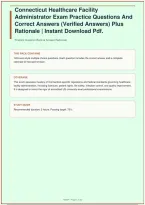
Connecticut Healthcare Facility
Administrator Exam Practice Questions And
Correct Answers (Verified Answers) Plus
Rationale | Instant Download Pdf.
Practice Question Bank & Answer Rationale
THIS PACK CONTAINS
149 exam-style multiple-choice questions. Each question includes the correct answer and a complete
rationale for focused revision.
COVERAGE
This exam assesses mastery of Connecticut-specific regulations and federal standards governing healthcare
facility administration, including licensure, patient rights, life safety, infection control, and quality improvement.
It is designed to mirror the rigor of accredited US university-level professional examinations.
STUDY GUIDE
Recommended duration: 2 hours. Passing target: 75%.
HIGHP - Page 1 of 52
,1. Under Connecticut law, which of the following best describes the administrator's
responsibility when a healthcare facility receives a statement of deficiencies from DPH?
[ ] A. Submit a plan of correction within 10 working days of receipt.
[ ] B. File an appeal within 20 calendar days and suspend all corrective actions.
[ ] C. Post the deficiencies in a public area and take no further action.
[ ] D. Request an informal dispute resolution within 5 business days.
CORRECT: A. Submit a plan of correction within 10 working days of receipt.
Connecticut regulations require a plan of correction within 10 working days of receipt of a statement of
deficiencies. Appeals and dispute resolutions have different timelines and do not suspend the obligation to
correct. Posting alone is insufficient.
2. A Connecticut nursing home administrator is reviewing the facility's compliance with
the federal Life Safety Code. Which of the following is a mandatory requirement for
existing healthcare occupancies?
[ ] A. Sprinkler systems in all resident rooms regardless of construction type.
[ ] B. Smoke detectors in every resident room and common area.
[ ] C. Fire drills conducted quarterly on each shift.
[ ] D. Annual inspection of all fire extinguishers by the local fire marshal.
CORRECT: C. Fire drills conducted quarterly on each shift.
The Life Safety Code (NFPA 101) requires quarterly fire drills on each shift for healthcare occupancies.
Sprinklers are not universally required in all existing buildings, and smoke detector placement varies. Annual
extinguisher inspection is a good practice but not the specific drill requirement.
3. Which of the following is a key requirement for a Connecticut hospital to maintain its
license under the Department of Public Health?
[ ] A. Compliance with Medicare Conditions of Participation.
[ ] B. Annual submission of a community health needs assessment.
[ ] C. Quarterly reporting of all patient falls to DPH.
[ ] D. Maintaining a minimum of 80% occupancy.
CORRECT: A. Compliance with Medicare Conditions of Participation.
Connecticut hospitals must comply with Medicare Conditions of Participation to maintain licensure.
Community health needs assessments are required for nonprofit hospitals under the ACA but not for
licensure. Quarterly fall reporting and occupancy minimums are not licensure requirements.
4. A Connecticut healthcare facility administrator is developing a policy to comply with the
Patient Self-Determination Act. Which of the following must be provided to patients upon
admission?
HIGHP - Page 2 of 52
, [ ] A. A copy of the facility's financial assistance policy.
[ ] B. Written information about advance directives and the right to refuse treatment.
[ ] C. A list of all staff members and their credentials.
[ ] D. A notice of the facility's malpractice insurance coverage.
CORRECT: B. Written information about advance directives and the right to refuse treatment.
The PSDA requires facilities to inform patients of their rights to make medical decisions, including advance
directives and refusal of treatment. Financial assistance, staff lists, and malpractice coverage are not PSDA
requirements.
5. In Connecticut, which agency is responsible for investigating complaints against
healthcare facilities and imposing sanctions?
[ ] A. Department of Social Services.
[ ] B. Department of Consumer Protection.
[ ] C. Department of Public Health.
[ ] D. Office of the Healthcare Advocate.
CORRECT: C. Department of Public Health.
The Connecticut Department of Public Health (DPH) is the primary licensing and regulatory agency for
healthcare facilities, including complaint investigations and sanctions. Other agencies have different roles,
such as consumer protection or advocacy.
6. A Connecticut nursing home administrator is reviewing the facility's infection control
program. Which of the following is required by OSHA for bloodborne pathogens?
[ ] A. Annual training for all employees with occupational exposure.
[ ] B. Monthly testing of all staff for HIV and hepatitis B.
[ ] C. Providing free condoms to all staff.
[ ] D. Posting the OSHA 300 log in a public area.
CORRECT: A. Annual training for all employees with occupational exposure.
OSHA requires annual bloodborne pathogens training for employees with occupational exposure. Monthly
testing, condom distribution, and posting the OSHA 300 log are not required. The OSHA 300 log is for
work-related injuries and illnesses, not bloodborne pathogens.
7. Under Connecticut law, what is the maximum time a facility may detain a patient
involuntarily for emergency psychiatric evaluation without a court order?
[ ] A. 24 hours.
[ ] B. 48 hours.
[ ] C. 72 hours.
[ ] D. 96 hours.
HIGHP - Page 3 of 52
, CORRECT: C. 72 hours.
Connecticut law allows for an emergency hold of up to 72 hours for psychiatric evaluation. Shorter or longer
periods are incorrect; 72 hours is the statutory limit without a court order.
8. A Connecticut hospital administrator is implementing a quality improvement program.
Which of the following best reflects the principles of total quality management?
[ ] A. Focus on individual staff performance and blame for errors.
[ ] B. Continuous improvement through data-driven processes and teamwork.
[ ] C. Reducing costs by limiting patient services.
[ ] D. Increasing administrative oversight of clinical decisions.
CORRECT: B. Continuous improvement through data-driven processes and teamwork.
Total quality management emphasizes continuous improvement, data-driven decision-making, and teamwork.
Blaming individuals, cutting services, or increasing oversight are contrary to TQM principles.
9. Which of the following is a requirement for a Connecticut assisted living facility
regarding resident rights?
[ ] A. Residents must be allowed to vote in federal elections.
[ ] B. Residents have the right to retain their personal belongings.
[ ] C. Residents must participate in all facility activities.
[ ] D. Residents must sign a contract waiving their right to privacy.
CORRECT: B. Residents have the right to retain their personal belongings.
Connecticut assisted living regulations protect residents' rights to retain personal belongings and privacy.
Mandatory participation in activities and waiving privacy rights are violations. Voting is a civic right but not
specifically a facility licensure requirement.
10. Under Connecticut's certificate of need (CON) statute, which proposed healthcare
facility project most clearly requires a CON before proceeding?
[ ] A. Renovation of an existing medical office building that does not add clinical services
[ ] B. Establishment of a new outpatient surgical facility with two operating rooms
[ ] C. Purchase of replacement imaging equipment that does not increase service capacity
[ ] D. Routine replacement of a facility's HVAC system for energy efficiency
CORRECT: B. Establishment of a new outpatient surgical facility with two operating rooms
Connecticut's CON program generally applies to the establishment of new healthcare facilities and expanded
clinical services, including new outpatient surgical facilities. Renovations without added services, equipment
replacements that do not increase capacity, and non-clinical infrastructure upgrades typically fall outside CON
review.
HIGHP - Page 4 of 52
Administrator Exam Practice Questions And
Correct Answers (Verified Answers) Plus
Rationale | Instant Download Pdf.
Practice Question Bank & Answer Rationale
THIS PACK CONTAINS
149 exam-style multiple-choice questions. Each question includes the correct answer and a complete
rationale for focused revision.
COVERAGE
This exam assesses mastery of Connecticut-specific regulations and federal standards governing healthcare
facility administration, including licensure, patient rights, life safety, infection control, and quality improvement.
It is designed to mirror the rigor of accredited US university-level professional examinations.
STUDY GUIDE
Recommended duration: 2 hours. Passing target: 75%.
HIGHP - Page 1 of 52
,1. Under Connecticut law, which of the following best describes the administrator's
responsibility when a healthcare facility receives a statement of deficiencies from DPH?
[ ] A. Submit a plan of correction within 10 working days of receipt.
[ ] B. File an appeal within 20 calendar days and suspend all corrective actions.
[ ] C. Post the deficiencies in a public area and take no further action.
[ ] D. Request an informal dispute resolution within 5 business days.
CORRECT: A. Submit a plan of correction within 10 working days of receipt.
Connecticut regulations require a plan of correction within 10 working days of receipt of a statement of
deficiencies. Appeals and dispute resolutions have different timelines and do not suspend the obligation to
correct. Posting alone is insufficient.
2. A Connecticut nursing home administrator is reviewing the facility's compliance with
the federal Life Safety Code. Which of the following is a mandatory requirement for
existing healthcare occupancies?
[ ] A. Sprinkler systems in all resident rooms regardless of construction type.
[ ] B. Smoke detectors in every resident room and common area.
[ ] C. Fire drills conducted quarterly on each shift.
[ ] D. Annual inspection of all fire extinguishers by the local fire marshal.
CORRECT: C. Fire drills conducted quarterly on each shift.
The Life Safety Code (NFPA 101) requires quarterly fire drills on each shift for healthcare occupancies.
Sprinklers are not universally required in all existing buildings, and smoke detector placement varies. Annual
extinguisher inspection is a good practice but not the specific drill requirement.
3. Which of the following is a key requirement for a Connecticut hospital to maintain its
license under the Department of Public Health?
[ ] A. Compliance with Medicare Conditions of Participation.
[ ] B. Annual submission of a community health needs assessment.
[ ] C. Quarterly reporting of all patient falls to DPH.
[ ] D. Maintaining a minimum of 80% occupancy.
CORRECT: A. Compliance with Medicare Conditions of Participation.
Connecticut hospitals must comply with Medicare Conditions of Participation to maintain licensure.
Community health needs assessments are required for nonprofit hospitals under the ACA but not for
licensure. Quarterly fall reporting and occupancy minimums are not licensure requirements.
4. A Connecticut healthcare facility administrator is developing a policy to comply with the
Patient Self-Determination Act. Which of the following must be provided to patients upon
admission?
HIGHP - Page 2 of 52
, [ ] A. A copy of the facility's financial assistance policy.
[ ] B. Written information about advance directives and the right to refuse treatment.
[ ] C. A list of all staff members and their credentials.
[ ] D. A notice of the facility's malpractice insurance coverage.
CORRECT: B. Written information about advance directives and the right to refuse treatment.
The PSDA requires facilities to inform patients of their rights to make medical decisions, including advance
directives and refusal of treatment. Financial assistance, staff lists, and malpractice coverage are not PSDA
requirements.
5. In Connecticut, which agency is responsible for investigating complaints against
healthcare facilities and imposing sanctions?
[ ] A. Department of Social Services.
[ ] B. Department of Consumer Protection.
[ ] C. Department of Public Health.
[ ] D. Office of the Healthcare Advocate.
CORRECT: C. Department of Public Health.
The Connecticut Department of Public Health (DPH) is the primary licensing and regulatory agency for
healthcare facilities, including complaint investigations and sanctions. Other agencies have different roles,
such as consumer protection or advocacy.
6. A Connecticut nursing home administrator is reviewing the facility's infection control
program. Which of the following is required by OSHA for bloodborne pathogens?
[ ] A. Annual training for all employees with occupational exposure.
[ ] B. Monthly testing of all staff for HIV and hepatitis B.
[ ] C. Providing free condoms to all staff.
[ ] D. Posting the OSHA 300 log in a public area.
CORRECT: A. Annual training for all employees with occupational exposure.
OSHA requires annual bloodborne pathogens training for employees with occupational exposure. Monthly
testing, condom distribution, and posting the OSHA 300 log are not required. The OSHA 300 log is for
work-related injuries and illnesses, not bloodborne pathogens.
7. Under Connecticut law, what is the maximum time a facility may detain a patient
involuntarily for emergency psychiatric evaluation without a court order?
[ ] A. 24 hours.
[ ] B. 48 hours.
[ ] C. 72 hours.
[ ] D. 96 hours.
HIGHP - Page 3 of 52
, CORRECT: C. 72 hours.
Connecticut law allows for an emergency hold of up to 72 hours for psychiatric evaluation. Shorter or longer
periods are incorrect; 72 hours is the statutory limit without a court order.
8. A Connecticut hospital administrator is implementing a quality improvement program.
Which of the following best reflects the principles of total quality management?
[ ] A. Focus on individual staff performance and blame for errors.
[ ] B. Continuous improvement through data-driven processes and teamwork.
[ ] C. Reducing costs by limiting patient services.
[ ] D. Increasing administrative oversight of clinical decisions.
CORRECT: B. Continuous improvement through data-driven processes and teamwork.
Total quality management emphasizes continuous improvement, data-driven decision-making, and teamwork.
Blaming individuals, cutting services, or increasing oversight are contrary to TQM principles.
9. Which of the following is a requirement for a Connecticut assisted living facility
regarding resident rights?
[ ] A. Residents must be allowed to vote in federal elections.
[ ] B. Residents have the right to retain their personal belongings.
[ ] C. Residents must participate in all facility activities.
[ ] D. Residents must sign a contract waiving their right to privacy.
CORRECT: B. Residents have the right to retain their personal belongings.
Connecticut assisted living regulations protect residents' rights to retain personal belongings and privacy.
Mandatory participation in activities and waiving privacy rights are violations. Voting is a civic right but not
specifically a facility licensure requirement.
10. Under Connecticut's certificate of need (CON) statute, which proposed healthcare
facility project most clearly requires a CON before proceeding?
[ ] A. Renovation of an existing medical office building that does not add clinical services
[ ] B. Establishment of a new outpatient surgical facility with two operating rooms
[ ] C. Purchase of replacement imaging equipment that does not increase service capacity
[ ] D. Routine replacement of a facility's HVAC system for energy efficiency
CORRECT: B. Establishment of a new outpatient surgical facility with two operating rooms
Connecticut's CON program generally applies to the establishment of new healthcare facilities and expanded
clinical services, including new outpatient surgical facilities. Renovations without added services, equipment
replacements that do not increase capacity, and non-clinical infrastructure upgrades typically fall outside CON
review.
HIGHP - Page 4 of 52


