
NHA CCMA Certification Tests 2.0 A, B, C - 2026/2027 NHA Medical Assistant Certification Exam
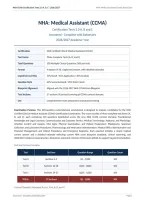
NHA: Medical Assistant (CCMA)
Certification Tests 2.0 A, B and C
Answered - Complete with Rationales
2026/2027 Academic Year
Certification NHA Certified Clinical Medical Assistant (CCMA)
Test Forms Three Complete Tests (A, B, and C)
Total Questions 300 Multiple Choice Questions (100 per test)
Format 4 options (A-D), single best answer, with detailed rationales
Cognitive Level Mix 35% Recall / 45% Application / 20% Analysis
Question Style 65% Scenario-based / 35% Direct recall
Blueprint Alignment Aligned with the 2026-2027 NHA CCMA Exam Blueprint
Test Sections 27 sections (9 per test) covering all CCMA content domains
Use Comprehensive exam preparation and practice testing
Examination Purpose: This 300-question comprehensive examination is designed to prepare candidates for the NHA
Certified Clinical Medical Assistant (CCMA) Certification Examination. The exam consists of three complete test forms (A,
B, and C), each containing 100 questions distributed across the nine NHA CCMA content domains: Foundational
Knowledge and Legal Concepts; Communication and Customer Service; Medical Terminology, Anatomy, and Physiology;
Infection Control and Asepsis; Vital Signs, Physical Examination, and Patient Preparation; Phlebotomy, Specimen
Collection, and Laboratory Procedures; Pharmacology and Medication Administration; Medical Office Administration and
Financial Management; and Clinical Procedures and Emergency Response. Each question includes a clearly marked
correct answer and a detailed rationale reflecting current NHA exam blueprint standards, clinical reasoning, and
2026/2027 evidence-based practice. Distractors represent common CCMA exam pitfalls to support targeted remediation.
Test and Section Overview:
Test Sections Question Range Question Count
Test A Sections 1-9 Q1 - Q100 100
Test B Sections 10-18 Q101 - Q200 100
Test C Sections 19-27 Q201 - Q300 100
TOTAL 27 Sections Q1 - Q300 300
Content Domains (Repeated Across Tests A, B, and C):
Answered - Complete with Rationales Page 1
,NHA CCMA Certification Tests 2.0 A, B, C - 2026/2027 NHA Medical Assistant Certification Exam
Domain 1 Foundational Knowledge and Legal Concepts (Medical Law, Ethics, & HIPAA)
Domain 2 Communication and Customer Service (Therapeutic Communication, Cultural Competence, & Patient Education)
Domain 3 Medical Terminology, Anatomy, and Physiology
Domain 4 Infection Control and Asepsis (Standard Precautions, Sterilization, & Disinfection)
Domain 5 Vital Signs, Physical Examination, and Patient Preparation
Domain 6 Phlebotomy, Specimen Collection, and Laboratory Procedures
Domain 7 Pharmacology and Medication Administration
Domain 8 Medical Office Administration and Financial Management
Domain 9 Clinical Procedures and Emergency Response
TEST A: NHA CCMA Certification Practice Test A
Questions Q1-Q100
Section 1: Foundational Knowledge and Legal Concepts
Medical Law, Ethics, & HIPAA (Q1-Q10)
Q1: A medical assistant (MA) is asked by a family member to disclose a patient's lab results over the phone. The
patient has not given written permission to share information with this family member. Which action by the MA
is most appropriate under HIPAA regulations?
A. Share the results because the caller is a family member.
B. Refuse to disclose the information without the patient's written authorization and verify the patient's privacy
preferences in the chart. [CORRECT]
C. Share limited information only if the caller can verify the patient's date of birth.
D. Transfer the call to the physician, who can share any information.
Correct Answer: B
Rationale:
Under the HIPAA Privacy Rule, protected health information (PHI) may not be disclosed to family members without the
patient's written authorization unless a permitted exception applies (such as a documented personal representative or
emergency care situation). Verifying the patient's date of birth does not substitute for authorization. The correct action is to
refuse disclosure, verify the patient's consent preferences in the medical record, and document the request. Sharing without
authorization is a reportable HIPAA violation, and physicians are bound by the same rules.
Q2: A patient is scheduled for a minor in-office surgical procedure. The physician asks the MA to obtain the
patient's signature on the informed consent form. Which statement best describes the MA's role in the informed
consent process?
A. The MA explains the procedure, risks, benefits, and alternatives, and then witnesses the patient's signature.
B. The MA may only witness the patient's signature after the physician has explained the procedure, risks,
benefits, and alternatives. [CORRECT]
Answered - Complete with Rationales Page 2
,NHA CCMA Certification Tests 2.0 A, B, C - 2026/2027 NHA Medical Assistant Certification Exam
C. The MA may sign on behalf of the physician if the physician is unavailable.
D. The MA is not permitted to be involved in the informed consent process in any capacity.
Correct Answer: B
Rationale:
Informed consent requires that the performing physician (or qualified provider) explain the procedure, its risks, benefits, and
alternatives, and answer the patient's questions. The MA's role is limited to witnessing the patient's signature after this
discussion has occurred and confirming the patient's identity. The MA must not explain the procedure or obtain consent
independently because doing so exceeds the MA's scope of practice. If the physician has not yet discussed the procedure, the
MA should notify the physician rather than proceed.
Q3: A patient alleges that a medical assistant failed to follow the standard of care when drawing blood, resulting
in nerve injury. To establish malpractice, which four elements must the patient prove?
A. Duty, breach, causation, and damages. [CORRECT]
B. Intent, negligence, harm, and witnesses.
C. Contract, breach, injury, and compensation.
D. Knowledge, error, outcome, and apology.
Correct Answer: A
Rationale:
The four elements required to prove medical malpractice are duty (a provider-patient relationship existed), breach (the
provider failed to meet the standard of care), causation (the breach directly caused the injury), and damages (the patient
suffered measurable harm). Without all four elements, a malpractice claim cannot succeed. Intent is not required in
malpractice (it is a negligence claim), and contract law applies to a different legal framework. The MA must always practice
within scope and document carefully to minimize malpractice risk.
Q4: Which document defines the specific tasks a medical assistant is legally permitted to perform in a particular
state?
A. The Medical Practice Act and state statutes governing medical assisting scope of practice. [CORRECT]
B. The clinic's employee handbook.
C. The American Association of Medical Assistants (AAMA) bylaws.
D. The Health Insurance Portability and Accountability Act (HIPAA).
Correct Answer: A
Rationale:
Scope of practice for medical assistants is defined by each state's Medical Practice Act and related statutes and regulations.
Scope varies significantly by state (e.g., some states permit MAs to administer injections, others restrict certain medication
routes). Although the AAMA provides professional standards and certification, it does not define legal scope. The employee
handbook describes employer expectations but cannot expand legal scope. HIPAA governs privacy, not scope of practice. The
MA must verify scope in each state of employment and practice accordingly.
Q5: A physician asks an MA to telephone in a prescription for a Schedule II controlled substance to a pharmacy.
Which response is correct?
A. Telephone the prescription as requested; Schedule II drugs may be called in by an MA acting as the physician's
agent.
B. Decline; Schedule II prescriptions generally require a written, signed prescription (with limited emergency
exceptions), and an MA cannot prescribe independently. [CORRECT]
C. Telephone the prescription only if the patient is a minor.
D. Telephone the prescription only if the physician is on vacation.
Correct Answer: B
Answered - Complete with Rationales Page 3
, NHA CCMA Certification Tests 2.0 A, B, C - 2026/2027 NHA Medical Assistant Certification Exam
Rationale:
Schedule II controlled substances under the Controlled Substances Act generally require a written, signed prescription, with
limited exceptions for emergencies (in which case the physician must still follow up with a written prescription within a
specified timeframe). Medical assistants cannot prescribe medications independently; they may only transmit prescription
orders as an agent of the physician under specific delegated authority. Telephone orders for Schedule II drugs are restricted and
the MA should refer such requests to the prescribing physician for proper handling.
Q6: A patient requests a copy of their complete medical record. Under HIPAA, how long does the covered entity
have to provide the records?
A. Within 24 hours of the request.
B. Within 30 days of the request, with a possible 30-day extension if the entity provides a written explanation.
[CORRECT]
C. Within 6 months of the request.
D. Records may be withheld indefinitely at the physician's discretion.
Correct Answer: B
Rationale:
Under the HIPAA Privacy Rule, a covered entity must provide access to requested protected health information within 30 days
of the request. If unable to meet this deadline, the entity may extend by an additional 30 days, provided it gives the patient a
written explanation of the delay and the date by which the records will be provided. Patients have a right to inspect, obtain a
copy of, and direct transmission of their PHI to a third party. Records cannot be withheld indefinitely. Reasonable, cost-based
fees may be charged for copies.
Q7: A medical assistant discovers that a patient's electronic health record was accessed by an unauthorized
employee. Which action is required first under the HIPAA Breach Notification Rule?
A. Notify the local news media immediately.
B. Conduct a risk assessment to determine the probability that PHI was compromised, then follow notification
requirements accordingly. [CORRECT]
C. Terminate the unauthorized employee without investigation.
D. No action is required unless the patient complains.
Correct Answer: B
Rationale:
Under the HIPAA Breach Notification Rule, the covered entity must first conduct a risk assessment to determine the probability
that protected health information was compromised. Based on the four-factor risk assessment (nature and extent of PHI, who
accessed it, whether it was acquired or viewed, and mitigation), the entity determines whether notification is required. If a
breach affecting 500 or more individuals occurs, notification must be made to affected individuals, HHS, and the media without
unreasonable delay (within 60 days). Smaller breaches require individual notification and annual HHS reporting.
Q8: Which ethical principle requires the medical assistant to act in the patient's best interest and avoid harm?
A. Autonomy.
B. Beneficence and nonmaleficence. [CORRECT]
C. Justice.
D. Fidelity.
Correct Answer: B
Rationale:
Beneficence is the ethical duty to act in the patient's best interest, while nonmaleficence is the duty to avoid causing harm
("first, do no harm"). Together, these principles require the MA to provide competent, safe care and to refrain from actions that
could injure patients. Autonomy refers to respecting the patient's right to self-determination; justice refers to fair distribution
of resources; fidelity refers to faithfulness and keeping promises. The MA must balance all four principles but prioritizes
Answered - Complete with Rationales Page 4
NHA: Medical Assistant (CCMA)
Certification Tests 2.0 A, B and C
Answered - Complete with Rationales
2026/2027 Academic Year
Certification NHA Certified Clinical Medical Assistant (CCMA)
Test Forms Three Complete Tests (A, B, and C)
Total Questions 300 Multiple Choice Questions (100 per test)
Format 4 options (A-D), single best answer, with detailed rationales
Cognitive Level Mix 35% Recall / 45% Application / 20% Analysis
Question Style 65% Scenario-based / 35% Direct recall
Blueprint Alignment Aligned with the 2026-2027 NHA CCMA Exam Blueprint
Test Sections 27 sections (9 per test) covering all CCMA content domains
Use Comprehensive exam preparation and practice testing
Examination Purpose: This 300-question comprehensive examination is designed to prepare candidates for the NHA
Certified Clinical Medical Assistant (CCMA) Certification Examination. The exam consists of three complete test forms (A,
B, and C), each containing 100 questions distributed across the nine NHA CCMA content domains: Foundational
Knowledge and Legal Concepts; Communication and Customer Service; Medical Terminology, Anatomy, and Physiology;
Infection Control and Asepsis; Vital Signs, Physical Examination, and Patient Preparation; Phlebotomy, Specimen
Collection, and Laboratory Procedures; Pharmacology and Medication Administration; Medical Office Administration and
Financial Management; and Clinical Procedures and Emergency Response. Each question includes a clearly marked
correct answer and a detailed rationale reflecting current NHA exam blueprint standards, clinical reasoning, and
2026/2027 evidence-based practice. Distractors represent common CCMA exam pitfalls to support targeted remediation.
Test and Section Overview:
Test Sections Question Range Question Count
Test A Sections 1-9 Q1 - Q100 100
Test B Sections 10-18 Q101 - Q200 100
Test C Sections 19-27 Q201 - Q300 100
TOTAL 27 Sections Q1 - Q300 300
Content Domains (Repeated Across Tests A, B, and C):
Answered - Complete with Rationales Page 1
,NHA CCMA Certification Tests 2.0 A, B, C - 2026/2027 NHA Medical Assistant Certification Exam
Domain 1 Foundational Knowledge and Legal Concepts (Medical Law, Ethics, & HIPAA)
Domain 2 Communication and Customer Service (Therapeutic Communication, Cultural Competence, & Patient Education)
Domain 3 Medical Terminology, Anatomy, and Physiology
Domain 4 Infection Control and Asepsis (Standard Precautions, Sterilization, & Disinfection)
Domain 5 Vital Signs, Physical Examination, and Patient Preparation
Domain 6 Phlebotomy, Specimen Collection, and Laboratory Procedures
Domain 7 Pharmacology and Medication Administration
Domain 8 Medical Office Administration and Financial Management
Domain 9 Clinical Procedures and Emergency Response
TEST A: NHA CCMA Certification Practice Test A
Questions Q1-Q100
Section 1: Foundational Knowledge and Legal Concepts
Medical Law, Ethics, & HIPAA (Q1-Q10)
Q1: A medical assistant (MA) is asked by a family member to disclose a patient's lab results over the phone. The
patient has not given written permission to share information with this family member. Which action by the MA
is most appropriate under HIPAA regulations?
A. Share the results because the caller is a family member.
B. Refuse to disclose the information without the patient's written authorization and verify the patient's privacy
preferences in the chart. [CORRECT]
C. Share limited information only if the caller can verify the patient's date of birth.
D. Transfer the call to the physician, who can share any information.
Correct Answer: B
Rationale:
Under the HIPAA Privacy Rule, protected health information (PHI) may not be disclosed to family members without the
patient's written authorization unless a permitted exception applies (such as a documented personal representative or
emergency care situation). Verifying the patient's date of birth does not substitute for authorization. The correct action is to
refuse disclosure, verify the patient's consent preferences in the medical record, and document the request. Sharing without
authorization is a reportable HIPAA violation, and physicians are bound by the same rules.
Q2: A patient is scheduled for a minor in-office surgical procedure. The physician asks the MA to obtain the
patient's signature on the informed consent form. Which statement best describes the MA's role in the informed
consent process?
A. The MA explains the procedure, risks, benefits, and alternatives, and then witnesses the patient's signature.
B. The MA may only witness the patient's signature after the physician has explained the procedure, risks,
benefits, and alternatives. [CORRECT]
Answered - Complete with Rationales Page 2
,NHA CCMA Certification Tests 2.0 A, B, C - 2026/2027 NHA Medical Assistant Certification Exam
C. The MA may sign on behalf of the physician if the physician is unavailable.
D. The MA is not permitted to be involved in the informed consent process in any capacity.
Correct Answer: B
Rationale:
Informed consent requires that the performing physician (or qualified provider) explain the procedure, its risks, benefits, and
alternatives, and answer the patient's questions. The MA's role is limited to witnessing the patient's signature after this
discussion has occurred and confirming the patient's identity. The MA must not explain the procedure or obtain consent
independently because doing so exceeds the MA's scope of practice. If the physician has not yet discussed the procedure, the
MA should notify the physician rather than proceed.
Q3: A patient alleges that a medical assistant failed to follow the standard of care when drawing blood, resulting
in nerve injury. To establish malpractice, which four elements must the patient prove?
A. Duty, breach, causation, and damages. [CORRECT]
B. Intent, negligence, harm, and witnesses.
C. Contract, breach, injury, and compensation.
D. Knowledge, error, outcome, and apology.
Correct Answer: A
Rationale:
The four elements required to prove medical malpractice are duty (a provider-patient relationship existed), breach (the
provider failed to meet the standard of care), causation (the breach directly caused the injury), and damages (the patient
suffered measurable harm). Without all four elements, a malpractice claim cannot succeed. Intent is not required in
malpractice (it is a negligence claim), and contract law applies to a different legal framework. The MA must always practice
within scope and document carefully to minimize malpractice risk.
Q4: Which document defines the specific tasks a medical assistant is legally permitted to perform in a particular
state?
A. The Medical Practice Act and state statutes governing medical assisting scope of practice. [CORRECT]
B. The clinic's employee handbook.
C. The American Association of Medical Assistants (AAMA) bylaws.
D. The Health Insurance Portability and Accountability Act (HIPAA).
Correct Answer: A
Rationale:
Scope of practice for medical assistants is defined by each state's Medical Practice Act and related statutes and regulations.
Scope varies significantly by state (e.g., some states permit MAs to administer injections, others restrict certain medication
routes). Although the AAMA provides professional standards and certification, it does not define legal scope. The employee
handbook describes employer expectations but cannot expand legal scope. HIPAA governs privacy, not scope of practice. The
MA must verify scope in each state of employment and practice accordingly.
Q5: A physician asks an MA to telephone in a prescription for a Schedule II controlled substance to a pharmacy.
Which response is correct?
A. Telephone the prescription as requested; Schedule II drugs may be called in by an MA acting as the physician's
agent.
B. Decline; Schedule II prescriptions generally require a written, signed prescription (with limited emergency
exceptions), and an MA cannot prescribe independently. [CORRECT]
C. Telephone the prescription only if the patient is a minor.
D. Telephone the prescription only if the physician is on vacation.
Correct Answer: B
Answered - Complete with Rationales Page 3
, NHA CCMA Certification Tests 2.0 A, B, C - 2026/2027 NHA Medical Assistant Certification Exam
Rationale:
Schedule II controlled substances under the Controlled Substances Act generally require a written, signed prescription, with
limited exceptions for emergencies (in which case the physician must still follow up with a written prescription within a
specified timeframe). Medical assistants cannot prescribe medications independently; they may only transmit prescription
orders as an agent of the physician under specific delegated authority. Telephone orders for Schedule II drugs are restricted and
the MA should refer such requests to the prescribing physician for proper handling.
Q6: A patient requests a copy of their complete medical record. Under HIPAA, how long does the covered entity
have to provide the records?
A. Within 24 hours of the request.
B. Within 30 days of the request, with a possible 30-day extension if the entity provides a written explanation.
[CORRECT]
C. Within 6 months of the request.
D. Records may be withheld indefinitely at the physician's discretion.
Correct Answer: B
Rationale:
Under the HIPAA Privacy Rule, a covered entity must provide access to requested protected health information within 30 days
of the request. If unable to meet this deadline, the entity may extend by an additional 30 days, provided it gives the patient a
written explanation of the delay and the date by which the records will be provided. Patients have a right to inspect, obtain a
copy of, and direct transmission of their PHI to a third party. Records cannot be withheld indefinitely. Reasonable, cost-based
fees may be charged for copies.
Q7: A medical assistant discovers that a patient's electronic health record was accessed by an unauthorized
employee. Which action is required first under the HIPAA Breach Notification Rule?
A. Notify the local news media immediately.
B. Conduct a risk assessment to determine the probability that PHI was compromised, then follow notification
requirements accordingly. [CORRECT]
C. Terminate the unauthorized employee without investigation.
D. No action is required unless the patient complains.
Correct Answer: B
Rationale:
Under the HIPAA Breach Notification Rule, the covered entity must first conduct a risk assessment to determine the probability
that protected health information was compromised. Based on the four-factor risk assessment (nature and extent of PHI, who
accessed it, whether it was acquired or viewed, and mitigation), the entity determines whether notification is required. If a
breach affecting 500 or more individuals occurs, notification must be made to affected individuals, HHS, and the media without
unreasonable delay (within 60 days). Smaller breaches require individual notification and annual HHS reporting.
Q8: Which ethical principle requires the medical assistant to act in the patient's best interest and avoid harm?
A. Autonomy.
B. Beneficence and nonmaleficence. [CORRECT]
C. Justice.
D. Fidelity.
Correct Answer: B
Rationale:
Beneficence is the ethical duty to act in the patient's best interest, while nonmaleficence is the duty to avoid causing harm
("first, do no harm"). Together, these principles require the MA to provide competent, safe care and to refrain from actions that
could injure patients. Autonomy refers to respecting the patient's right to self-determination; justice refers to fair distribution
of resources; fidelity refers to faithfulness and keeping promises. The MA must balance all four principles but prioritizes
Answered - Complete with Rationales Page 4


