
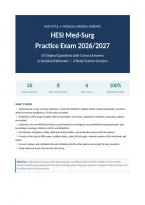
HESI-STYLE • MEDICAL-SURGICAL NURSING
HESI Med-Surg
Practice Exam 2026/2027
50 Original Questions with Correct Answers
& Detailed Rationales | 8 Body-System Sections
50 8 6 100%
Original questions Body-system sections Item formats Rationales included
WHAT'S INSIDE
✓ Cardiovascular: acute coronary syndrome, ventricular fibrillation, digoxin safety, cardiac tamponade, aneurysm,
arterial vs venous insufficiency, IV drip-rate calculation
✓ Respiratory: COPD oxygen targets, ABG interpretation, chest tubes, pulmonary embolism, suctioning, airborne
precautions
✓ Endocrine, renal and fluid/electrolytes, gastrointestinal, neurological, musculoskeletal and perioperative, plus
hematology, oncology, infection control, and delegation
✓ Prioritization, delegation, safety, laboratory interpretation, and medication-safety items throughout
✓ Formats in the style of HESI exams: multiple choice, select all that apply, ordered response, fill-in-the-blank, and
matrix
✓ A correct answer and a detailed rationale (including why the other options are wrong) for every question
✓ Quick-reference answer key for fast self-scoring
Disclaimer: Original practice questions for study purposes; not affiliated with ATI, HESI, or NCSBN. Content reflects
current standard nursing references at the time of writing; always follow your program's materials, facility protocols, and
prescriber orders in clinical practice.
, HESI Med-Surg Practice Exam 2026/2027 | 50 Original Questions with Rationales
Table of Contents
Sections, question numbers, and page locations
# Section Questions Page
1 Cardiovascular Q1–Q7 (7) 3
2 Respiratory Q8–Q13 (6) 6
3 Endocrine & Metabolic Q14–Q20 (7) 9
4 Renal, Fluid & Electrolytes Q21–Q26 (6) 13
5 Gastrointestinal & Hepatic Q27–Q31 (5) 16
6 Neurological Q32–Q37 (6) 18
7 Musculoskeletal & Perioperative Q38–Q43 (6) 21
8 Hematology, Oncology, Infection Control & Delegation Q44–Q50 (7) 24
Quick-Reference Answer Key Q1–Q50 27
How to Use This Exam
• Take the exam in a timed, quiet setting (about 1 minute per question) to build test stamina.
• Cover the answer box beneath each question and commit to an answer before reading the rationale.
• Select-all-that-apply items may have any number of correct options; judge each option on its own as true or
false.
• For priority questions think airway, breathing, circulation first; then acute before chronic, unstable before
stable.
• Read every rationale, including why the wrong options are wrong; this is where most of the learning happens.
• Log the topics you miss and revisit them in your course materials, facility protocols, and drug references.
Disclaimer: Original practice questions for study purposes; not affiliated with ATI, HESI, or NCSBN. All questions were
written from scratch and are not reproduced from any exam, publisher, or question bank. This document is an
educational study aid and is not a substitute for clinical judgment, institutional protocols, or professional references.
Original practice questions for study purposes; not affiliated with ATI, HESI, or NCSBN. • Page 2
, HESI Med-Surg Practice Exam 2026/2027 | 50 Original Questions with Rationales
SECTION 1
Cardiovascular
Questions 1–7
Question 1 Multiple Choice
The nurse sees ventricular fibrillation on the cardiac monitor of a client who is unresponsive and pulseless. What
is the priority action?
A. Perform synchronized cardioversion
B. Administer amiodarone and wait for the effect
C. Begin chest compressions and defibrillate as soon as a defibrillator is available
D. Check the client's blood pressure in both arms
Correct Answer: C
Rationale: Pulseless ventricular fibrillation is a shockable rhythm: high-quality CPR is started immediately and
an unsynchronized shock is delivered as soon as possible. Medications such as epinephrine and amiodarone
follow. Synchronized cardioversion is used for rhythms with a pulse, such as unstable ventricular tachycardia.
Question 2 Select All That Apply
A client arrives with crushing chest pain radiating to the left arm and diaphoresis. Which actions should the nurse
anticipate? Select all that apply.
☐ A. Administer aspirin 162 to 325 mg to chew if there is no allergy
☐ B. Give sublingual nitroglycerin if the systolic BP is adequate
☐ C. Establish IV access
☐ D. Administer oxygen if the SpO₂ is below 90%
☐ E. Obtain a 12-lead ECG within 10 minutes
☐ F. Place the client on high-flow oxygen regardless of the SpO₂
☐ G. Give nitroglycerin to the client who took sildenafil earlier today
Correct Answer: A, B, C, D, E
Rationale: Rapid ECG, IV access, chewed aspirin, targeted oxygen, and nitroglycerin (if blood pressure allows)
are core early actions. PDE-5 inhibitors such as sildenafil cause profound hypotension with nitrates, so
nitroglycerin is contraindicated. Oxygen is given when SpO₂ is below 90% because excess oxygen can be
harmful.
Original practice questions for study purposes; not affiliated with ATI, HESI, or NCSBN. • Page 3


