
dynamics
026, 1:16:47
Hibbeler
solution
PM10/12/2026Hibbeler
15th
manual10/12/2026,
dynamics solution
15th
1:15:42
manual.pdf2026-10-12Page
dynamics
PMhttps://www.stuvia.com/user/aaaplus_)W()*E(*&R(&*&R*&()*()*_)*(*&$*(*&%*&(@%)%&*(@&(*@%*&@(%@%&*(
solution manual10/12/2026,
1 of 23610/12/2026,
1:15:42 PMhttps://www.stuvia.com/user/aaaplus_)W()*E(*&R(&*&R*&()*()*_)*(*&$*(*&%*&(@
1:16:47 PM10/12/2026Hibbeler 15th dynamics solution manual10/12/2026, 1:15:42
© 2022 by R.C. Hibbeler. Published by Pearson Education, Inc., Hoboken, NJ. All rights reserved. This material is protected under all copyright laws
as they currently exist. No portion of this material may be reproduced, in any form or by any means, without permission in writing from the publisher.
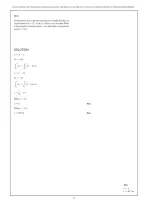
12–1.
Starting from rest, a particle moving in a straight line has an
acceleration of a = (2t - 6) m>s2, where t is in seconds. What
is the particle’s velocity when t = 6 s, and what is its position
when t = 11 s?
SOLUTION
a = 2t - 6
dv = a dt
v t
L0 L0
dv = (2t - 6) dt
v = t 2 - 6t
ds = v dt
s t
L0 L0
ds = (t2 - 6t) dt
t3
s = - 3t2
3
When t = 6 s,
v = 0 Ans.
When t = 11 s,
s = 80.7 m Ans.
Ans:
v = 0
s = 80.7 m
1
dynamics
026, 1:16:47
solution
PM10/12/2026Hibbeler
manual10/12/2026,15th
1:15:42
dynamics
PMhttps://www.stuvia.com/user/aaaplus_)W()*E(*&R(&*&R*&()*()*_)*(*&$*(*&%*&(@%)%&*(@&(*@%*&@(%@%&*(
solution manual10/12/2026, 1:15:42 PMhttps://www.stuvia.com/user/aaaplus_)W()*E(*&R(&*&R*&()*()*_)*(*&$*(*&%*&(@
,dynamics
026, 1:16:47
Hibbeler
solution
PM10/12/2026Hibbeler
15th
manual10/12/2026,
dynamics solution
15th
1:15:42
manual.pdf2026-10-12Page
dynamics
PMhttps://www.stuvia.com/user/aaaplus_)W()*E(*&R(&*&R*&()*()*_)*(*&$*(*&%*&(@%)%&*(@&(*@%*&@(%@%&*(
solution manual10/12/2026,
2 of 23610/12/2026,
1:15:42 PMhttps://www.stuvia.com/user/aaaplus_)W()*E(*&R(&*&R*&()*()*_)*(*&$*(*&%*&(@
1:16:47 PM10/12/2026Hibbeler 15th dynamics solution manual10/12/2026, 1:15:42
© 2022 by R.C. Hibbeler. Published by Pearson Education, Inc., Hoboken, NJ. All rights reserved. This material is protected under all copyright laws
as they currently exist. No portion of this material may be reproduced, in any form or by any means, without permission in writing from the publisher.
12–2.
If a particle has an initial velocity of v0 = 12 ft>s to the
right, at s0 = 0, determine its position when t = 10 s, if
a = 2 ft>s2 to the left.
SOLUTION
1 2
1S
+2 s = s0 + v0 t + a t
2 c
1
= 0 + 12(10) + ( -2)(10)2
2
= 20 ft Ans.
Ans:
s = 20 ft
2
dynamics
026, 1:16:47
solution
PM10/12/2026Hibbeler
manual10/12/2026,15th
1:15:42
dynamics
PMhttps://www.stuvia.com/user/aaaplus_)W()*E(*&R(&*&R*&()*()*_)*(*&$*(*&%*&(@%)%&*(@&(*@%*&@(%@%&*(
solution manual10/12/2026, 1:15:42 PMhttps://www.stuvia.com/user/aaaplus_)W()*E(*&R(&*&R*&()*()*_)*(*&$*(*&%*&(@
,dynamics
026, 1:16:47
Hibbeler
solution
PM10/12/2026Hibbeler
15th
manual10/12/2026,
dynamics solution
15th
1:15:42
manual.pdf2026-10-12Page
dynamics
PMhttps://www.stuvia.com/user/aaaplus_)W()*E(*&R(&*&R*&()*()*_)*(*&$*(*&%*&(@%)%&*(@&(*@%*&@(%@%&*(
solution manual10/12/2026,
3 of 23610/12/2026,
1:15:42 PMhttps://www.stuvia.com/user/aaaplus_)W()*E(*&R(&*&R*&()*()*_)*(*&$*(*&%*&(@
1:16:47 PM10/12/2026Hibbeler 15th dynamics solution manual10/12/2026, 1:15:42
© 2022 by R.C. Hibbeler. Published by Pearson Education, Inc., Hoboken, NJ. All rights reserved. This material is protected under all copyright laws
as they currently exist. No portion of this material may be reproduced, in any form or by any means, without permission in writing from the publisher.
12–3.
A particle travels along a straight line with a velocity
2
v = (12 -
v - 3t 2) m>s, where t is in seconds. When t = 1 s, the
particle is located 10 m to the left of the origin. Determine
the acceleration when t t == 44 s,s, the
acceleration when the displacement
displacement from
t = 0 to t = 10 s, and the distance the particle travels during
this time period.
SOLUTION
v = 12 - 3t 2 (1)
dv
a = = - 6t t=4 = -24 m>s2 Ans.
dt
s t t
L-10 L1 L1
ds = v dt = ( 12 - 3t 2 ) dt
s + 10 = 12t - t 3 - 11
s = 12t - t 3 - 21
s t=0 = - 21
s t = 10 = - 901
∆s = - 901 - ( -21) = -880 m Ans.
From Eq. (1):
v = 0 when t = 2s
s t=2 = 12(2) - (2)3 - 21 = -5
sT = (21 - 5) + (901 - 5) = 912 m Ans.
Ans:
a = -24 m>s2
∆ s = -880 m
sT = 912 m
3
dynamics
026, 1:16:47
solution
PM10/12/2026Hibbeler
manual10/12/2026,15th
1:15:42
dynamics
PMhttps://www.stuvia.com/user/aaaplus_)W()*E(*&R(&*&R*&()*()*_)*(*&$*(*&%*&(@%)%&*(@&(*@%*&@(%@%&*(
solution manual10/12/2026, 1:15:42 PMhttps://www.stuvia.com/user/aaaplus_)W()*E(*&R(&*&R*&()*()*_)*(*&$*(*&%*&(@
,dynamics
026, 1:16:47
Hibbeler
solution
PM10/12/2026Hibbeler
15th
manual10/12/2026,
dynamics solution
15th
1:15:42
manual.pdf2026-10-12Page
dynamics
PMhttps://www.stuvia.com/user/aaaplus_)W()*E(*&R(&*&R*&()*()*_)*(*&$*(*&%*&(@%)%&*(@&(*@%*&@(%@%&*(
solution manual10/12/2026,
4 of 23610/12/2026,
1:15:42 PMhttps://www.stuvia.com/user/aaaplus_)W()*E(*&R(&*&R*&()*()*_)*(*&$*(*&%*&(@
1:16:47 PM10/12/2026Hibbeler 15th dynamics solution manual10/12/2026, 1:15:42
© 2022 by R.C. Hibbeler. Published by Pearson Education, Inc., Hoboken, NJ. All rights reserved. This material is protected under all copyright laws
as they currently exist. No portion of this material may be reproduced, in any form or by any means, without permission in writing from the publisher.
*12–4.
A particle travels along a straight line with a constant
acceleration. When s = 4 ft, v = 3 ft>s and when s = 10 ft,
v = 8 ft>s. Determine the velocity as a function of position.
SOLUTION
Velocity: To determine the constant acceleration ac, set s0 = 4 ft, v0 = 3 ft>s,
s = 10 ft and v = 8 ft>s and apply Eq. 12–6.
+ )
(: v2 = v20 + 2ac (s - s0)
82 = 32 + 2ac (10 - 4)
ac = 4.583 ft>s2
Using the result ac = 4.583 ft>s2, the velocity function can be obtained by applying
Eq. 12–6.
+ )
(: v2 = v20 + 2ac (s - s0)
v2 = 32 + 2(4.583) (s - 4)
A
v = A 29.17s - 27.7 ft>s Ans.
( 19.17s - 27.7 ) ft>s
Ans:
v =
4
dynamics
026, 1:16:47
solution
PM10/12/2026Hibbeler
manual10/12/2026,15th
1:15:42
dynamics
PMhttps://www.stuvia.com/user/aaaplus_)W()*E(*&R(&*&R*&()*()*_)*(*&$*(*&%*&(@%)%&*(@&(*@%*&@(%@%&*(
solution manual10/12/2026, 1:15:42 PMhttps://www.stuvia.com/user/aaaplus_)W()*E(*&R(&*&R*&()*()*_)*(*&$*(*&%*&(@
026, 1:16:47
Hibbeler
solution
PM10/12/2026Hibbeler
15th
manual10/12/2026,
dynamics solution
15th
1:15:42
manual.pdf2026-10-12Page
dynamics
PMhttps://www.stuvia.com/user/aaaplus_)W()*E(*&R(&*&R*&()*()*_)*(*&$*(*&%*&(@%)%&*(@&(*@%*&@(%@%&*(
solution manual10/12/2026,
1 of 23610/12/2026,
1:15:42 PMhttps://www.stuvia.com/user/aaaplus_)W()*E(*&R(&*&R*&()*()*_)*(*&$*(*&%*&(@
1:16:47 PM10/12/2026Hibbeler 15th dynamics solution manual10/12/2026, 1:15:42
© 2022 by R.C. Hibbeler. Published by Pearson Education, Inc., Hoboken, NJ. All rights reserved. This material is protected under all copyright laws
as they currently exist. No portion of this material may be reproduced, in any form or by any means, without permission in writing from the publisher.
12–1.
Starting from rest, a particle moving in a straight line has an
acceleration of a = (2t - 6) m>s2, where t is in seconds. What
is the particle’s velocity when t = 6 s, and what is its position
when t = 11 s?
SOLUTION
a = 2t - 6
dv = a dt
v t
L0 L0
dv = (2t - 6) dt
v = t 2 - 6t
ds = v dt
s t
L0 L0
ds = (t2 - 6t) dt
t3
s = - 3t2
3
When t = 6 s,
v = 0 Ans.
When t = 11 s,
s = 80.7 m Ans.
Ans:
v = 0
s = 80.7 m
1
dynamics
026, 1:16:47
solution
PM10/12/2026Hibbeler
manual10/12/2026,15th
1:15:42
dynamics
PMhttps://www.stuvia.com/user/aaaplus_)W()*E(*&R(&*&R*&()*()*_)*(*&$*(*&%*&(@%)%&*(@&(*@%*&@(%@%&*(
solution manual10/12/2026, 1:15:42 PMhttps://www.stuvia.com/user/aaaplus_)W()*E(*&R(&*&R*&()*()*_)*(*&$*(*&%*&(@
,dynamics
026, 1:16:47
Hibbeler
solution
PM10/12/2026Hibbeler
15th
manual10/12/2026,
dynamics solution
15th
1:15:42
manual.pdf2026-10-12Page
dynamics
PMhttps://www.stuvia.com/user/aaaplus_)W()*E(*&R(&*&R*&()*()*_)*(*&$*(*&%*&(@%)%&*(@&(*@%*&@(%@%&*(
solution manual10/12/2026,
2 of 23610/12/2026,
1:15:42 PMhttps://www.stuvia.com/user/aaaplus_)W()*E(*&R(&*&R*&()*()*_)*(*&$*(*&%*&(@
1:16:47 PM10/12/2026Hibbeler 15th dynamics solution manual10/12/2026, 1:15:42
© 2022 by R.C. Hibbeler. Published by Pearson Education, Inc., Hoboken, NJ. All rights reserved. This material is protected under all copyright laws
as they currently exist. No portion of this material may be reproduced, in any form or by any means, without permission in writing from the publisher.
12–2.
If a particle has an initial velocity of v0 = 12 ft>s to the
right, at s0 = 0, determine its position when t = 10 s, if
a = 2 ft>s2 to the left.
SOLUTION
1 2
1S
+2 s = s0 + v0 t + a t
2 c
1
= 0 + 12(10) + ( -2)(10)2
2
= 20 ft Ans.
Ans:
s = 20 ft
2
dynamics
026, 1:16:47
solution
PM10/12/2026Hibbeler
manual10/12/2026,15th
1:15:42
dynamics
PMhttps://www.stuvia.com/user/aaaplus_)W()*E(*&R(&*&R*&()*()*_)*(*&$*(*&%*&(@%)%&*(@&(*@%*&@(%@%&*(
solution manual10/12/2026, 1:15:42 PMhttps://www.stuvia.com/user/aaaplus_)W()*E(*&R(&*&R*&()*()*_)*(*&$*(*&%*&(@
,dynamics
026, 1:16:47
Hibbeler
solution
PM10/12/2026Hibbeler
15th
manual10/12/2026,
dynamics solution
15th
1:15:42
manual.pdf2026-10-12Page
dynamics
PMhttps://www.stuvia.com/user/aaaplus_)W()*E(*&R(&*&R*&()*()*_)*(*&$*(*&%*&(@%)%&*(@&(*@%*&@(%@%&*(
solution manual10/12/2026,
3 of 23610/12/2026,
1:15:42 PMhttps://www.stuvia.com/user/aaaplus_)W()*E(*&R(&*&R*&()*()*_)*(*&$*(*&%*&(@
1:16:47 PM10/12/2026Hibbeler 15th dynamics solution manual10/12/2026, 1:15:42
© 2022 by R.C. Hibbeler. Published by Pearson Education, Inc., Hoboken, NJ. All rights reserved. This material is protected under all copyright laws
as they currently exist. No portion of this material may be reproduced, in any form or by any means, without permission in writing from the publisher.
12–3.
A particle travels along a straight line with a velocity
2
v = (12 -
v - 3t 2) m>s, where t is in seconds. When t = 1 s, the
particle is located 10 m to the left of the origin. Determine
the acceleration when t t == 44 s,s, the
acceleration when the displacement
displacement from
t = 0 to t = 10 s, and the distance the particle travels during
this time period.
SOLUTION
v = 12 - 3t 2 (1)
dv
a = = - 6t t=4 = -24 m>s2 Ans.
dt
s t t
L-10 L1 L1
ds = v dt = ( 12 - 3t 2 ) dt
s + 10 = 12t - t 3 - 11
s = 12t - t 3 - 21
s t=0 = - 21
s t = 10 = - 901
∆s = - 901 - ( -21) = -880 m Ans.
From Eq. (1):
v = 0 when t = 2s
s t=2 = 12(2) - (2)3 - 21 = -5
sT = (21 - 5) + (901 - 5) = 912 m Ans.
Ans:
a = -24 m>s2
∆ s = -880 m
sT = 912 m
3
dynamics
026, 1:16:47
solution
PM10/12/2026Hibbeler
manual10/12/2026,15th
1:15:42
dynamics
PMhttps://www.stuvia.com/user/aaaplus_)W()*E(*&R(&*&R*&()*()*_)*(*&$*(*&%*&(@%)%&*(@&(*@%*&@(%@%&*(
solution manual10/12/2026, 1:15:42 PMhttps://www.stuvia.com/user/aaaplus_)W()*E(*&R(&*&R*&()*()*_)*(*&$*(*&%*&(@
,dynamics
026, 1:16:47
Hibbeler
solution
PM10/12/2026Hibbeler
15th
manual10/12/2026,
dynamics solution
15th
1:15:42
manual.pdf2026-10-12Page
dynamics
PMhttps://www.stuvia.com/user/aaaplus_)W()*E(*&R(&*&R*&()*()*_)*(*&$*(*&%*&(@%)%&*(@&(*@%*&@(%@%&*(
solution manual10/12/2026,
4 of 23610/12/2026,
1:15:42 PMhttps://www.stuvia.com/user/aaaplus_)W()*E(*&R(&*&R*&()*()*_)*(*&$*(*&%*&(@
1:16:47 PM10/12/2026Hibbeler 15th dynamics solution manual10/12/2026, 1:15:42
© 2022 by R.C. Hibbeler. Published by Pearson Education, Inc., Hoboken, NJ. All rights reserved. This material is protected under all copyright laws
as they currently exist. No portion of this material may be reproduced, in any form or by any means, without permission in writing from the publisher.
*12–4.
A particle travels along a straight line with a constant
acceleration. When s = 4 ft, v = 3 ft>s and when s = 10 ft,
v = 8 ft>s. Determine the velocity as a function of position.
SOLUTION
Velocity: To determine the constant acceleration ac, set s0 = 4 ft, v0 = 3 ft>s,
s = 10 ft and v = 8 ft>s and apply Eq. 12–6.
+ )
(: v2 = v20 + 2ac (s - s0)
82 = 32 + 2ac (10 - 4)
ac = 4.583 ft>s2
Using the result ac = 4.583 ft>s2, the velocity function can be obtained by applying
Eq. 12–6.
+ )
(: v2 = v20 + 2ac (s - s0)
v2 = 32 + 2(4.583) (s - 4)
A
v = A 29.17s - 27.7 ft>s Ans.
( 19.17s - 27.7 ) ft>s
Ans:
v =
4
dynamics
026, 1:16:47
solution
PM10/12/2026Hibbeler
manual10/12/2026,15th
1:15:42
dynamics
PMhttps://www.stuvia.com/user/aaaplus_)W()*E(*&R(&*&R*&()*()*_)*(*&$*(*&%*&(@%)%&*(@&(*@%*&@(%@%&*(
solution manual10/12/2026, 1:15:42 PMhttps://www.stuvia.com/user/aaaplus_)W()*E(*&R(&*&R*&()*()*_)*(*&$*(*&%*&(@


