
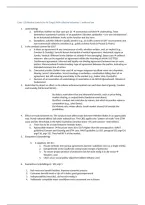
Case 1 (Collusion (cartels) in Air Cargo) AKA collusive behaviour / antitrust law
1. undertakings
a. definition: Hoffner en Elsar case par 21 economisch activiteit undertaking. Twee
kenmerken economsich activity: of ze goederen/ diensten aanbieden + is er een wintsstreven?
Its an functional definition: looks at the function not the form
b. Exceptions: activities linked to public powers (e.g., air traffic control in SAT v Eurocontrol) and
non-commercial solidarity activities (e.g., public sickness funds in Poucet & Pistre).
2. is the conduct covered by 101?
a. Is there an agreement any concurrence of wills, whether written, oral, or implicit (e.g.,
Consten & Grundig). Verschil tussen horizontal of vertical agreement. Horizontal: Appie en
Jumbo. Vertical: different levels (Adidas en zalando less damaging). Bayer case unliteral
measure- also can be regarded an agreement within the meaning of article 101 TFEU.
Gentlemens agreement: informal and legally non-binding agreement between two or more
parties. Memorandum if understanding: type of agreement between the parties, indicating an
intended common line of action.
b. Concerted practice (Suiker Unie case) ze mogen reageren op elkaar maar niet afspreken.
Sharing ‘secret’ information. Secret meetings is verboden. coordination falling short of an
agreement, but still reducing uncertainty in the market (e.g., Suiker Unie, Dyestuffs).
c. Decision of an association of undertakings association is de NOVA bijvoorbeeld. (Wouters)
(suikerunie)
3. Restriction by object or effect, is de collusie anticoncurrentieel van aard door doel of gevolg. Consten
and Grundig (56/64 and 58/64);
- By object: restrictions that are inherently harmful, such as price-fixing,
market-sharing, or output limits (hardcore restrictions).
- By effect: conduct not restrictive by nature, but which in practice reduces
competition (e.g., John Deere).
- De Minimis rule: minor effects (small market shares) fall outside the
prohibition.
4. Effect on trade between ms. The conduct must affect trade between Member States in an appreciable
way. Purely national effects fall under national law. The CJEU applies the “pattern of trade” test (STM
case) and the thresholds in the NAAT Guidelines (market share <5% and turnover <€40 million).
a. There has to be a trade between member states
b. Appreciable manner the prices were 10 to 30 % higher than the average price. (NAAT
guideline) Consten and Grundig and STM case. NAAT guideline ( p 183, paragraaf 18, prgrf 24,
prgrf 36, prgr 53). They had 80 % of the market.
5. Exceptions (uitzondering)
b. 4 exeptions 101 lid :
1. Fiscale eenheid. Intra-group agreements (parent–subsidiary seen as a single entity).
2. Gerugeleerde sector (Ladbroke racing) zoals energie of goksector
3. To ensure proper practice of profession (als het echt nodig is in die sector
Wouters case)
4. CAO’s als ze social pollicy objective hebben (Albany case)
6. Exemptions (vrijstellingen). 101 prgr 1
1. Het moet een benefit hebben. improve economic process
2. Consumer benefit moet er zijn of in ieder geval gecompenseerd
3. Indispensability (nececity), als het echt nodig is
4. Voldoende competitie moet overblijven voor consument om te kiezen
,Exemptions can be individual (case-by-case) or block exemptions (whole categories, e.g., R&D agreements
under Reg. 1217/2010). Consequences (Art. 101(2)) Agreements that violate Art. 101(1) are automatically void,
with retroactive effect.
Webcast basic notions II
Exeption. Whatever falls under it falls outside the scope of EU law. Uitzondering
Exemption. If exempted, measure is no violation of EU internal market law. Vrijstelling
If permitted for justification, a measure must meet the requirements of the proportionality test. Depends on
1. Explicit justification grounds
2. Mandatory requirements.
Explicit justification grounds, in an own article. Limited to the ground mentioned in the treaties
Mandatory requirements. Unwritten justification grounds that MS can rely on.
Something must be proportionate in relation to something else. Two items: measure under scrutiny and the
benchmark against which the proportionality of the measure is tested. Three step test.
1. Is the measure suitable to achieve the objective it invokes
2. Is the measure necessary to attain this objective
3. Does even the least restrictive measure not interfere with the EU free movement rights
Undertakings under Articles 101 and 102 TFEU are protected by due process: they can respond to objections,
appeal Commission decisions before the General Court and Court of Justice (which have full review powers),
challenge interim measures, and even claim damages. The Merger Regulation adds preventive control by
requiring prior notification of mergers, allowing the Commission to block those harming competition.
- Objective differentiation: two situations are treated differently remain dfferent even if we exclude all
forbidden grounds as possible elements that could define these situations as being different. The
different treatment is fine.
- Direct and indirect discrimination. Direct if you can identify the ground on which the different treatment
is based by simply reading the wording of the measure. Indirect if the measure does not literally use the
origin. The measure is indistinctly applicable.
- Non-discriminatory restriction: if a measure does not treat two comparable situations differently:
neither directly in its owning, nor directly by affecting one situation less favorably than the other.
Hoorcollege 1
Origins of the EU
Problem after Second World War: Coal and steel deposits in the Saarland and the Ruhr area Remembering
‘Ruhrkampf’ 1923 Germany had to pay a lot so high that Germany couldn’t keep up. Belgium took coal and
steel instead of money. German steel workers stopped working.
Finishing the spiral of revenge lead to WW2
Solution: Schuman Declaration of 9th May 1950 (Now 9 May Europe Day)
Schuman Plan
Proposal to place French and German production of coal and steel under a single Common authority
− High Authority (today’s Commission)
− “This would make war between the two "not only unthinkable but materially impossible" Economic
integration as basis for keeping peace in Europe
Became the European Coal and Steel Community (ECSC)
− Established in1951 by the Treaty of Paris
− Founding MS: France, (West) Germany, Belgium, Italy, Luxembourg, the Netherlands
Basis for the European Economic Community (EEC)
− Established in 1957 by the Treaty of Rome
The EU internal market is at the very heart of the European integration process.
− The EU (EEC back then) inherently and historically associated with the conceptual idea of free trade
− Free trade and interconnectedness of MS economies is positive not only for conflict prevention but also for
prosperity
, 1968 European Customs Union
− removal of tariffs between the 6 founding MS + common external tariff
− Commission → Directorate-General for Trade (DG Trade)
− Commissioner for trade the most powerful portfolio
1993 European Single/Internal Market
− European single market/ internal market / common market
− Area in which the free movement of goods, services, capital and persons is assured, and in which citizens are
free to live, work, study and conduct business
Case 2
Article 102 TFEU requires the fulfilment of four criteria.
Undertaking. The notion of undertaking is the same as for the application of Article 101 TFEU > Höfner
and Elser case economic activity. Collective dominance: when more undertakings act (1) as
independent economic entities being united by (2) economic links that are on a specific market so
strong that they can be considered to hold together a dominant position.
+Exceptions:
1. Exercise of public powers exeption (SAT v Eurocontrol)
2. Non-commercial activities (Poucet and Pistre)
The undertaking needs to be in a dominant position (AKZO case/United brands) within the internal
market or in a substantial part of it. Relevant market (Hoffman la roche case)+ assessing
the position that the undertaking has on the market; dominance of the undertaking?
Relevant market:
Product market; comprises all those products and/or services which are regarded as
interchangeable or substitutable by the consumer, by reason of the products' characteristics,
their prices and their intended use
The interchangeability of a particular product (which products may be regarded as substitutes
for each other) plays a role in the establishment of the relevant product market. Consists of:
- Demand substitution: SSNIP test to see whether customers would switch to other readily
available substitute products or to suppliers located elsewhere in response to a
hypothetical small, but permanent increase in price of the product in question.
- Supply subsititution: perspective of the suppliers. The question is whether suppliers would
start producing another product if there is a permanent price increase in the market.
Geographic market; place where the offer takes place. Consists of:
- Demand substitution: assesses the extent to which the customers of a product in question
would switch to suppliers located in other territories in response to a hypothetical small,
but permanent increase in price of that given product
- Supply substitution: Identify the possibility of other suppliers located outside of a certain
geographic area, to start supplying that area in the short term and without incurring
signigicant addition costs or risks.
The undertaking must have ‘abused’ its dominance. Dominance can be established by looking at
the market shares of the undertakings. Very high market shares are the main indicator
of dominance (Hoffmann – La Roche par. 41 and AKZO par. 60). Low market shares are generally
illustrative of the absence of substantial market power. The following percentages can be used as a
guideline Market shares provide a first indication of the market structure and the importance of the
various undertakings.
o Exclusionary; aimed at eliminate remaining competitors (abusive rebates)
o Exploitative; aimed at exploiting a dominant position at the expense of suppliers and consumers
(unfair prices)
Potential effect on the trade between Member States .
A condition for the application of Article 102 TFEU is that the undertaking’s abusive behavior should
potentially affect the trade between the countries in EU. The effect on trade between Member States
has the same meaning as established for cases dealing with Article 101 TFEU (i.e. see definition
1. undertakings
a. definition: Hoffner en Elsar case par 21 economisch activiteit undertaking. Twee
kenmerken economsich activity: of ze goederen/ diensten aanbieden + is er een wintsstreven?
Its an functional definition: looks at the function not the form
b. Exceptions: activities linked to public powers (e.g., air traffic control in SAT v Eurocontrol) and
non-commercial solidarity activities (e.g., public sickness funds in Poucet & Pistre).
2. is the conduct covered by 101?
a. Is there an agreement any concurrence of wills, whether written, oral, or implicit (e.g.,
Consten & Grundig). Verschil tussen horizontal of vertical agreement. Horizontal: Appie en
Jumbo. Vertical: different levels (Adidas en zalando less damaging). Bayer case unliteral
measure- also can be regarded an agreement within the meaning of article 101 TFEU.
Gentlemens agreement: informal and legally non-binding agreement between two or more
parties. Memorandum if understanding: type of agreement between the parties, indicating an
intended common line of action.
b. Concerted practice (Suiker Unie case) ze mogen reageren op elkaar maar niet afspreken.
Sharing ‘secret’ information. Secret meetings is verboden. coordination falling short of an
agreement, but still reducing uncertainty in the market (e.g., Suiker Unie, Dyestuffs).
c. Decision of an association of undertakings association is de NOVA bijvoorbeeld. (Wouters)
(suikerunie)
3. Restriction by object or effect, is de collusie anticoncurrentieel van aard door doel of gevolg. Consten
and Grundig (56/64 and 58/64);
- By object: restrictions that are inherently harmful, such as price-fixing,
market-sharing, or output limits (hardcore restrictions).
- By effect: conduct not restrictive by nature, but which in practice reduces
competition (e.g., John Deere).
- De Minimis rule: minor effects (small market shares) fall outside the
prohibition.
4. Effect on trade between ms. The conduct must affect trade between Member States in an appreciable
way. Purely national effects fall under national law. The CJEU applies the “pattern of trade” test (STM
case) and the thresholds in the NAAT Guidelines (market share <5% and turnover <€40 million).
a. There has to be a trade between member states
b. Appreciable manner the prices were 10 to 30 % higher than the average price. (NAAT
guideline) Consten and Grundig and STM case. NAAT guideline ( p 183, paragraaf 18, prgrf 24,
prgrf 36, prgr 53). They had 80 % of the market.
5. Exceptions (uitzondering)
b. 4 exeptions 101 lid :
1. Fiscale eenheid. Intra-group agreements (parent–subsidiary seen as a single entity).
2. Gerugeleerde sector (Ladbroke racing) zoals energie of goksector
3. To ensure proper practice of profession (als het echt nodig is in die sector
Wouters case)
4. CAO’s als ze social pollicy objective hebben (Albany case)
6. Exemptions (vrijstellingen). 101 prgr 1
1. Het moet een benefit hebben. improve economic process
2. Consumer benefit moet er zijn of in ieder geval gecompenseerd
3. Indispensability (nececity), als het echt nodig is
4. Voldoende competitie moet overblijven voor consument om te kiezen
,Exemptions can be individual (case-by-case) or block exemptions (whole categories, e.g., R&D agreements
under Reg. 1217/2010). Consequences (Art. 101(2)) Agreements that violate Art. 101(1) are automatically void,
with retroactive effect.
Webcast basic notions II
Exeption. Whatever falls under it falls outside the scope of EU law. Uitzondering
Exemption. If exempted, measure is no violation of EU internal market law. Vrijstelling
If permitted for justification, a measure must meet the requirements of the proportionality test. Depends on
1. Explicit justification grounds
2. Mandatory requirements.
Explicit justification grounds, in an own article. Limited to the ground mentioned in the treaties
Mandatory requirements. Unwritten justification grounds that MS can rely on.
Something must be proportionate in relation to something else. Two items: measure under scrutiny and the
benchmark against which the proportionality of the measure is tested. Three step test.
1. Is the measure suitable to achieve the objective it invokes
2. Is the measure necessary to attain this objective
3. Does even the least restrictive measure not interfere with the EU free movement rights
Undertakings under Articles 101 and 102 TFEU are protected by due process: they can respond to objections,
appeal Commission decisions before the General Court and Court of Justice (which have full review powers),
challenge interim measures, and even claim damages. The Merger Regulation adds preventive control by
requiring prior notification of mergers, allowing the Commission to block those harming competition.
- Objective differentiation: two situations are treated differently remain dfferent even if we exclude all
forbidden grounds as possible elements that could define these situations as being different. The
different treatment is fine.
- Direct and indirect discrimination. Direct if you can identify the ground on which the different treatment
is based by simply reading the wording of the measure. Indirect if the measure does not literally use the
origin. The measure is indistinctly applicable.
- Non-discriminatory restriction: if a measure does not treat two comparable situations differently:
neither directly in its owning, nor directly by affecting one situation less favorably than the other.
Hoorcollege 1
Origins of the EU
Problem after Second World War: Coal and steel deposits in the Saarland and the Ruhr area Remembering
‘Ruhrkampf’ 1923 Germany had to pay a lot so high that Germany couldn’t keep up. Belgium took coal and
steel instead of money. German steel workers stopped working.
Finishing the spiral of revenge lead to WW2
Solution: Schuman Declaration of 9th May 1950 (Now 9 May Europe Day)
Schuman Plan
Proposal to place French and German production of coal and steel under a single Common authority
− High Authority (today’s Commission)
− “This would make war between the two "not only unthinkable but materially impossible" Economic
integration as basis for keeping peace in Europe
Became the European Coal and Steel Community (ECSC)
− Established in1951 by the Treaty of Paris
− Founding MS: France, (West) Germany, Belgium, Italy, Luxembourg, the Netherlands
Basis for the European Economic Community (EEC)
− Established in 1957 by the Treaty of Rome
The EU internal market is at the very heart of the European integration process.
− The EU (EEC back then) inherently and historically associated with the conceptual idea of free trade
− Free trade and interconnectedness of MS economies is positive not only for conflict prevention but also for
prosperity
, 1968 European Customs Union
− removal of tariffs between the 6 founding MS + common external tariff
− Commission → Directorate-General for Trade (DG Trade)
− Commissioner for trade the most powerful portfolio
1993 European Single/Internal Market
− European single market/ internal market / common market
− Area in which the free movement of goods, services, capital and persons is assured, and in which citizens are
free to live, work, study and conduct business
Case 2
Article 102 TFEU requires the fulfilment of four criteria.
Undertaking. The notion of undertaking is the same as for the application of Article 101 TFEU > Höfner
and Elser case economic activity. Collective dominance: when more undertakings act (1) as
independent economic entities being united by (2) economic links that are on a specific market so
strong that they can be considered to hold together a dominant position.
+Exceptions:
1. Exercise of public powers exeption (SAT v Eurocontrol)
2. Non-commercial activities (Poucet and Pistre)
The undertaking needs to be in a dominant position (AKZO case/United brands) within the internal
market or in a substantial part of it. Relevant market (Hoffman la roche case)+ assessing
the position that the undertaking has on the market; dominance of the undertaking?
Relevant market:
Product market; comprises all those products and/or services which are regarded as
interchangeable or substitutable by the consumer, by reason of the products' characteristics,
their prices and their intended use
The interchangeability of a particular product (which products may be regarded as substitutes
for each other) plays a role in the establishment of the relevant product market. Consists of:
- Demand substitution: SSNIP test to see whether customers would switch to other readily
available substitute products or to suppliers located elsewhere in response to a
hypothetical small, but permanent increase in price of the product in question.
- Supply subsititution: perspective of the suppliers. The question is whether suppliers would
start producing another product if there is a permanent price increase in the market.
Geographic market; place where the offer takes place. Consists of:
- Demand substitution: assesses the extent to which the customers of a product in question
would switch to suppliers located in other territories in response to a hypothetical small,
but permanent increase in price of that given product
- Supply substitution: Identify the possibility of other suppliers located outside of a certain
geographic area, to start supplying that area in the short term and without incurring
signigicant addition costs or risks.
The undertaking must have ‘abused’ its dominance. Dominance can be established by looking at
the market shares of the undertakings. Very high market shares are the main indicator
of dominance (Hoffmann – La Roche par. 41 and AKZO par. 60). Low market shares are generally
illustrative of the absence of substantial market power. The following percentages can be used as a
guideline Market shares provide a first indication of the market structure and the importance of the
various undertakings.
o Exclusionary; aimed at eliminate remaining competitors (abusive rebates)
o Exploitative; aimed at exploiting a dominant position at the expense of suppliers and consumers
(unfair prices)
Potential effect on the trade between Member States .
A condition for the application of Article 102 TFEU is that the undertaking’s abusive behavior should
potentially affect the trade between the countries in EU. The effect on trade between Member States
has the same meaning as established for cases dealing with Article 101 TFEU (i.e. see definition


