THE MULTI-STORE MODEL OF MEMORY
A01 – DESCRIPTION
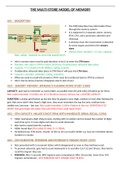
The MSM describes how information flows
through the memory system.
It is explained in 3 separate stores: sensory,
STM, LTM, and 2 processes: attention and
rehearsal.
A stimulus from the environment is detected
by sense organs and enters the sensory
store.
Sensory Store: duration – 0.5 secs, capacity –
high, coding – depends on sense that passed into it.
Info in sensory store must be paid attention to for it to enter the STM store.
Duration: info stays in STM for about 18-30 secs if maintenance rehearsal takes place.
Capacity: 7+/-2 chunks of info (Miller), Coding: acoustic.
If elaborative rehearsal takes place in STM then it will pass into LTM store.
Capacity + duration: unlimited. Coding: semantics.
When we want to recall info stored in LTM it must be transferred back to STM by retrieval.
Info is lost by decay (memory disappears due to lack of use).
AO3 – SENSORY MEMORY: SPERLING’S FLASHING ROWS STUDY (1960)
CAPACITY: ppts had to remember as many letters as possible from the grid when it flashed up for 50ms.
Ppts could remember 3-4 letters out of 12 therefore sensory memory has a LIMITED CAPACITY.
DURATION: a similar grid flashed up but this time he played a tone (high, medium or low) after flashing the
grid. Ppts were told if they heard a high tone, they must remember the top line only, medium tone –
middle row, low tone – last row. Ppts could remember 3 of the 4 letters in the row. DURATION IS SO
SHORT that ppts forgot the letters they saw before they could report them.
A03 – STM CAPACITY: MILLER’S DIGIT SPAN WITH IMMEDIATE SERIAL RECALL (1956)
Miller read aloud a digit string to ppts, starting with 3 numbers and increased the number of digits
each time up to 11 (new digits each time to avoid rehearsal).
Ppts had to repeat back the numbers.
Miller found that STM CAPACITY WAS 7+/-2 ITEMS.
He believed our STM stores ‘chunks’ of info so we can recall it better e.g. how we remember phone
numbers in chunks.
A03 – STM DURATION: PETERSON AND PETERSON’S TRIGAM STUDY (1959)
Ppts presented with 3 consonant letters which disappeared as soon as they had been read.
To prevent rehearsal, ppts had to count backwards in 3s and after 3,6,9,12 and 18 secs, they had to
recall the trigram they saw.
FINDINGS: After 3 seconds, 80% trigrams were remembered. After 18 seconds, fewer than 10%
trigrams remembered – STM DURATION ISN’T LONGER THAN 18 SECS.
, AO3 – LTM DURATION: BAHRICK’S HIGH SCHOOL PHOTOGRAPH STUDY (1975)
He tracked down graduates from highschool over 50 year period. 392 students were
shown photos from their yearbook and he used 2 techniques to test their recall
duration.
RECALL GROUP – ppts were asked to name people in photos.
RECOGNITION GROUP – ppts were given a group of names and had to select the
name that matched the person in the photo.
FINDINGS: Recognition group were best at recalling names : after 14 years, they were
90% accurate , 47 years: 60% accurate.
This was due to the fact that the cue (list of names) triggered the people’s LTM store.
LTM DURATION IS ALMOST A LIFETIME.
A03 – STM + LTM ENCODING
CONRAD’S ACOUSTICALLY SIMILAR LETTERS (1964) – STM
In the first condition, ppts had to immediately recall in order a list of letters which
sounded the same (acoustically similar) e.g. B, G, C, D, E.
In the second condition, ppts did the same but with letters that didn’t sound the
same (acoustically dissimilar) e.g. F, J , L , X , M, R.
FINDINGS: ppt’s tended to confuse the order of similar letters which suggest they
were trying to remember the letters by repeating them sub vocally. This shows the
encoding in STM happens ACOUSTICALLY.
BADDELEY’S SEMANTICALLY SIMILAR LETTERS (1966) - LTM
4 groups: acoustically similar, acoustically dissimilar, semantically similar (words with
similar meaning) and semantically dissimilar.
After 20 mins they were asked to recall the words.
FINDINGS: recall rates were the same for the 2 acoustic groups which shows acoustic
encoding wasn’t important in LTM.
Only 55% semantically similar words recalled and 85% semantically dissimilar words
recalled which shows semantic encoding process had been interfered during
memorising of the words of similar meaning. CODING IS SEMANTIC IN LTM.
A01 – DESCRIPTION
The MSM describes how information flows
through the memory system.
It is explained in 3 separate stores: sensory,
STM, LTM, and 2 processes: attention and
rehearsal.
A stimulus from the environment is detected
by sense organs and enters the sensory
store.
Sensory Store: duration – 0.5 secs, capacity –
high, coding – depends on sense that passed into it.
Info in sensory store must be paid attention to for it to enter the STM store.
Duration: info stays in STM for about 18-30 secs if maintenance rehearsal takes place.
Capacity: 7+/-2 chunks of info (Miller), Coding: acoustic.
If elaborative rehearsal takes place in STM then it will pass into LTM store.
Capacity + duration: unlimited. Coding: semantics.
When we want to recall info stored in LTM it must be transferred back to STM by retrieval.
Info is lost by decay (memory disappears due to lack of use).
AO3 – SENSORY MEMORY: SPERLING’S FLASHING ROWS STUDY (1960)
CAPACITY: ppts had to remember as many letters as possible from the grid when it flashed up for 50ms.
Ppts could remember 3-4 letters out of 12 therefore sensory memory has a LIMITED CAPACITY.
DURATION: a similar grid flashed up but this time he played a tone (high, medium or low) after flashing the
grid. Ppts were told if they heard a high tone, they must remember the top line only, medium tone –
middle row, low tone – last row. Ppts could remember 3 of the 4 letters in the row. DURATION IS SO
SHORT that ppts forgot the letters they saw before they could report them.
A03 – STM CAPACITY: MILLER’S DIGIT SPAN WITH IMMEDIATE SERIAL RECALL (1956)
Miller read aloud a digit string to ppts, starting with 3 numbers and increased the number of digits
each time up to 11 (new digits each time to avoid rehearsal).
Ppts had to repeat back the numbers.
Miller found that STM CAPACITY WAS 7+/-2 ITEMS.
He believed our STM stores ‘chunks’ of info so we can recall it better e.g. how we remember phone
numbers in chunks.
A03 – STM DURATION: PETERSON AND PETERSON’S TRIGAM STUDY (1959)
Ppts presented with 3 consonant letters which disappeared as soon as they had been read.
To prevent rehearsal, ppts had to count backwards in 3s and after 3,6,9,12 and 18 secs, they had to
recall the trigram they saw.
FINDINGS: After 3 seconds, 80% trigrams were remembered. After 18 seconds, fewer than 10%
trigrams remembered – STM DURATION ISN’T LONGER THAN 18 SECS.
, AO3 – LTM DURATION: BAHRICK’S HIGH SCHOOL PHOTOGRAPH STUDY (1975)
He tracked down graduates from highschool over 50 year period. 392 students were
shown photos from their yearbook and he used 2 techniques to test their recall
duration.
RECALL GROUP – ppts were asked to name people in photos.
RECOGNITION GROUP – ppts were given a group of names and had to select the
name that matched the person in the photo.
FINDINGS: Recognition group were best at recalling names : after 14 years, they were
90% accurate , 47 years: 60% accurate.
This was due to the fact that the cue (list of names) triggered the people’s LTM store.
LTM DURATION IS ALMOST A LIFETIME.
A03 – STM + LTM ENCODING
CONRAD’S ACOUSTICALLY SIMILAR LETTERS (1964) – STM
In the first condition, ppts had to immediately recall in order a list of letters which
sounded the same (acoustically similar) e.g. B, G, C, D, E.
In the second condition, ppts did the same but with letters that didn’t sound the
same (acoustically dissimilar) e.g. F, J , L , X , M, R.
FINDINGS: ppt’s tended to confuse the order of similar letters which suggest they
were trying to remember the letters by repeating them sub vocally. This shows the
encoding in STM happens ACOUSTICALLY.
BADDELEY’S SEMANTICALLY SIMILAR LETTERS (1966) - LTM
4 groups: acoustically similar, acoustically dissimilar, semantically similar (words with
similar meaning) and semantically dissimilar.
After 20 mins they were asked to recall the words.
FINDINGS: recall rates were the same for the 2 acoustic groups which shows acoustic
encoding wasn’t important in LTM.
Only 55% semantically similar words recalled and 85% semantically dissimilar words
recalled which shows semantic encoding process had been interfered during
memorising of the words of similar meaning. CODING IS SEMANTIC IN LTM.