
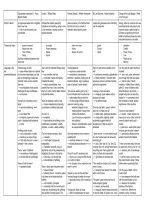
Ozymandias (ramasses II) - Percy London - William Blake Prelude (Extract) - William Wordsworth My Last Duchess - Robert browning Charge of the Light Brigade - Alfred
Bysshe Shelley Lord Tennyson
What’s it about? an oppressive leader who is forgotten criticises the suffering caused by personal memory of a childhood boat a duke being possessive and controlling eulogy, written by someone who was
about over time institutions and monarchy, giving a voice trip that turns into a moment of over his (late) wife commissioned to write piece by the
—> fall of a once powerful ruler, to the members of society whom are realisation about nature's power. monarch about a batter during the
ozymandias typically silenced. Crimean war glorifying the men in
battle but criticising those who made
miscommunications in the battle
Themes (list them) - power is transient - corruption - nature over man - power - patriotism
- Nature over man - Power imbalance - Hubris - Control - Conflict
- Time if infinite - Nature - Allusion of control - Hubris - Power of man
- Decay - Hubris - - Loss
Symbiotic relationship between time - Reality of war
and power. - Memory
Language (a few ’trunkless legs of stone’ ’near when the chartered Thames does ’troubled pleasure’ ‘that’s my last duchess painted on the ’into the valley of death rode the six
key —> uses withered statue as a symbol flow’ —> oxymoron, evokes sublime wall’ hundred.’
quotations/features) of how power deteriorates over time —> not controlled, free flow —> ambivelence (simultaneous —> possessive ownership, objectification —> ‘rode’ verb, active, determined
and no important figure heads are —> controlled, imports and exports, attraction + repulsion), looking back at —> Robert browning = Victorian writer, even though their fate was sealed.
immortal, nature is more powerful Industrial Revolution troubled reflection, regret, juxtapose possessive pronoun endorses Victorian —> ‘into the valley of death
than man —> natures unpredictable, more past and present, haunts narrator patriarchal expectation metaphor + biblical illusion (death),
—> incompacitated, mock decline, powerful than man, ironic, man thinks palm 23 - verse of bible that talks
challenges the idea of idiolisation they’re in control, hubris, Blake criticises ‘One summer evening (led by her) I ‘Looking as if she were alive’ about the bravery at all costs —>
—> anonymous Industrial Revolution found a little boat tied to a willow tree’ —> ambiguity, hyper realistic portrait, people being brave for what they
—> nature personified as feminine because she’s dead. believe in —> commentary about
‘My name is ozymandias, king of ‘Marks of weakness, marks of woe.‘ —>. Evokes image of Mother Nature, —> No definitive death the inevitability of death, spiritual
kings:’ —> bruises metaphorical, physicality, maternal, nurturing, caring significance of their sacrifice.
—> syntactical patterning - word connotations of suffering and torture. - extended metaphor for the ‘Even you had skill in speech -(which I
order metamorphosis f narrator from have not)- to make your will’ ‘Some one had blunder’d:’
—> puts himself first ‘In every’ x3 childhood to adulthood —> skilled orator, duplicitous (deceitful) —> blunder - means simpler error,
—> arrogance, superiority complex, —> anaphora - Loss of innocence, progression —> manipulative, regularity, iambic trying not to ne too critical, works for
vanity - obsessed with themselves. —> hyperbolisimg the suffering of man into adulthood pentameter suggests that he’s monarch doesn’t want to get in
—> hubris (proletarians), expectation - wealth, - Nature is underestimated, should disingenuous or that his speech is trouble.
progress - vs reality - duality, suffering’ be enjoyed and feared. rehearsed. —> past tense - subtle critism about
‘Nothing beside remains’ whoever gave the order to attack
—> ironic, expectation vs reality ‘The mind forged manacles I hear’ ‘Until they melted all into one track of ‘I know not how - as if she ranked my gift —> commanding officers fault not
—> reductive, just a pair of legs —> metaphor sparkling light’ of a nine hundred years old name with soldiers, hierarchy that follows.
—> Volta, after the point - power is —> ‘mind forged’ propaganda, —> harmony between m + n in past anybody’s gift’
transient + time is infinite. manipulation. —>troubled pleasure between m + n in —> class. ‘She’ (line 32), ‘my’ (line 33), ‘Theirs not to make reply, theirs not
—>’manacles’ handcuffs, trying to present ‘anybody’ (line 34), ranking himself above to reason why, theirs but to do + die’
‘Decay’ ‘wreck’ ‘shattered’ amplify the voice of the proletarians by everything else. Preoccupation with —> anaphora, lack of individuality +
—> connotations of disintegration highlighting the noise in the stanza ‘Proud of his skill’ ‘unswerving line’ status, he feels she’s responsible control
—> semantic field of ruin/damage. —> excecution, rule through fear —> hubris, as a young boy feels that he —> ‘gift’ bestow on someone else —> perfect rhyme, can mirror how
—> externalisation of suffering is in control of nature they were forced to recite + follow
‘Sneer of cold command’ —> in retrospect ,irony, realised he was ‘Then would be stooping; and I choose orders without questioning them
—> oppressive leader ‘Runs in blood down the palace walls.’ never in control never to stoop’
—> abuse of power —> ‘stooping’ lower oneself, he’s acted ‘Into the jaws of death, into the
—> attacking church - monarchy, palace ‘Dipped my oars into the silent lake’ within remit of class mouth of hell’
is to blame for the blood shed from ‘heaving through the water like a swan’ —> how dangerous the battle was
soldiers —> physically taxing, shift in meaning of ‘This grew I gave commands then all with the personification of war
—> anti institution, corruption poem smiles stopped together.’ —> alludes to the inevitable
—> symbolizes that the monarchy and —> caesura, echoes death suffering of the fighters
ruling class are stained by the suffering ‘A huge peak, black and huge’ —> ambiguity, heavily implied commands —> eaten alive, difference in
and sacrifice of normal people. This —> shift in characterisation of nature to have her killed, he spoke to her - she’s numbers in army, monstrous.
, symbolises the institutional guilt for ‘Upreared its head’ not happy - all smiles stopped
oppression and bloodshed while they —> change in pronoun, no longer ‘Volley’d’ ‘thunder’d’’storm’d’ ‘shot’
remain safe within the palace walls that familiar, uncanny being evoked ‘Is my object’ ‘shell’
contain lots of security (disorientation) —> he’s in process of transacting next —> graphic semantic field of
wife artillery, can’t escape on horse
‘Grim shape’ —> cyclical structure —> vicious + repeated attack
—> connotations of death —> control
‘Left of six hundred’
‘Towering up between me and the stars’ ‘Which Claus of innsbruck cast in bronze —> highlights the loss of men
—> overpowering + highly dominant for me!’ —> sacrifice of many, those that fell
—> ironic, learn more about him than her are heroes + those that survived.
‘Strode after me’ (line 29) subverts
‘leaving behind her still (line 8) ‘Noble six hundred!’
—> subversion of power, generates —> epithet
terror —> title, honour, ironic since the
—> trivial mood replaced by epiphany commanding officers bought their
titles but the soldiers worked for it +
‘No familiar shapes remained’ ‘that do were even more honoured.
not live like living men’
—> epiphany of protagonist
—> insignificant in comparison to
nature, beyond our comprehension.
Structure (describe sonnet form - autobiographical - autobiographical - dramatic monologue, silences - linear structure
key features or - 14 lines - Written mostly in iambic - Retrospective duchess, one sided view, bias, - 3rd person narrative
quote them) - Typically explore the pentameter, the structure of the - Explores idea of memory allows speaker to inadvertently - Using dectilic repetitive
complicated nature about love poem mimics the constrains of - Hubris reveal. —> emasculated by her, meter, shows continuous
/ affection society - Conflict, between man + nature, accuse her of being unfaithful ‘her falling of the horses hooves,
- Regular structure, shows how nature outlast all of humanity, looks went everywhere’ cuckolded quickness of battle and
Shelly uses sonnet term to ridicule society expects one to conform man insignificant in comparison. (victim in unfaithful relationship), relentless attack
ozymandias’ love of self. - Structure of the poem reinforces - Iambic pentameter, linked to shameful in victorian era, shows - Ballard poem
Blake’s pessimistic views of control, memory, reflecting on why he is so critical in his - Remember active piece
London and its institutions. childhood experiences, changed recollection of her. ‘Since none - Commissioned by monarch,
world view. puts by the curtain I have drawn propaganda.
for you but I’ dominant - Falling rhythm
- 1st person narrative, narcissistic
- Iambic pentameter
Which poems could - checking out me history - - exposure - focus on suffering - London - power of nature - ozymandias - abuse of power - bayonet charge - war
you compare it to power of time - Prelude - power of nature - Kamikaze - power of time - Remains - disturbed speaker - Exposure - soldiers suffering
and why? - London - critiquing abuse of - - Remains - power of memory - Checking out me history - how
power power causes suffering
- My last duchess - themes of (individuals vs multiples), abuse of
control and oppression power (how society controls
perception of black people/ how
society controls women)


