
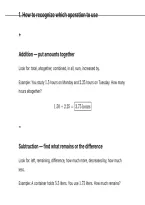
1. How to recognize which operation to use
+
Addition — put amounts together
Look for: total, altogether, combined, in all, sum, increased by.
Example: You study 1.5 hours on Monday and 2.25 hours on Tuesday. How many
hours altogether?
1.50 + 2.25 = 3.75 hours
−
Subtraction — find what remains or the difference
Look for: left, remaining, difference, how much more, decreased by, how much
less.
Example: A container holds 5.5 liters. You use 1.75 liters. How much remains?
, 5.50 − 1.75 = 3.75 liters
×
Multiplication — equal groups or repeated amounts
Look for: each, per group when finding a total, times, twice, double, of.
Example: Each of 4 containers holds 0.75 liters. How much liquid is there
altogether?
4 × 0.75 = 3 liters
÷
Division — sharing or finding how many groups
Look for: shared equally, split, per person, how many groups, how many times
does it fit.


