
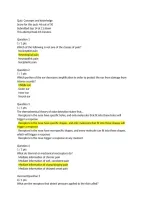
Quiz: Concepts and knowledge
Score for this quiz: 46 out of 50
Submitted Sep 14 at 11:56am
This attempt took 69 minutes.
Question 1
pts
Which of the following is not one of the classes of pain?
Nociceptive pain
Neurological pain
Neuropathic pain
Nociplastic pain
Question 2
pts
Which portion of the ear decreases amplification in order to protect the ear from damage from
intense sounds?
Middle ear
Outer ear
Inner ear
Neural ear
Question 3
pts
The stereochemical theory of odor detection states that…
Receptors in the nose have specific holes, and only molecules that fit into these holes will
trigger a response
Receptors in the nose have specific shapes, and only molecules that fit into these shapes will
trigger a response
Receptors in the nose have non-specific shapes, and every molecule can fit into these shapes,
which will trigger a response
Receptors in the nose trigger a response at any moment
Question 4
pts
What do thermal or mechanical nociceptors do?
Mediate information of chronic pain
Mediate information of soft, consistent pain
Mediate information of sharp/stinging pain
Mediate information of delayed onset pain
IncorrectQuestion 5
pts
What are the receptors that detect pressure applied to the skin called?
, Kinetosis receptors
Cutaneous sensitivity
Pacinian corpuscles
Otolith organs
Question 6
pts
In order to observe electrical brain activity in response to environmental stimulation, a scientist
may use which device?
SPECT
PET
fMRI
EEG
Question 7
pts
What is the assumption that our parents, grandparents, and great-grandparents had the same
experience of the world called?
Crossover effect
Generalizability
Spatiotemporally universal
Potential stimulus
Question 8
pts
In order for us to experience a sensation, there must be a _____.
Reduction
Response
Cognition
Stimulus
Question 9
pts
Narcotics, painkillers, and analgesics (opioids. are the second most powerful medications
available for alleviating pain
True
False
Question 10
pts
During a stimulus detection experiment, the researcher cannot control for ____, which is always
present affects a participant’s ability to detect a signal.
Nerves
Delay
Score for this quiz: 46 out of 50
Submitted Sep 14 at 11:56am
This attempt took 69 minutes.
Question 1
pts
Which of the following is not one of the classes of pain?
Nociceptive pain
Neurological pain
Neuropathic pain
Nociplastic pain
Question 2
pts
Which portion of the ear decreases amplification in order to protect the ear from damage from
intense sounds?
Middle ear
Outer ear
Inner ear
Neural ear
Question 3
pts
The stereochemical theory of odor detection states that…
Receptors in the nose have specific holes, and only molecules that fit into these holes will
trigger a response
Receptors in the nose have specific shapes, and only molecules that fit into these shapes will
trigger a response
Receptors in the nose have non-specific shapes, and every molecule can fit into these shapes,
which will trigger a response
Receptors in the nose trigger a response at any moment
Question 4
pts
What do thermal or mechanical nociceptors do?
Mediate information of chronic pain
Mediate information of soft, consistent pain
Mediate information of sharp/stinging pain
Mediate information of delayed onset pain
IncorrectQuestion 5
pts
What are the receptors that detect pressure applied to the skin called?
, Kinetosis receptors
Cutaneous sensitivity
Pacinian corpuscles
Otolith organs
Question 6
pts
In order to observe electrical brain activity in response to environmental stimulation, a scientist
may use which device?
SPECT
PET
fMRI
EEG
Question 7
pts
What is the assumption that our parents, grandparents, and great-grandparents had the same
experience of the world called?
Crossover effect
Generalizability
Spatiotemporally universal
Potential stimulus
Question 8
pts
In order for us to experience a sensation, there must be a _____.
Reduction
Response
Cognition
Stimulus
Question 9
pts
Narcotics, painkillers, and analgesics (opioids. are the second most powerful medications
available for alleviating pain
True
False
Question 10
pts
During a stimulus detection experiment, the researcher cannot control for ____, which is always
present affects a participant’s ability to detect a signal.
Nerves
Delay


