
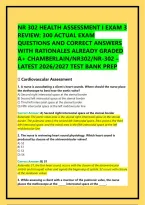
NR 302 HEALTH ASSESSMENT I EXAM 3
REVIEW: 300 ACTUAL EXAM
QUESTIONS AND CORRECT ANSWERS
WITH RATIONALES ALREADY GRADED
A+ CHAMBERLAIN/NR302/NR-302 –
LATEST 2026/2027 TEST BANK PREP
🫀 Cardiovascular Assessment
1. A nurse is auscultating a client's heart sounds. Where should the nurse place
the stethoscope to best hear the aortic valve?
A) Second right intercostal space at the sternal border
B) Second left intercostal space at the sternal border
C) Third left intercostal space at the sternal border
D) Fifth intercostal space at the left midclavicular line
Correct Answer: A) Second right intercostal space at the sternal border
Rationale: The aortic valve area is the second right intercostal space at the sternal
border. The pulmonic area is the second left intercostal space, Erb's point is the third
left intercostal space, and the mitral area is the fifth intercostal space at the left
midclavicular line.
2. The nurse is reviewing heart sound physiology. Which heart sound is
produced by closure of the atrioventricular valves?
A) S2
B) S1
C) S3
D) S4
Correct Answer: B) S1
Rationale: S1, the first heart sound, occurs with the closure of the atrioventricular
(mitral and tricuspid) valves and signals the beginning of systole. S2 occurs with closure
of the semilunar valves.
3. While assessing a client with a murmur of the pulmonic valve, the nurse
places the stethoscope at the ______ intercostal space at the ______.
,Correct Answer: 2nd left; sternal border
Rationale: The pulmonic valve is best auscultated at the second left intercostal space at
the sternal border.
4. During a cardiovascular assessment, the nurse knows that a thrill is:
Correct Answer: A vibration that is palpable.
Rationale: A thrill is a palpable vibration that signifies turbulent blood flow and
accompanies loud murmurs.
5. A client with no history of cardiovascular disease comes into the ambulatory
clinic with flu-like symptoms. The client suddenly complains of chest pain.
Which question would best help a nurse determine the most likely source of the
client's chest pain?
Correct Answer: "Does the pain get worse when you breathe in?"
Rationale: This question helps differentiate between cardiac and pleuritic chest pain.
Pleuritic pain typically worsens with inspiration.
6. The nurse has completed the health history and review of systems with an
older adult. Which client-reported cues indicate a focused assessment of the
cardiovascular system should be completed? Select all that apply.
A) Agitation
B) Mental status changes
C) Frequent falls
Correct Answer: A, B, and C
Rationale: Agitation, mental status changes, and frequent falls can all be indicators of
decreased cerebral perfusion, which may result from cardiovascular issues.
7. Drag the risk factors for cardiovascular disease to the correct category.
Correct Answer:
• Modifiable factors: cholesterol, diabetes, blood pressure, inactivity, smoking,
stress, and obesity.
• Non-Modifiable factors: age, gender, race, and genetics.*
🫀 Respiratory Assessment
8. A nurse is assessing a patient's respiratory rate. Which finding would be
documented as tachypnea?
A) 10 breaths/min
B) 16 breaths/min
,C) 24 breaths/min
D) 12 breaths/min
Correct Answer: C) 24 breaths/min
Rationale: Tachypnea is defined as a respiratory rate greater than 24 breaths per
minute. Normal adult respiratory rate is 12–20 breaths/min.
9. Which breath sound is normally heard over the trachea and bronchial tube of
the neck?
A) Vesicular
B) Bronchovesicular
C) Bronchial
D) Crackles
Correct Answer: C) Bronchial
Rationale: Bronchial breath sounds are normally heard over the trachea and bronchial
tube of the neck. They are high-pitched and loud with equal inspiration and expiration.
10. A nurse auscultates a patient's lungs and hears a low-pitched, soft sound
over the peripheral lung fields. This is best described as:
A) Bronchial
B) Bronchovesicular
C) Vesicular
D) Wheezing
Correct Answer: C) Vesicular
Rationale: Vesicular sounds are soft, low-pitched sounds heard over the periphery of
the lungs. They are normal breath sounds.
11. Where are bronchovesicular breath sounds normally heard?
A) Over the trachea
B) Around the sternum and along the vertebral line
C) Over the peripheral lung fields
D) At the lung bases only
Correct Answer: B) Around the sternum and along the vertebral line
Rationale: Bronchovesicular sounds are heard around the sternum (anterior) and along
the spinal column/vertebral line (posterior). They are moderate in pitch and intensity.
12. When performing a respiratory assessment on a patient, the nurse notices a
costal angle of approximately 90 degrees. This characteristic is:
Correct Answer: A normal finding.
Rationale: A costal angle of 90 degrees or less is a normal finding in adults. An
increased angle (barrel chest) may indicate chronic obstructive pulmonary disease
(COPD).
, 13. What tools does one use to determine breath sounds?
Correct Answer: Diaphragm of the stethoscope.
Rationale: The diaphragm is best for high-pitched sounds like breath sounds. The bell is
used for low-pitched sounds like heart murmurs.
14. How does the presence of fluid in the lungs affect tactile fremitus?
Correct Answer: It decreases tactile fremitus.
Rationale: Fluid in the lungs (e.g., pneumonia, pleural effusion) transmits sound poorly,
leading to decreased tactile fremitus.
🧠 Neurological & Mental Status Assessment
15. A nurse is testing a patient's cranial nerve XI (Accessory). What action
should the nurse ask the patient to perform?
Correct Answer: Shrug the shoulders against resistance.
Rationale: Cranial nerve XI innervates the sternocleidomastoid and trapezius muscles.
Testing shoulder shrug against resistance assesses its function.
16. A nurse is performing the Romberg test. What is the primary purpose of
this test?
Correct Answer: To assess for balance and proprioception.
Rationale: The Romberg test evaluates the client's ability to maintain balance when the
eyes are closed, assessing the vestibular system and proprioception.
17. What does PERRLA stand for in neurological assessment?
Correct Answer: Pupils Equal, Round, Reactive to Light and Accommodation.
Rationale: PERRLA is a standard acronym used to document a normal neurological
assessment of the pupils.
18. A patient has ptosis, miosis, anhidrosis, and apparent enophthalmos on the
right eye. This constellation is called:
A) Horner's syndrome
B) Cushing's triad
C) Bell's palsy
D) Myasthenia gravis
Correct Answer: A) Horner's syndrome
Rationale: This classic triad of symptoms (ptosis, miosis, anhidrosis) is indicative of
Horner's syndrome, which results from a lesion in the sympathetic nervous system.
19. When testing plantar reflex, the great toe extends and the other toes fan.
The nurse should document this as:


