
Praxis 5005 Science - Exam Questions & Verified Answers
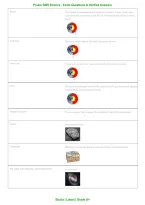
Mantle Thick Layer surrounding Earth's outer core made of a thick, solid, rocky
substance that represents about 85% of the total weight and mass of the
Earth
Inner Core The most inside layer of the Earth, composed of iron
Outer Core Closet to the Inner Core, liquid composed of a nickel-iron alloy
Crust The most outside layer of the Earth, composed of a great variety of igneous,
metamorphic, and sedimentary rocks
Nitrogen & Oxygen The two gasses that compose the majority of the Earth's Atmosphere
Schist Metamorphic Rock
Convergent Mountains most likely to form along which type of plate boundary
The shape of the Milky Way can be described as... A spiral disk
Stuvia | Latest | Grade A+
, Praxis 5005 Science - Exam Questions & Verified Answers
What is the moon's position relative to Earth during a lunar The moon and sun are on opposite sides of the earth
Eclipse?
Metaphase Phase Phase of mitosis when the duplicated chromosomes line up along the
equatorial plate of the spindle
Brainstem The structure responsible for regulating basic functions of the respiration
and heartbeat
Heredity and experience A behavioral response from an organism is determined by what two factors?
23 Pairs of Chromosomes (64 individual chromosomes) Number of pairs of chromosomes within a typical cell in a human body
High salinity of sea water causes tissues to become Why can't people drink sea water?
dehydrated due to osmotic diffusion of water from within
the cells
Kingdom Highest level on the biological classification scale. ALL living creatures are
classified as part of the Kingdom.
Phylum Splits animals by major characteristics. Vertebrates (fish, mammals) are in
the Chordata Phylum. (2nd level)
Class Distinguishes further. Fish are divided into Chondrichthyes (cartilaginous
fish) and Osteichthyes (bony fish). (3rd level)
Order Further differentiates by physical characteristics. (4th level)
Family Follows on from order by placing into groups by further physical
characteristics. Ex: cod, coalfish, pollock and whiting are all members of the
Gadidae family, and share features such as all having three dorsal fins. (5th
level)
Genus Further, final breakdown. Ex: Cod are in Gadus Genus to differentiate them
form the other fish in the Gadidae family. (6th level)
Species The final step and pinpoints the exact creature. (7th level)
Stuvia | Latest | Grade A+
, Praxis 5005 Science - Exam Questions & Verified Answers
Half life Time required for half the atoms of a particular substance to disintegrate is
know as
Producers Plants are producers because they produce their own food
Consumers Animals are called consumers. They cannot make their own food, so they
eat plants and/or animals
Decomposers Bacteria and fungi.. They eat decaying matter - dead plants and animals and
in the process they break them down and decompose them when that
happens, the release nutrients and minerals back into the soil.
Herbivores Animals that only eat plants
Carnivores Animals that eat only animals
Omnivores Animals that eat both plants and animals
Fission Releasing atomic energy by bombarding a dense element with neutrons and
splitting its nucleus
UV Radiation Shortest wavelength
Lithification Process where sediments are compacted and cemented into sedimentary
rock
Lithosphere "Rock sphere" is the ground you are standing on and the whole inside of the
earth
Stuvia | Latest | Grade A+


