
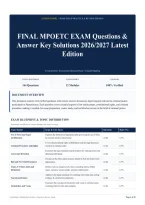
[STUDY GUIDE] • HIGH-YIELD PRACTICE & REVIEW EDITION
FINAL MPOETC EXAM Questions &
Answer Key Solutions 2026/2027 Latest
Edition
Comprehensive Examination Question Bank • Concept Mapping
TOTAL QUESTIONS EXAM TOPICS ANSWERS
164 Questions 12 Modules 100% Verified
DOCUMENT OVERVIEW
This document contains 164 verified questions with correct answers focused on legal concepts relevant to criminal justice,
particularly in Pennsylvania. Each question covers essential aspects of law enforcement, constitutional rights, and criminal
procedure, making it suitable for exam preparation, course study, and certification review in the field of criminal justice.
EXAM BLUEPRINT & TOPIC DISTRIBUTION
Systematic breakdown of subject domains and exam coverage.
Topic Module Scope & Core Focus Questions Share (%)
Use of Force and Legal Explores the statutes and legal principles governing the use of force
Justifications by citizens and law enforcement. 14 Qs 8.5%
Covers the procedural rights of defendants and the legal processes
Criminal Procedure and Rights involved in criminal cases. 14 Qs 8.5%
Examines the legal standards and procedures for making arrests and
Arrest and Detention detaining individuals. 14 Qs 8.5%
Focuses on the rules and procedures related to bail and initial court
Bail and Pre-Trial Procedures appearances. 14 Qs 8.5%
Types of Crimes and Legal Defines various categories of crimes, including serious bodily
Definitions injury, statutory sexual assault, and their implications. 14 Qs 8.5%
Addresses the legal standards for searching individuals and seizing
Search and Seizure evidence in criminal investigations. 14 Qs 8.5%
Examines the concepts of jurisdiction and venue in criminal cases,
Jurisdiction and Venue including relevant rules and examples. 14 Qs 8.5%
Confidential • Student Study Edition • Practice & Review Guide Page 1 of 35
,STUDENT STUDY & MASTERY EDITION PRACTICE & REVIEW GUIDE
Discusses the historical evolution of policing and various models of
Policing Eras and Models law enforcement. 14 Qs 8.5%
Explores foundational legal principles, including the Bill of Rights
Criminal Law Foundations and relevant case law. 13 Qs 7.9%
Covers important legal terminology and concepts essential for
Legal Terms and Concepts understanding criminal law. 13 Qs 7.9%
Examines landmark cases and their impact on criminal justice
Case Law and Precedents practices and procedures. 13 Qs 7.9%
Summary Offenses and Lesser Focuses on summary offenses, their definitions, and the legal
Crimes processes involved. 13 Qs 7.9%
Total Exam Coverage 12 Integrated Topic Modules 164 Qs 100.0%
TOPIC 1: USE OF FORCE AND LEGAL JUSTIFICATIONS
14 Questions • 8.5% of Exam • Explores the statutes and legal principles governing the use of force by citizens and law enforcement.
QUESTION 1
What statute allows citizens to use force?
Answer: > 505.
QUESTION 2
What statute allows law enforcement to use force?
Answer: > 508.
QUESTION 3
What is not a defense of culpability? (304)
Answer: > Ignorance of the law
> Voluntary intoxication/drugged.
Confidential • Student Study Edition • Practice & Review Guide Page 2 of 35
,STUDENT STUDY & MASTERY EDITION PRACTICE & REVIEW GUIDE
QUESTION 4
Forced Abandonment Example
Answer: > Two people talking, officer stated "hey come here", & they take off running & drop bag; officer looks in &
finds drugs > Arrest is not good b/c of forced coercion.
QUESTION 5
Justification for a Detention
Answer: > Flight
> High Crime Area
> Officer's Experience
> Tips
> Anonymous Tips
> Combined, these justifications create justifications.
QUESTION 6
Tolling
Answer: > A legal doctrine the allows for the pausing or delaying of the running of the period of the time set forth by a
statute of limitations.
QUESTION 7
Deadly Force
Answer: > Capable of causing death/serious bodily injury/permanent disfigurement.
QUESTION 8
What case law established use of deadly force?
Answer: > Tennessee v. Garner
> Suspect ran, officers shot suspect while fleeing.
Confidential • Student Study Edition • Practice & Review Guide Page 3 of 35
, STUDENT STUDY & MASTERY EDITION PRACTICE & REVIEW GUIDE
QUESTION 9
Article 1 Section 17
Answer: > Disallows passage of ex past facto laws; only applies to penal statutes & must impose a punishment for an act
which was not punishable at the time it was committed, or impose additional punishment to that then prescribed.
QUESTION 10
Disorderly Conduct Upgrade in Grading happens when?
Answer: > Person persists after you give them a reasonable warning to stop or request for them to desist. (did not comply
so goes from Summary to M3) > Disorderly conduct with more than 2 people can be charged with failure to disperse >
YOU CANNOT BE DISORDERLY IN YOUR OWN HOME.
QUESTION 11
Arizona v. Hicks
Answer: > Bullet fired through an apt. floor; police enter looking for shooter/victims/weapons > They seize weapons &
then notice stereo equipment, wrote down serial numbers > Held that the 4th Amendment requires the police to have
probable cause to seize items in plain view > Exigent circumstances ended when weapons were seized, so stereo equipment
is out (needed a warrant & independent PC) > Plain view doctrine violated, wasn't immediately apparent status of item as
stolen.
QUESTION 12
Procedure in Summary Cases
Answer: > Criminal proceedings in summary cases shall be instituted either by:
1. Issuing a citation to the defendant; or
2. Filing a citation; or
3. Filing a complaint; or
4. Arresting w/o a warrant when arrest is specifically authorized by law.
QUESTION 13
Rule 510 Contents of Summons; Notice of Preliminary Hearing
Answer: > The date set for the preliminary hearing shall be NOT LESS THAN 20 days from the date of mailing the
summons.
Confidential • Student Study Edition • Practice & Review Guide Page 4 of 35
FINAL MPOETC EXAM Questions &
Answer Key Solutions 2026/2027 Latest
Edition
Comprehensive Examination Question Bank • Concept Mapping
TOTAL QUESTIONS EXAM TOPICS ANSWERS
164 Questions 12 Modules 100% Verified
DOCUMENT OVERVIEW
This document contains 164 verified questions with correct answers focused on legal concepts relevant to criminal justice,
particularly in Pennsylvania. Each question covers essential aspects of law enforcement, constitutional rights, and criminal
procedure, making it suitable for exam preparation, course study, and certification review in the field of criminal justice.
EXAM BLUEPRINT & TOPIC DISTRIBUTION
Systematic breakdown of subject domains and exam coverage.
Topic Module Scope & Core Focus Questions Share (%)
Use of Force and Legal Explores the statutes and legal principles governing the use of force
Justifications by citizens and law enforcement. 14 Qs 8.5%
Covers the procedural rights of defendants and the legal processes
Criminal Procedure and Rights involved in criminal cases. 14 Qs 8.5%
Examines the legal standards and procedures for making arrests and
Arrest and Detention detaining individuals. 14 Qs 8.5%
Focuses on the rules and procedures related to bail and initial court
Bail and Pre-Trial Procedures appearances. 14 Qs 8.5%
Types of Crimes and Legal Defines various categories of crimes, including serious bodily
Definitions injury, statutory sexual assault, and their implications. 14 Qs 8.5%
Addresses the legal standards for searching individuals and seizing
Search and Seizure evidence in criminal investigations. 14 Qs 8.5%
Examines the concepts of jurisdiction and venue in criminal cases,
Jurisdiction and Venue including relevant rules and examples. 14 Qs 8.5%
Confidential • Student Study Edition • Practice & Review Guide Page 1 of 35
,STUDENT STUDY & MASTERY EDITION PRACTICE & REVIEW GUIDE
Discusses the historical evolution of policing and various models of
Policing Eras and Models law enforcement. 14 Qs 8.5%
Explores foundational legal principles, including the Bill of Rights
Criminal Law Foundations and relevant case law. 13 Qs 7.9%
Covers important legal terminology and concepts essential for
Legal Terms and Concepts understanding criminal law. 13 Qs 7.9%
Examines landmark cases and their impact on criminal justice
Case Law and Precedents practices and procedures. 13 Qs 7.9%
Summary Offenses and Lesser Focuses on summary offenses, their definitions, and the legal
Crimes processes involved. 13 Qs 7.9%
Total Exam Coverage 12 Integrated Topic Modules 164 Qs 100.0%
TOPIC 1: USE OF FORCE AND LEGAL JUSTIFICATIONS
14 Questions • 8.5% of Exam • Explores the statutes and legal principles governing the use of force by citizens and law enforcement.
QUESTION 1
What statute allows citizens to use force?
Answer: > 505.
QUESTION 2
What statute allows law enforcement to use force?
Answer: > 508.
QUESTION 3
What is not a defense of culpability? (304)
Answer: > Ignorance of the law
> Voluntary intoxication/drugged.
Confidential • Student Study Edition • Practice & Review Guide Page 2 of 35
,STUDENT STUDY & MASTERY EDITION PRACTICE & REVIEW GUIDE
QUESTION 4
Forced Abandonment Example
Answer: > Two people talking, officer stated "hey come here", & they take off running & drop bag; officer looks in &
finds drugs > Arrest is not good b/c of forced coercion.
QUESTION 5
Justification for a Detention
Answer: > Flight
> High Crime Area
> Officer's Experience
> Tips
> Anonymous Tips
> Combined, these justifications create justifications.
QUESTION 6
Tolling
Answer: > A legal doctrine the allows for the pausing or delaying of the running of the period of the time set forth by a
statute of limitations.
QUESTION 7
Deadly Force
Answer: > Capable of causing death/serious bodily injury/permanent disfigurement.
QUESTION 8
What case law established use of deadly force?
Answer: > Tennessee v. Garner
> Suspect ran, officers shot suspect while fleeing.
Confidential • Student Study Edition • Practice & Review Guide Page 3 of 35
, STUDENT STUDY & MASTERY EDITION PRACTICE & REVIEW GUIDE
QUESTION 9
Article 1 Section 17
Answer: > Disallows passage of ex past facto laws; only applies to penal statutes & must impose a punishment for an act
which was not punishable at the time it was committed, or impose additional punishment to that then prescribed.
QUESTION 10
Disorderly Conduct Upgrade in Grading happens when?
Answer: > Person persists after you give them a reasonable warning to stop or request for them to desist. (did not comply
so goes from Summary to M3) > Disorderly conduct with more than 2 people can be charged with failure to disperse >
YOU CANNOT BE DISORDERLY IN YOUR OWN HOME.
QUESTION 11
Arizona v. Hicks
Answer: > Bullet fired through an apt. floor; police enter looking for shooter/victims/weapons > They seize weapons &
then notice stereo equipment, wrote down serial numbers > Held that the 4th Amendment requires the police to have
probable cause to seize items in plain view > Exigent circumstances ended when weapons were seized, so stereo equipment
is out (needed a warrant & independent PC) > Plain view doctrine violated, wasn't immediately apparent status of item as
stolen.
QUESTION 12
Procedure in Summary Cases
Answer: > Criminal proceedings in summary cases shall be instituted either by:
1. Issuing a citation to the defendant; or
2. Filing a citation; or
3. Filing a complaint; or
4. Arresting w/o a warrant when arrest is specifically authorized by law.
QUESTION 13
Rule 510 Contents of Summons; Notice of Preliminary Hearing
Answer: > The date set for the preliminary hearing shall be NOT LESS THAN 20 days from the date of mailing the
summons.
Confidential • Student Study Edition • Practice & Review Guide Page 4 of 35


