
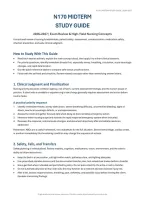
N170 | MIDTERM STUDY GUIDE | 2026–2027
N170 MIDTERM
STUDY GUIDE
2026–2027 | Exam Review & High-Yield Nursing Concepts
A structured review of nursing fundamentals, patient safety, assessment, communication, medication safety,
infection prevention, and early clinical judgment.
How to Study With This Guide
• Read each section actively: explain the main concept aloud, then apply it to a short clinical scenario.
• For priority questions, identify immediate threats first, especially airway, breathing, circulation, acute neurologic
changes, and rapid deterioration.
• Use the quick-reference tables to compare safe versus unsafe actions.
• Finish with the self-test and checklist. Review missed concepts rather than memorizing answer letters.
1. Clinical Judgment and Prioritization
Nursing priority decisions combine urgency, risk of harm, current assessment findings, and the nurse's scope of
practice. A client who is unstable or experiencing a new change generally requires assessment and action before
routine tasks.
A practical priority sequence
1. Identify immediate threats: airway obstruction, severe breathing difficulty, uncontrolled bleeding, signs of
shock, new focal neurologic deficits, or unresponsiveness.
2. Assess the client and gather focused data when doing so does not delay emergency action.
3. Intervene within nursing scope and activate the rapid response/emergency system when indicated.
4. Reassess the response, communicate changes, and document objectively after immediate needs are
addressed.
Remember: ABCs are a useful framework, not a substitute for the full situation. Severe hemorrhage, cardiac arrest,
or another immediately life-threatening condition may change the sequence of actions.
2. Safety, Falls, and Transfers
Safety planning is individualized. Review mobility, cognition, medications, vision, environment, and the client's
ability to follow instructions.
• Keep the bed in a low position, call light within reach, pathways clear, and lighting adequate.
• Use prescribed assistive devices and the documented transfer plan; lock wheelchair brakes before a transfer.
• Use a gait belt when indicated and permitted by policy. Do not pull a client by the arms or rush a transfer.
• Do not automatically raise all four side rails; this may function as a restraint and can increase injury risk.
• After a fall, assess responsiveness, breathing, pain, deformity, and possible injury before moving the client.
Escalate concerning findings.
Original educational review resource • Confirm course objectives with your instructor
, N170 | MIDTERM STUDY GUIDE | 2026–2027
3. Infection Prevention and Aseptic Technique
Standard precautions apply to all clients. Add transmission-based precautions according to the suspected or
confirmed organism and facility policy.
Practice Key point Common unsafe error
Hand hygiene Perform at the indicated moments; Leaving gloves on between tasks or
gloves do not replace hand hygiene. clients.
Sterile field Keep sterile items within view and Continuing after a sterile item
above waist level; protect the field touches a nonsterile surface.
from moisture and contact
contamination.
C. difficile Use appropriate contact Relying only on alcohol hand rub for
precautions; soap-and-water spore removal.
handwashing is especially
important when spore
contamination is suspected.
Urinary catheter Maintain a closed drainage system, Unnecessary disconnections or
unobstructed flow, and bag below placing the bag above the bladder.
bladder level; reassess ongoing
need.
Respiratory hygiene Use source control and appropriate Ignoring cough hygiene or indicated
precautions based on symptoms protective equipment.
and policy.
4. Medication Administration and Safety
Medication safety includes the rights of medication administration, allergy review, appropriate assessment,
accurate calculations, patient education, monitoring, and documentation. Follow the institution's current policy and
medication-specific instructions.
• Verify the client with two approved identifiers; do not use room number as an identifier.
• Clarify an incomplete, unusual, illegible, or potentially unsafe order before giving the medication.
• Check allergies, relevant vital signs/laboratory results, contraindications, and the intended effect.
• Never guess a dose, independently change a prescription, or document a medication as given when it was not
administered.
• Some extended-release, enteric-coated, or otherwise specially formulated tablets must not be crushed. Verify
with a pharmacist or authoritative medication reference.
• For a medication error, assess the client and provide immediate care first, notify appropriate clinicians,
document factually, and complete the safety report according to policy.
• High-alert medications require the safeguards specified by the facility, which may include independent double
checks and focused monitoring.
5. Focused Assessment and Vital Signs
Trends and changes from baseline can be more meaningful than a single number. Reassess abnormal findings and
consider the whole clinical picture.
Finding Possible concern Priority response
New confusion or reduced Hypoxia, infection, medication Assess promptly; check airway,
effect, metabolic or neurologic breathing, oxygenation and other
Original educational review resource • Confirm course objectives with your instructor
N170 MIDTERM
STUDY GUIDE
2026–2027 | Exam Review & High-Yield Nursing Concepts
A structured review of nursing fundamentals, patient safety, assessment, communication, medication safety,
infection prevention, and early clinical judgment.
How to Study With This Guide
• Read each section actively: explain the main concept aloud, then apply it to a short clinical scenario.
• For priority questions, identify immediate threats first, especially airway, breathing, circulation, acute neurologic
changes, and rapid deterioration.
• Use the quick-reference tables to compare safe versus unsafe actions.
• Finish with the self-test and checklist. Review missed concepts rather than memorizing answer letters.
1. Clinical Judgment and Prioritization
Nursing priority decisions combine urgency, risk of harm, current assessment findings, and the nurse's scope of
practice. A client who is unstable or experiencing a new change generally requires assessment and action before
routine tasks.
A practical priority sequence
1. Identify immediate threats: airway obstruction, severe breathing difficulty, uncontrolled bleeding, signs of
shock, new focal neurologic deficits, or unresponsiveness.
2. Assess the client and gather focused data when doing so does not delay emergency action.
3. Intervene within nursing scope and activate the rapid response/emergency system when indicated.
4. Reassess the response, communicate changes, and document objectively after immediate needs are
addressed.
Remember: ABCs are a useful framework, not a substitute for the full situation. Severe hemorrhage, cardiac arrest,
or another immediately life-threatening condition may change the sequence of actions.
2. Safety, Falls, and Transfers
Safety planning is individualized. Review mobility, cognition, medications, vision, environment, and the client's
ability to follow instructions.
• Keep the bed in a low position, call light within reach, pathways clear, and lighting adequate.
• Use prescribed assistive devices and the documented transfer plan; lock wheelchair brakes before a transfer.
• Use a gait belt when indicated and permitted by policy. Do not pull a client by the arms or rush a transfer.
• Do not automatically raise all four side rails; this may function as a restraint and can increase injury risk.
• After a fall, assess responsiveness, breathing, pain, deformity, and possible injury before moving the client.
Escalate concerning findings.
Original educational review resource • Confirm course objectives with your instructor
, N170 | MIDTERM STUDY GUIDE | 2026–2027
3. Infection Prevention and Aseptic Technique
Standard precautions apply to all clients. Add transmission-based precautions according to the suspected or
confirmed organism and facility policy.
Practice Key point Common unsafe error
Hand hygiene Perform at the indicated moments; Leaving gloves on between tasks or
gloves do not replace hand hygiene. clients.
Sterile field Keep sterile items within view and Continuing after a sterile item
above waist level; protect the field touches a nonsterile surface.
from moisture and contact
contamination.
C. difficile Use appropriate contact Relying only on alcohol hand rub for
precautions; soap-and-water spore removal.
handwashing is especially
important when spore
contamination is suspected.
Urinary catheter Maintain a closed drainage system, Unnecessary disconnections or
unobstructed flow, and bag below placing the bag above the bladder.
bladder level; reassess ongoing
need.
Respiratory hygiene Use source control and appropriate Ignoring cough hygiene or indicated
precautions based on symptoms protective equipment.
and policy.
4. Medication Administration and Safety
Medication safety includes the rights of medication administration, allergy review, appropriate assessment,
accurate calculations, patient education, monitoring, and documentation. Follow the institution's current policy and
medication-specific instructions.
• Verify the client with two approved identifiers; do not use room number as an identifier.
• Clarify an incomplete, unusual, illegible, or potentially unsafe order before giving the medication.
• Check allergies, relevant vital signs/laboratory results, contraindications, and the intended effect.
• Never guess a dose, independently change a prescription, or document a medication as given when it was not
administered.
• Some extended-release, enteric-coated, or otherwise specially formulated tablets must not be crushed. Verify
with a pharmacist or authoritative medication reference.
• For a medication error, assess the client and provide immediate care first, notify appropriate clinicians,
document factually, and complete the safety report according to policy.
• High-alert medications require the safeguards specified by the facility, which may include independent double
checks and focused monitoring.
5. Focused Assessment and Vital Signs
Trends and changes from baseline can be more meaningful than a single number. Reassess abnormal findings and
consider the whole clinical picture.
Finding Possible concern Priority response
New confusion or reduced Hypoxia, infection, medication Assess promptly; check airway,
effect, metabolic or neurologic breathing, oxygenation and other
Original educational review resource • Confirm course objectives with your instructor


