HUMAN GROWTH AND DEVELOPMENT
EXAM 2 QUESTIONS AND ANSWERS
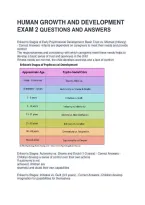
Erikson's Stages of Early Psychosocial Development: Basic Trust vs. Mistrust (Infancy)
- Correct Answers -Infants are dependent on caregivers to meet their needs and provide
comfort
The responsiveness and consistency with which caregivers meet these needs helps to
develop a basic sense of trust and openness in the child
If these needs are not met, the child develops wariness and a lack of comfort
Erikson's Stages: Autonomy vs. Shame and Doubt (1-3 years) - Correct Answers -
Children develop a sense of control over their own actions
If autonomy is not
achieved, children are
shameful and doubt their own capabilities
Erikson's Stages: Initiative vs. Guilt (3-5 years) - Correct Answers -Children develop
imagination for possibilities for themselves
,Play becomes purposeful and includes paying the roles of mother, father, teacher, or
athlete
With proper encouragement and balance, initiative and cooperation are developed
Erikson's Psychosocial Stages - Correct Answers -Review from Chapter 1- Name the
last five Erikson stages
1.
2.
3.
4.
5.
The Growth of Attachment - Correct Answers -Evolutionary Psychology
Views many human behaviors as successful adaptations to the environment
Security in the presence of another, along with need for physical closeness is
attachment
Bowlby noticed that children who form attachments to an adult are more likely to survive
Attachments are usually formed with the mother but may be any responsive and caring
person
,STEPS Toward Attachment - Correct Answers -1. Preattachment stage (Birth to 6-8
weeks)
2. Attachment in the making (6-8 weeks to 6-8 months)
3. True Attachment (6-8 months to 18 months)
4. Reciprocal Relationships (18 months on)
Father -Infant Relationships - Correct Answers -Attachment for fathers tends to follow
that with mothers
Fathers tend to spend more time playing with children than taking care of them
Fathers play with children differently
than mothers (more rough-and-tumble)
Children tend to seek out the father for a playmate. Mothers are preferred for comfort
Re-Cap
Follows attachment with mothers
Spend more time PLAYING
Rough-and- Tumble play
Children like to play with their fathers
Forms of Attachment: The Strange Situation Experiment - Correct Answers -Ainsworth
introduced children and mothers to a room from which the mother then left. Upon her
return, the nature of the child's reaction was studied
Four types of reactions were observed . . .
1. Secure Attachment - on the mother's return, the child is comforted, crying stops, and
the child begins to explore again
2. Avoidant Attachment - on the mother's return the child ignores or turns away
3. Resistant Attachment - the baby is upset and remains upset when mother returns and
is difficult to console
4. Disorganized Attachment - the child seems confused and is unsure of reaction
CONSEQUENCES of Attachment - Correct Answers -Important considerations:
How do children with secure attachments relate to peers?
Early attachments are prototypes for what later in life?
, What Determines
Quality of Attachment? - Correct Answers --Predictable and responsible parenting
promote secure attachment relationships
-Infants are frequently in childcare
Think about Good Parenting promotes secure attachment relationships because of
what? __________________
Infants develop this _____________.
Which is a __________.
Attachment, Work, & Alternate Caregiving - Correct Answers -NICHD research
suggested:
1. No relationship between quality of the daycare and mother-child attachment
2. No relationship between length of stays or changes in daycare and parent attachment
3. Quality of attachment was found to be more related to the sensitivity of the mother to
the child's needs and care
Functions of Emotions - Correct Answers -Why do people feel emotions?
Modern theories point at the functional value of emotions
Emotions are useful because they help people: (Fill in Blank)
adapt ________________
meet_________________
To _____________________
Basic emotions and their elements - Correct Answers -Joy, anger, and fear are
considered the 3 basic emotions
Basic emotions are experienced across the globe and consist of 3 basic elements:
1. A subjective feeling
2. A physiological change
3. An overt behavior
Measuring Emotions - Correct Answers -Facial expressions indicate emotional state
Infants all over the world express emotions similarly, suggesting biological programming
By 5-6 months, infants' facial expressions change in reaction to events