
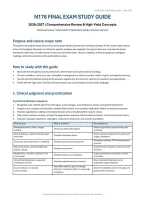
N176 FINAL EXAM STUDY GUIDE | 2026–2027
N176 FINAL EXAM STUDY GUIDE
2026–2027 | Comprehensive Review & High-Yield Concepts
Clinical priorities • Adult health • Medication safety • Practice self-test
Purpose and course-scope note
This guide is an original study resource for broad adult-health and practical-nursing concepts. N176 course codes vary by
school and program. Because no institution-specific syllabus was supplied, the topics below are a provisional review
framework rather than a verified match to your course's final exam. Use your syllabus, instructor guidance, assigned
readings, and local protocols as the authoritative scope.
How to study with this guide
• Start with the emergency-priority framework, then review each system and its red flags.
• For each condition, learn: key cues, immediate nursing actions, what to monitor, what to report, and patient teaching.
• Use the self-test without looking at the answers; explain why the incorrect options are unsafe or less appropriate.
• Finish with the high-yield checklist and revisit topics you cannot explain aloud in plain language.
1. Clinical judgment and prioritization
A practical decision sequence
1. Recognize cues: identify abnormal vital signs, acute changes, new symptoms, trends, and patient statements.
2. Analyze cues: compare with baseline, identify likely threats, and consider medication effects or recent procedures.
3. Prioritize hypotheses: address immediate threats to life and safety before routine needs.
4. Take action: assess promptly, activate the appropriate response, follow orders/protocols, and communicate clearly.
5. Evaluate: reassess symptoms, vital signs, response to treatment, and need for escalation.
Priority cue Why it matters Nursing focus
Airway obstruction, stridor, tongue Call for urgent help; support airway and
Airway can deteriorate rapidly
swelling breathing
Severe dyspnea, cyanosis, falling oxygen Rapid respiratory assessment, prescribed
Possible respiratory failure
saturation oxygen, escalation
Emergency pathway, ECG/monitoring per
Chest pain with diaphoresis or instability Possible acute coronary syndrome
protocol
New facial droop, unilateral weakness, Activate stroke response; note last-known-
Possible acute stroke
speech change well time
Hypotension, cool skin, confusion, low Urgent assessment, escalation, monitor
Possible shock or poor perfusion
urine output circulation
Uncontrolled bleeding or suspected Stop implicated transfusion when
Potential rapid blood loss or reaction
transfusion reaction suspected; urgent response
May reflect hypoxia, glucose change,
Acute confusion or reduced Assess immediately; check vital signs and
infection, medication effect, or neurologic
consciousness glucose when indicated
emergency
Original educational study resource • Confirm scope with your institution
, N176 FINAL EXAM STUDY GUIDE | 2026–2027
2. Cardiovascular and perfusion
Heart failure and fluid overload
• Common cues: increasing dyspnea, orthopnea, crackles, edema, rapid weight gain, reduced exercise tolerance, or
worsening oxygen needs.
• Nursing priorities: assess respiratory status and perfusion, trend daily weight and intake/output, administer prescribed
therapies, and escalate acute deterioration.
• Teaching: follow individualized sodium/fluid guidance, take medicines as prescribed, weigh daily under similar
conditions, and report rapid weight gain or worsening symptoms according to the care plan.
Acute coronary syndrome
• Concerning cues include pressure-like chest discomfort, radiation to arm/jaw/back, diaphoresis, nausea, dyspnea, or
atypical symptoms in older adults and people with diabetes.
• Priorities: urgent escalation, prompt ECG and monitoring per protocol, focused assessment, and avoiding exertion. Do
not delay emergency care for routine tasks.
• Nitroglycerin can interact dangerously with phosphodiesterase-5 inhibitors such as sildenafil; verify medication history
and follow emergency orders.
Dysrhythmia and medication safety
• Assess symptoms and hemodynamic stability, not just the monitor number. New chest pain, syncope, hypotension, or
altered consciousness requires urgent attention.
• Digoxin can slow heart rate; follow prescribed pulse/hold parameters and report concerning bradycardia or toxicity
symptoms.
• Diuretics may contribute to dehydration and electrolyte abnormalities. Monitor relevant labs, blood pressure,
intake/output, and symptoms.
3. Respiratory conditions
Problem High-yield cues Priority approach
Fever, cough, crackles, hypoxemia, new Assess oxygenation, support breathing,
Pneumonia
confusion monitor response, report deterioration
Use prescribed rescue treatment;
Wheeze, tightness, increased work of
Asthma exacerbation silent/very quiet chest with exhaustion is
breathing
an emergency
Assess promptly; titrate oxygen to
Increased dyspnea, sputum change,
COPD deterioration prescribed target and escalate altered
drowsiness, shallow breathing
mentation
Sudden dyspnea, pleuritic chest pain, Emergency escalation; do not massage a
Pulmonary embolism
tachycardia, hypoxemia painful swollen calf
Distress, inability to pass suction catheter, Call for urgent assistance and follow the
Airway/tracheostomy obstruction
poor air movement airway emergency protocol
• Oxygen is a treatment, not a reason to delay assessment. Follow the prescribed target and local protocol; COPD alone
is not a reason to withhold oxygen from a hypoxemic client.
• After surgery, follow prescribed pulmonary hygiene and mobility measures to support ventilation and reduce
atelectasis risk.
4. Diabetes and endocrine emergencies
Issue Recognition Core response
Original educational study resource • Confirm scope with your institution


