
1|Page
WGU C180 TEST – INTRO TO
PSYCHOLOGY QUESTIONS AND
ANSWERS | DETAILED RATIONALES |
2026/2027.
Introduction
WGU C180: Introduction to Psychology is a course focused on understanding human behavior,
mental processes, psychological development, and the scientific principles used to explain how
people think, feel, learn, and interact. This practice question bank is designed for students
preparing for introductory psychology assessments, particularly those studying through Western
Governors University (WGU).
Psychology is important because it provides a foundation for understanding cognition, emotion,
motivation, personality, social interaction, psychological disorders, and the biological processes
underlying behavior. Students benefit from learning not only key concepts but also how to apply
psychological theories to realistic situations.
This question bank contains challenging, scenario-based multiple-choice questions with four
answer options and detailed rationales. Each explanation identifies the best answer and clarifies
why the alternative options are less appropriate. The questions are intended to strengthen critical
thinking, improve recall, identify knowledge gaps, and develop the ability to apply psychological
concepts to unfamiliar situations.
For the best results, attempt each question before reading its explanation, record incorrect
answers, and revisit the relevant concepts. Consistent practice can improve exam readiness,
although no practice resource can guarantee a particular grade or passing result.
Content Area Overview
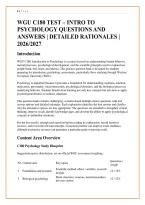
C180 Psychology Study Blueprint
Suggested practice distribution; not an official WGU assessment weighting.
Questions /
No. Content area Key topics
weight
Scientific method, ethics, variables, research
1 Foundations and research %
designs
Brain structures, neurons, neurotransmitters,
2 Biological psychology %
nervous system
,2|Page
Sensory thresholds, vision, hearing, perceptual
3 Sensation and perception %
processes
Classical conditioning, operant conditioning,
4 Learning and conditioning %
observational learning
Encoding, retrieval, forgetting, problem-
5 Memory and cognition %
solving, intelligence
Attachment, cognitive development, lifespan
6 Developmental psychology %
changes
7 Motivation and emotion Drive, incentives, stress, emotional theories %
Psychodynamic, humanistic, trait, social-
8 Personality %
cognitive theories
Psychological disorders and Diagnostic concepts, therapy approaches,
9 %
treatment treatment principles
Conformity, obedience, attribution, prejudice,
10 Social psychology %
group behavior
QUESTIONS 1–100
Content Area Overview — Questions 1–12
Foundations and Research Methods
Content area
Research methods
Key topics
Correlation, experiments, sampling, ethics, operational definitions, validity
Questions: 12
Suggested weight: 12%
Q1: A psychologist investigates whether sleep deprivation affects decision-making. Participants
are randomly assigned to either four hours of sleep or eight hours of sleep before completing the
same decision-making task. Which methodological feature most directly supports a causal
conclusion?
A) Participants complete the task in a quiet room.
B) Random assignment to different sleep conditions
C) The psychologist records participants' ages.
,3|Page
D) Participants are informed about the purpose of the research.
Rationale: B is correct because random assignment helps distribute preexisting differences across
the conditions, strengthening the inference that the manipulated sleep condition caused
differences in decision-making. A controls a testing environment but does not establish causality
by itself. C allows researchers to describe or statistically examine age but does not eliminate
confounding. D concerns informed participation and does not establish a causal relationship.
Q2: A researcher finds that students who spend more time studying tend to earn higher
examination scores. The correlation coefficient is +0.78. Which interpretation is most
appropriate?
A) Studying causes higher scores in every student.
B) The relationship is weak and negative.
C) Examination scores explain all differences in study time.
D) Study time and examination scores have a strong positive association.
Rationale: D is correct because a correlation of +0.78 indicates a relatively strong positive linear
relationship: greater study time tends to accompany higher scores. A incorrectly assumes
causation and universality. B misstates both the direction and strength. C incorrectly claims that
the correlation accounts for all variation; even a strong correlation leaves unexplained
differences.
Q3: A researcher wants to determine whether a brief mindfulness exercise reduces test anxiety.
Which design provides the strongest evidence of effectiveness?
A) Ask students who already practice mindfulness whether they feel less anxious.
B) Compare students' grades before and after an examination without measuring anxiety.
C) Randomly assign participants to mindfulness or a suitable control condition and measure
anxiety consistently.
D) Interview one student who reports benefiting from mindfulness.
Rationale: C is correct because random assignment, a comparison condition, and consistent
outcome measurement help isolate the intervention's effect. A is vulnerable to self-selection and
retrospective reporting. B measures grades rather than the stated outcome and lacks a control for
other changes. D provides an anecdote that cannot establish general effectiveness.
Q4: A psychologist defines aggression as the number of times a child hits, kicks, or pushes
another person during a 30-minute observation. What does this definition represent?
, 4|Page
A) A theoretical explanation of aggression
B) A confounding variable
C) A population parameter
D) An operational definition
Rationale: D is correct because an operational definition specifies how an abstract construct will
be measured. A explains a possible cause rather than specifying measurement. B is an
uncontrolled factor that could distort results. C describes a numerical characteristic of a
population.
Q5: A study reports that a new memory technique improves performance. However, only
volunteers who are highly motivated to improve their memory participated. What is the principal
concern when generalizing the findings?
A) Random assignment guarantees the findings cannot generalize.
B) Volunteer selection may produce a sample that differs from the wider population.
C) The dependent variable must be the same as the independent variable.
D) The study necessarily has no internal validity.
Rationale: B is correct because volunteers may differ systematically from nonvolunteers in
motivation, interest, or other characteristics. A confuses random assignment with representative
sampling. C confuses two different methodological roles. D is too strong: a study can have
reasonable internal validity while still having limited generalizability.
Q6: Participants are told that a study examines visual attention, but the researcher also secretly
records their private conversations outside the agreed research setting. Which ethical principle is
most clearly violated?
A) Randomization
B) Construct validity
C) Protection of privacy and confidentiality
D) Replication
Rationale: C is correct because collecting private conversations beyond the authorized research
scope violates privacy and may breach confidentiality. A concerns allocation to conditions. B
concerns whether measurements represent the intended construct. D concerns whether findings
can be reproduced.


