
1|P a g e
TEAS 7 EXAM PDF – ALL VERSIONS
COMBINED 2025 COMPLETE 180
QUESTION EXAM WITH VERIFIED
ANSWERS & DETAILED RATIONALES
This practice resource is designed for students preparing for the Test of Essential Academic
Skills (TEAS), Version 7, commonly used in nursing and allied health program admissions. It
covers four major academic areas: Reading, Mathematics, Science, and English and Language
Usage.
The questions emphasize application, interpretation, problem-solving, and critical thinking rather
than simple memorization. Reading questions focus on identifying central ideas, evaluating
evidence, and interpreting written information. Mathematics questions address numerical
operations, ratios, percentages, algebra, and data interpretation. Science questions assess human
anatomy and physiology, biology, chemistry, and scientific reasoning. English and Language
Usage questions focus on grammar, sentence structure, vocabulary, and effective written
communication.
Each question has four answer choices, one best answer, and a detailed rationale explaining why
the correct answer is appropriate and why the alternatives are less suitable. Students can use this
resource to identify knowledge gaps, practice under exam-like conditions, and develop a
structured revision plan before test day.
These are original practice questions, not official ATI exam questions or a verified collection of
questions from every TEAS 7 version. No practice resource can guarantee a particular score or
admission outcome.
Content Area Overview
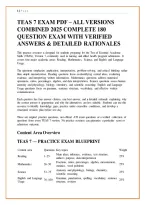
TEAS 7 — PRACTICE EXAM BLUEPRINT
Content area Questions Key topics Weight
Main ideas, inference, evidence, text structure,
Reading 1–25 25%
author's purpose, data interpretation
Fractions, ratios, percentages, algebra, measurement,
Mathematics 26–50 25%
statistics, word problems
Anatomy and physiology, biology, chemistry,
Science 51–75 25%
scientific reasoning
English and Language Grammar, punctuation, spelling, vocabulary, sentence
76–100 25%
Usage structure, revision
,2|P a g e
This is the distribution for this 100-question practice set, not the official TEAS 7 section
weighting. The official test contains four sections and uses its own question distribution.
QUESTIONS 1–100
Section 1: Reading (Questions 1–25)
Q1. A community clinic introduced evening appointments after discovering that many patients
missed daytime visits because of work. Six months later, missed appointments declined by 28%.
However, the clinic also began sending text reminders during the same period. Which conclusion
is best supported?
A) Evening appointments alone caused the entire decline.
B) The combined changes may have contributed to fewer missed appointments, but the effect of
each change cannot be isolated from the information given.
C) Text reminders were ineffective.
D) Patients no longer face scheduling barriers.
Rationale: B is correct because two interventions occurred during the same period, so the data do
not establish the independent effect of either one. A incorrectly attributes the entire change to
one intervention. C is unsupported because the reminders may have contributed. D makes a
broader claim than the evidence permits.
Q2. Read the passage: “Although electric buses cost more initially than diesel buses,
municipalities may recover part of the additional expense through lower fuel and maintenance
costs. The extent of the savings depends on electricity prices, charging infrastructure, and vehicle
use.” What is the central idea?
A) Electric buses are always cheaper than diesel buses.
B) Diesel buses require no maintenance.
C) The long-term financial advantage of electric buses depends on operating conditions despite
their higher initial cost.
D) Electricity prices have no influence on transportation budgets.
Rationale: C is correct because it captures both the higher upfront cost and the conditional
possibility of long-term savings. A overstates the claim. B is factually incorrect and irrelevant. D
directly contradicts the passage.
,3|P a g e
Q3. A researcher writes, “The survey included 40 volunteers recruited from a single university.
Therefore, its findings should not automatically be applied to all adults nationwide.” What
limitation is the researcher emphasizing?
A) The survey cannot contain numerical data.
B) The sample may not represent the wider population.
C) Volunteers always provide dishonest answers.
D) A university cannot conduct research.
Rationale: B is correct because a small, geographically and institutionally restricted volunteer
sample may introduce selection bias and limit generalizability. A confuses sample limitations
with data type. C is an unsupported absolute. D is plainly false.
Q4. A passage states that a city planted trees along several streets, after which summer sidewalk
temperatures decreased. The author notes that shade and local wind patterns varied between
streets. Which additional evidence would best strengthen the claim that the trees contributed to
lower temperatures?
A) Interviews showing that residents like trees.
B) A list of tree species planted in the city.
C) Repeated temperature measurements before and after planting on comparable streets,
including streets without new trees.
D) A photograph of a particularly shady street.
Rationale: C is correct because comparison streets and repeated measurements help distinguish
the effect of tree planting from weather and other environmental changes. A measures
preference, not temperature effects. B identifies species but does not establish causation. D
provides only anecdotal visual evidence.
Q5. A passage describes a student's initial frustration with a difficult laboratory course, followed
by improved study habits and growing confidence after seeking feedback. Which theme is best
supported?
A) Difficult courses should always be avoided.
B) Feedback makes independent learning unnecessary.
C) Persistence and constructive feedback can support learning and confidence.
D) Confidence must develop before effort begins.
, 4|P a g e
Rationale: C is correct because the student's progress follows changes in study habits and use of
feedback. A contradicts the positive outcome. B misrepresents feedback as a replacement for
learning. D reverses the sequence described.
Q6. A report states: “The committee postponed the proposal pending a comprehensive review of
its financial implications.” What does “pending” mean in this context?
A) Despite.
B) Immediately following.
C) Until a decision or event occurs.
D) In opposition to.
Rationale: C is correct because the proposal is postponed until the financial review is completed.
A expresses contrast, B indicates sequence, and D indicates opposition; none conveys the
conditional delay in the sentence.
Q7. A passage presents two studies on sleep. Study A finds an association between longer sleep
and improved memory. Study B finds that the association weakens after controlling for stress.
What is the most reasonable interpretation?
A) Study A proves sleep is the only cause of better memory.
B) Study B proves sleep has no relationship with memory.
C) Stress may explain part of the observed association, and further research may be needed to
clarify causal relationships.
D) The two studies cannot both be scientifically useful.
Rationale: C is correct because controlling for a possible confounder can change the observed
relationship without proving that the relationship is entirely absent. A confuses association with
causation. B overinterprets a weakened association. D falsely assumes that differing findings
eliminate the value of both studies.
Q8. A public notice states: “Water service will be interrupted from 9 a.m. to 1 p.m. on Tuesday
while crews replace a damaged valve. Residents should store sufficient water in advance.” What
is the primary purpose?
A) To criticize residents for wasting water.
B) To inform residents of a planned interruption and recommend preparation.
C) To advertise plumbing services.


