
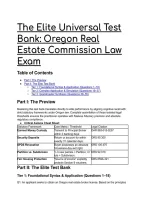
The Elite Universal Test
Bank: Oregon Real
Estate Commission Law
Exam
Table of Contents
● Part I: The Preview
● Part II: The Elite Test Bank
○ Tier 1: Foundational Syntax & Application (Questions 1–18)
○ Tier 2: Complex Application & Simulation (Questions 19–37)
○ Tier 3: Grandmaster Synthesis (Questions 38–55)
Part I: The Preview
Mastering this test bank translates directly to elite performance by aligning cognitive recall with
strict statutory frameworks under Oregon law. Complete assimilation of these isolated legal
thresholds ensures the practitioner operates with flawless fiduciary precision and absolute
regulatory compliance.
● Critical Axioms Cheat Sheet:
Statutory Framework Core Metric / Threshold Legal Citation
Earnest Money Custody Transmit to Principal Broker OAR 863-015-0257
within 3 banking days.
Security Deposits Return or account for within ORS 90.300
exactly 31 calendar days.
SPDS Revocation Buyer possesses an absolute ORS 105.475
5-business-day exit right.
Partition vs. Subdivision 1–3 new parcels = Partition; 4+ ORS 92.010
lots = Subdivision.
Fair Housing Protection "Source of income" explicitly ORS 659A.421
protects Section 8 vouchers.
Part II: The Elite Test Bank
Tier 1: Foundational Syntax & Application (Questions 1–18)
Q1: An applicant seeks to obtain an Oregon real estate broker license. Based on the principles
,of the Real Estate Agency licensing system, which action is the FIRST mandatory educational
requirement before passing the examination? A) Acquiring a bachelor's degree in real estate
finance B) Serving a one-year apprenticeship under a managing principal broker C) Completing
150 hours of required broker pre-license education D) Managing three personal rental
properties for a minimum of two years
● Answer: C (Completing 150 hours of required broker pre-license education)
● Distractor Analysis:
○ A is incorrect: A high school diploma or GED is the baseline, not a bachelor's
degree.
○ B is incorrect: Oregon does not require an apprenticeship period prior to licensing.
○ D is incorrect: Personal property management does not substitute for the statutory
education requirement.
The Mentor's Analysis: Licensure demands standardized, foundational knowledge. When facing
an initial license application, the immediate priority is verifying the statutory educational
threshold. By utilizing the 150-hour OREA-approved course requirement, you bypass the
common trap of assuming practical experience negates formal education. Professional Intuition:
Broker licensure unconditionally requires 150 hours of pre-license education, a high
school equivalent, and a 75% passing exam score.
Q2: A sole principal real estate broker must take an emergency leave of absence. Based on the
principles of ORS 696.022, which conclusion is the MOST APPROPRIATE regarding temporary
supervision? A) An unlicensed office manager may supervise for up to 30 days. B) Any
associated broker may supervise provided they have a valid active license. C) A broker with
three years of active experience may supervise for up to 90 days with written authorization. D)
The business must temporarily suspend all operations until the principal broker returns.
● Answer: C (A broker with three years of active experience may supervise for up to 90
days with written authorization.)
● Distractor Analysis:
○ A is incorrect: Unlicensed individuals can never supervise professional real estate
activity.
○ B is incorrect: Temporary supervision explicitly requires three years of active broker
experience.
○ D is incorrect: Suspension of operations is unnecessary if a qualified temporary
supervisor is authorized.
The Mentor's Analysis: Continuous supervision is the bedrock of brokerage legality. When
facing principal broker absence, the immediate priority is authorizing a statutorily qualified
licensee. By utilizing an experienced broker (3+ years) for a maximum of 90 days, you bypass
the common trap of operational paralysis or illegal oversight. Professional Intuition: Temporary
authorization demands three years of active experience, a 90-day maximum limit, and
OREA notification prior to the effective date.
Q3: A principal broker concludes a complex commercial transaction. Based on the principles of
Oregon recordkeeping rules, which action is the REQUIRED timeline for document retention? A)
Maintain the records for 3 years from the date the transaction was accepted, rejected, or
withdrawn. B) Maintain the records for 6 years from the date the transaction was accepted,
rejected, or withdrawn. C) Maintain the records for 7 years to align with IRS tax audit standards.
D) Purge the records immediately to protect client confidentiality.
● Answer: B (Maintain the records for 6 years from the date the transaction was accepted,
rejected, or withdrawn.)
● Distractor Analysis:
, ○ A is incorrect: Three years applies to continuing education (CE) records, not
transactional documents.
○ C is incorrect: IRS guidelines do not override the specific OREA 6-year statutory
mandate.
○ D is incorrect: Purging documents violates the fundamental mandate of regulatory
audit readiness.
The Mentor's Analysis: Records are the singular defense during an agency audit. When facing
closed or failed transactions, the immediate priority is secure, long-term archival. By utilizing the
6-year retention rule, you bypass the common trap of premature document destruction.
Professional Intuition: Transactional real estate documents must survive for six years;
continuing education records must survive for three.
Q4: A real estate broker receives an earnest money check from a buyer on a Tuesday. Based
on the principles of OAR 863-015-0257, which action is the MANDATORY deadline for
delivering these funds to the principal broker? A) Before the close of business on Tuesday B)
Within three banking days C) Within five banking days D) Only after the seller formally accepts
the offer
● Answer: B (Within three banking days)
● Distractor Analysis:
○ A is incorrect: While promptness is ideal, the statute allows three banking days.
○ C is incorrect: Five banking days applies strictly to non-earnest money funds
belonging to others.
○ D is incorrect: The delivery to the principal broker must occur regardless of offer
acceptance status.
The Mentor's Analysis: Chain of custody dictates fiduciary integrity. When facing the receipt of
trust assets, the immediate priority is transferring liability to the principal broker. By utilizing the
3-banking-day transmittal rule, you bypass the common trap of unintentional commingling.
Professional Intuition: Earnest money moves from broker to principal broker within 3
banking days; non-earnest money moves within 5 banking days.
Q5: A buyer and seller agree to place earnest money into an interest-bearing trust account.
Based on the principles of ORS 696.241, which conclusion is the ONLY legal way the principal
broker may retain the earned interest? A) The broker may retain it automatically as an
administrative processing fee. B) The broker may retain it if the funds remain in escrow for more
than 30 days. C) The broker may retain it only if expressly approved in writing by all parties who
have an interest in the funds before deposit. D) The broker may retain it if they split the earnings
50/50 with the Oregon Law Foundation.
● Answer: C (The broker may retain it only if expressly approved in writing by all parties
who have an interest in the funds before deposit.)
● Distractor Analysis:
○ A is incorrect: Interest belongs to the clients; auto-retention is illegal conversion.
○ B is incorrect: Escrow duration has no bearing on the legal ownership of interest
yields.
○ D is incorrect: OLF handles attorney IOLTA accounts, not real estate broker trust
accounts.
The Mentor's Analysis: Yield generated by client capital remains client capital. When facing
interest-bearing accounts, the immediate priority is establishing written consent. By utilizing
explicit, pre-deposit written approval, you bypass the common trap of unlawful retention of client
assets. Professional Intuition: A broker cannot harvest interest from a trust account unless
every interested party signs a written authorization before the deposit is made.
Bank: Oregon Real
Estate Commission Law
Exam
Table of Contents
● Part I: The Preview
● Part II: The Elite Test Bank
○ Tier 1: Foundational Syntax & Application (Questions 1–18)
○ Tier 2: Complex Application & Simulation (Questions 19–37)
○ Tier 3: Grandmaster Synthesis (Questions 38–55)
Part I: The Preview
Mastering this test bank translates directly to elite performance by aligning cognitive recall with
strict statutory frameworks under Oregon law. Complete assimilation of these isolated legal
thresholds ensures the practitioner operates with flawless fiduciary precision and absolute
regulatory compliance.
● Critical Axioms Cheat Sheet:
Statutory Framework Core Metric / Threshold Legal Citation
Earnest Money Custody Transmit to Principal Broker OAR 863-015-0257
within 3 banking days.
Security Deposits Return or account for within ORS 90.300
exactly 31 calendar days.
SPDS Revocation Buyer possesses an absolute ORS 105.475
5-business-day exit right.
Partition vs. Subdivision 1–3 new parcels = Partition; 4+ ORS 92.010
lots = Subdivision.
Fair Housing Protection "Source of income" explicitly ORS 659A.421
protects Section 8 vouchers.
Part II: The Elite Test Bank
Tier 1: Foundational Syntax & Application (Questions 1–18)
Q1: An applicant seeks to obtain an Oregon real estate broker license. Based on the principles
,of the Real Estate Agency licensing system, which action is the FIRST mandatory educational
requirement before passing the examination? A) Acquiring a bachelor's degree in real estate
finance B) Serving a one-year apprenticeship under a managing principal broker C) Completing
150 hours of required broker pre-license education D) Managing three personal rental
properties for a minimum of two years
● Answer: C (Completing 150 hours of required broker pre-license education)
● Distractor Analysis:
○ A is incorrect: A high school diploma or GED is the baseline, not a bachelor's
degree.
○ B is incorrect: Oregon does not require an apprenticeship period prior to licensing.
○ D is incorrect: Personal property management does not substitute for the statutory
education requirement.
The Mentor's Analysis: Licensure demands standardized, foundational knowledge. When facing
an initial license application, the immediate priority is verifying the statutory educational
threshold. By utilizing the 150-hour OREA-approved course requirement, you bypass the
common trap of assuming practical experience negates formal education. Professional Intuition:
Broker licensure unconditionally requires 150 hours of pre-license education, a high
school equivalent, and a 75% passing exam score.
Q2: A sole principal real estate broker must take an emergency leave of absence. Based on the
principles of ORS 696.022, which conclusion is the MOST APPROPRIATE regarding temporary
supervision? A) An unlicensed office manager may supervise for up to 30 days. B) Any
associated broker may supervise provided they have a valid active license. C) A broker with
three years of active experience may supervise for up to 90 days with written authorization. D)
The business must temporarily suspend all operations until the principal broker returns.
● Answer: C (A broker with three years of active experience may supervise for up to 90
days with written authorization.)
● Distractor Analysis:
○ A is incorrect: Unlicensed individuals can never supervise professional real estate
activity.
○ B is incorrect: Temporary supervision explicitly requires three years of active broker
experience.
○ D is incorrect: Suspension of operations is unnecessary if a qualified temporary
supervisor is authorized.
The Mentor's Analysis: Continuous supervision is the bedrock of brokerage legality. When
facing principal broker absence, the immediate priority is authorizing a statutorily qualified
licensee. By utilizing an experienced broker (3+ years) for a maximum of 90 days, you bypass
the common trap of operational paralysis or illegal oversight. Professional Intuition: Temporary
authorization demands three years of active experience, a 90-day maximum limit, and
OREA notification prior to the effective date.
Q3: A principal broker concludes a complex commercial transaction. Based on the principles of
Oregon recordkeeping rules, which action is the REQUIRED timeline for document retention? A)
Maintain the records for 3 years from the date the transaction was accepted, rejected, or
withdrawn. B) Maintain the records for 6 years from the date the transaction was accepted,
rejected, or withdrawn. C) Maintain the records for 7 years to align with IRS tax audit standards.
D) Purge the records immediately to protect client confidentiality.
● Answer: B (Maintain the records for 6 years from the date the transaction was accepted,
rejected, or withdrawn.)
● Distractor Analysis:
, ○ A is incorrect: Three years applies to continuing education (CE) records, not
transactional documents.
○ C is incorrect: IRS guidelines do not override the specific OREA 6-year statutory
mandate.
○ D is incorrect: Purging documents violates the fundamental mandate of regulatory
audit readiness.
The Mentor's Analysis: Records are the singular defense during an agency audit. When facing
closed or failed transactions, the immediate priority is secure, long-term archival. By utilizing the
6-year retention rule, you bypass the common trap of premature document destruction.
Professional Intuition: Transactional real estate documents must survive for six years;
continuing education records must survive for three.
Q4: A real estate broker receives an earnest money check from a buyer on a Tuesday. Based
on the principles of OAR 863-015-0257, which action is the MANDATORY deadline for
delivering these funds to the principal broker? A) Before the close of business on Tuesday B)
Within three banking days C) Within five banking days D) Only after the seller formally accepts
the offer
● Answer: B (Within three banking days)
● Distractor Analysis:
○ A is incorrect: While promptness is ideal, the statute allows three banking days.
○ C is incorrect: Five banking days applies strictly to non-earnest money funds
belonging to others.
○ D is incorrect: The delivery to the principal broker must occur regardless of offer
acceptance status.
The Mentor's Analysis: Chain of custody dictates fiduciary integrity. When facing the receipt of
trust assets, the immediate priority is transferring liability to the principal broker. By utilizing the
3-banking-day transmittal rule, you bypass the common trap of unintentional commingling.
Professional Intuition: Earnest money moves from broker to principal broker within 3
banking days; non-earnest money moves within 5 banking days.
Q5: A buyer and seller agree to place earnest money into an interest-bearing trust account.
Based on the principles of ORS 696.241, which conclusion is the ONLY legal way the principal
broker may retain the earned interest? A) The broker may retain it automatically as an
administrative processing fee. B) The broker may retain it if the funds remain in escrow for more
than 30 days. C) The broker may retain it only if expressly approved in writing by all parties who
have an interest in the funds before deposit. D) The broker may retain it if they split the earnings
50/50 with the Oregon Law Foundation.
● Answer: C (The broker may retain it only if expressly approved in writing by all parties
who have an interest in the funds before deposit.)
● Distractor Analysis:
○ A is incorrect: Interest belongs to the clients; auto-retention is illegal conversion.
○ B is incorrect: Escrow duration has no bearing on the legal ownership of interest
yields.
○ D is incorrect: OLF handles attorney IOLTA accounts, not real estate broker trust
accounts.
The Mentor's Analysis: Yield generated by client capital remains client capital. When facing
interest-bearing accounts, the immediate priority is establishing written consent. By utilizing
explicit, pre-deposit written approval, you bypass the common trap of unlawful retention of client
assets. Professional Intuition: A broker cannot harvest interest from a trust account unless
every interested party signs a written authorization before the deposit is made.


