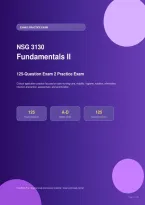
EXAM 2 PRACTICE EXAM
NSG 3130
Fundamentals II
125-Question Exam 2 Practice Exam
Clinical application practice focused on safe nursing care, mobility, hygiene, nutrition, elimination,
infection prevention, assessment, and prioritization.
125 A-D 125
Practice Questions Multiple Choice Explained Answers
PassPoint Pro • Original study and revision material • Clean print-ready format
Page 1 of 33
,PASSPOINT PRO | NSG 3130 - FUNDAMENTAL CONCEPTS & SKILLS FOR NURSING PRACTICE II
How to use this practice exam
This set contains 125 original multiple-choice questions for NSG 3130. Questions emphasize application, prioritization, safety,
and nursing judgment rather than simple memorization.
Answer format: answer and rationale immediately after each question. For best results, answer each item before reviewing the
rationale and keep a list of concepts that need focused review.
Scoring suggestion: 90%+ strong readiness; 80-89% targeted review; below 80% return to the study guide and repeat missed
concepts.
1. A client has dependent edema, crackles, weight gain, and jugular venous distention. Which interpretation or nursing
priority is most appropriate?
A. fluid volume excess
B. Document the findings as expected and reassess tomorrow
C. Promote vigorous ambulation before correcting the imbalance
D. Encourage unrestricted free-water intake without further assessment
Answer: A
Explanation: These findings reflect excess intravascular/interstitial fluid and pulmonary congestion. The safest response is the one that
addresses the client's immediate physiologic or safety need while staying within nursing scope and evidence-based practice. The other
options either delay the priority action, introduce avoidable risk, or do not directly correct the problem described.
2. A nurse is reviewing pharmacokinetics. A client with first-pass effect is most likely to have an alteration in which
process?
A. distribution
B. absorption
C. oral bioavailability
D. metabolism
Answer: C
Explanation: Drugs absorbed from the gastrointestinal tract may be metabolized in the liver before reaching systemic circulation. The
safest response is the one that addresses the client's immediate physiologic or safety need while staying within nursing scope and
evidence-based practice. The other options either delay the priority action, introduce avoidable risk, or do not directly correct the problem
described.
3. A medication dose seems unusually high. What should the nurse do?
A. Ask the client to decide whether the medication is correct
B. Hold the dose and independently verify the order and safe dose range
C. Skip identification if the nurse recognizes the client
D. Administer the medication because it is already on the MAR
Answer: B
Explanation: Questioning an unusual dose is a core medication-safety responsibility. The safest response is the one that addresses the
client's immediate physiologic or safety need while staying within nursing scope and evidence-based practice. The other options either
delay the priority action, introduce avoidable risk, or do not directly correct the problem described.
Original practice material for study and self-assessment Page 2
,PASSPOINT PRO | NSG 3130 - FUNDAMENTAL CONCEPTS & SKILLS FOR NURSING PRACTICE II
4. Which statement or intervention is correct for a client with new urinary retention?
A. Keep drainage tubing looped above the bladder
B. Expect a healthy stoma to be dry and pale
C. Assess bladder distention and post-void residual as ordered
D. Use routine antibiotics to prevent all catheter infections
Answer: C
Explanation: Objective assessment helps determine retention severity and guides intervention. The safest response is the one that
addresses the client's immediate physiologic or safety need while staying within nursing scope and evidence-based practice. The other
options either delay the priority action, introduce avoidable risk, or do not directly correct the problem described.
5. A nurse is reviewing pharmacokinetics. A client with severe liver disease is most likely to have an alteration in
which process?
A. excretion
B. distribution
C. metabolism
D. absorption
Answer: C
Explanation: The liver is the primary site for biotransformation of many drugs. The safest response is the one that addresses the client's
immediate physiologic or safety need while staying within nursing scope and evidence-based practice. The other options either delay the
priority action, introduce avoidable risk, or do not directly correct the problem described.
6. A client has dry mucous membranes, tachycardia, concentrated urine, and orthostatic hypotension. Which
interpretation or nursing priority is most appropriate?
A. Encourage unrestricted free-water intake without further assessment
B. Document the findings as expected and reassess tomorrow
C. fluid volume deficit
D. Promote vigorous ambulation before correcting the imbalance
Answer: C
Explanation: These findings indicate reduced circulating volume and dehydration. The safest response is the one that addresses the
client's immediate physiologic or safety need while staying within nursing scope and evidence-based practice. The other options either
delay the priority action, introduce avoidable risk, or do not directly correct the problem described.
7. A client with diabetes is shaky, diaphoretic, and confused before lunch. What is the nurse's priority action?
A. Reassess the client in 30 minutes
B. Check blood glucose immediately and treat hypoglycemia if confirmed
C. Ask the unlicensed assistive personnel to continue monitoring the client
D. Complete routine documentation before intervening
Answer: B
Explanation: The symptoms are classic for hypoglycemia and can deteriorate to seizure or coma. The safest response is the one that
addresses the client's immediate physiologic or safety need while staying within nursing scope and evidence-based practice. The other
options either delay the priority action, introduce avoidable risk, or do not directly correct the problem described.
Original practice material for study and self-assessment Page 3
, PASSPOINT PRO | NSG 3130 - FUNDAMENTAL CONCEPTS & SKILLS FOR NURSING PRACTICE II
8. Which nursing intervention is most appropriate for a client with dysphagia after stroke?
A. Use thin liquids for all clients with swallowing difficulty
B. sit upright at 90 degrees, use prescribed texture modifications, and monitor for coughing or a wet voice
C. Place the client flat during meals
D. Ignore food labels if the client avoids adding table salt
Answer: B
Explanation: Positioning and prescribed texture changes reduce aspiration risk. The safest response is the one that addresses the client's
immediate physiologic or safety need while staying within nursing scope and evidence-based practice. The other options either delay the
priority action, introduce avoidable risk, or do not directly correct the problem described.
9. The nurse observes IV pump alarm for occlusion. Which action is most appropriate?
A. Increase the infusion rate to overcome the problem
B. Silence the pump alarm and continue the infusion without assessment
C. Massage the IV site vigorously
D. Assess the tubing for kinks and the insertion site for complications before restarting
Answer: D
Explanation: The cause of an occlusion alarm should be identified before simply overriding the pump. The safest response is the one that
addresses the client's immediate physiologic or safety need while staying within nursing scope and evidence-based practice. The other
options either delay the priority action, introduce avoidable risk, or do not directly correct the problem described.
10. A client reports neuropathic burning pain in both feet. Which nursing action is best?
A. Withhold treatment until objective signs of pain appear
B. Ask a family member to choose the pain score
C. Delay reassessment until the next scheduled vital-sign check
D. Assess quality, location, triggers, function, and response to prior therapies
Answer: D
Explanation: A multidimensional assessment guides treatment of neuropathic pain. The safest response is the one that addresses the
client's immediate physiologic or safety need while staying within nursing scope and evidence-based practice. The other options either
delay the priority action, introduce avoidable risk, or do not directly correct the problem described.
11. Which statement or intervention is correct for a client with constipation from immobility?
A. Use routine antibiotics to prevent all catheter infections
B. Expect a healthy stoma to be dry and pale
C. Increase mobility, fluids, and fiber when not contraindicated
D. Keep drainage tubing looped above the bladder
Answer: C
Explanation: Activity, hydration, and fiber support normal bowel motility. The safest response is the one that addresses the client's
immediate physiologic or safety need while staying within nursing scope and evidence-based practice. The other options either delay the
priority action, introduce avoidable risk, or do not directly correct the problem described.
Original practice material for study and self-assessment Page 4
NSG 3130
Fundamentals II
125-Question Exam 2 Practice Exam
Clinical application practice focused on safe nursing care, mobility, hygiene, nutrition, elimination,
infection prevention, assessment, and prioritization.
125 A-D 125
Practice Questions Multiple Choice Explained Answers
PassPoint Pro • Original study and revision material • Clean print-ready format
Page 1 of 33
,PASSPOINT PRO | NSG 3130 - FUNDAMENTAL CONCEPTS & SKILLS FOR NURSING PRACTICE II
How to use this practice exam
This set contains 125 original multiple-choice questions for NSG 3130. Questions emphasize application, prioritization, safety,
and nursing judgment rather than simple memorization.
Answer format: answer and rationale immediately after each question. For best results, answer each item before reviewing the
rationale and keep a list of concepts that need focused review.
Scoring suggestion: 90%+ strong readiness; 80-89% targeted review; below 80% return to the study guide and repeat missed
concepts.
1. A client has dependent edema, crackles, weight gain, and jugular venous distention. Which interpretation or nursing
priority is most appropriate?
A. fluid volume excess
B. Document the findings as expected and reassess tomorrow
C. Promote vigorous ambulation before correcting the imbalance
D. Encourage unrestricted free-water intake without further assessment
Answer: A
Explanation: These findings reflect excess intravascular/interstitial fluid and pulmonary congestion. The safest response is the one that
addresses the client's immediate physiologic or safety need while staying within nursing scope and evidence-based practice. The other
options either delay the priority action, introduce avoidable risk, or do not directly correct the problem described.
2. A nurse is reviewing pharmacokinetics. A client with first-pass effect is most likely to have an alteration in which
process?
A. distribution
B. absorption
C. oral bioavailability
D. metabolism
Answer: C
Explanation: Drugs absorbed from the gastrointestinal tract may be metabolized in the liver before reaching systemic circulation. The
safest response is the one that addresses the client's immediate physiologic or safety need while staying within nursing scope and
evidence-based practice. The other options either delay the priority action, introduce avoidable risk, or do not directly correct the problem
described.
3. A medication dose seems unusually high. What should the nurse do?
A. Ask the client to decide whether the medication is correct
B. Hold the dose and independently verify the order and safe dose range
C. Skip identification if the nurse recognizes the client
D. Administer the medication because it is already on the MAR
Answer: B
Explanation: Questioning an unusual dose is a core medication-safety responsibility. The safest response is the one that addresses the
client's immediate physiologic or safety need while staying within nursing scope and evidence-based practice. The other options either
delay the priority action, introduce avoidable risk, or do not directly correct the problem described.
Original practice material for study and self-assessment Page 2
,PASSPOINT PRO | NSG 3130 - FUNDAMENTAL CONCEPTS & SKILLS FOR NURSING PRACTICE II
4. Which statement or intervention is correct for a client with new urinary retention?
A. Keep drainage tubing looped above the bladder
B. Expect a healthy stoma to be dry and pale
C. Assess bladder distention and post-void residual as ordered
D. Use routine antibiotics to prevent all catheter infections
Answer: C
Explanation: Objective assessment helps determine retention severity and guides intervention. The safest response is the one that
addresses the client's immediate physiologic or safety need while staying within nursing scope and evidence-based practice. The other
options either delay the priority action, introduce avoidable risk, or do not directly correct the problem described.
5. A nurse is reviewing pharmacokinetics. A client with severe liver disease is most likely to have an alteration in
which process?
A. excretion
B. distribution
C. metabolism
D. absorption
Answer: C
Explanation: The liver is the primary site for biotransformation of many drugs. The safest response is the one that addresses the client's
immediate physiologic or safety need while staying within nursing scope and evidence-based practice. The other options either delay the
priority action, introduce avoidable risk, or do not directly correct the problem described.
6. A client has dry mucous membranes, tachycardia, concentrated urine, and orthostatic hypotension. Which
interpretation or nursing priority is most appropriate?
A. Encourage unrestricted free-water intake without further assessment
B. Document the findings as expected and reassess tomorrow
C. fluid volume deficit
D. Promote vigorous ambulation before correcting the imbalance
Answer: C
Explanation: These findings indicate reduced circulating volume and dehydration. The safest response is the one that addresses the
client's immediate physiologic or safety need while staying within nursing scope and evidence-based practice. The other options either
delay the priority action, introduce avoidable risk, or do not directly correct the problem described.
7. A client with diabetes is shaky, diaphoretic, and confused before lunch. What is the nurse's priority action?
A. Reassess the client in 30 minutes
B. Check blood glucose immediately and treat hypoglycemia if confirmed
C. Ask the unlicensed assistive personnel to continue monitoring the client
D. Complete routine documentation before intervening
Answer: B
Explanation: The symptoms are classic for hypoglycemia and can deteriorate to seizure or coma. The safest response is the one that
addresses the client's immediate physiologic or safety need while staying within nursing scope and evidence-based practice. The other
options either delay the priority action, introduce avoidable risk, or do not directly correct the problem described.
Original practice material for study and self-assessment Page 3
, PASSPOINT PRO | NSG 3130 - FUNDAMENTAL CONCEPTS & SKILLS FOR NURSING PRACTICE II
8. Which nursing intervention is most appropriate for a client with dysphagia after stroke?
A. Use thin liquids for all clients with swallowing difficulty
B. sit upright at 90 degrees, use prescribed texture modifications, and monitor for coughing or a wet voice
C. Place the client flat during meals
D. Ignore food labels if the client avoids adding table salt
Answer: B
Explanation: Positioning and prescribed texture changes reduce aspiration risk. The safest response is the one that addresses the client's
immediate physiologic or safety need while staying within nursing scope and evidence-based practice. The other options either delay the
priority action, introduce avoidable risk, or do not directly correct the problem described.
9. The nurse observes IV pump alarm for occlusion. Which action is most appropriate?
A. Increase the infusion rate to overcome the problem
B. Silence the pump alarm and continue the infusion without assessment
C. Massage the IV site vigorously
D. Assess the tubing for kinks and the insertion site for complications before restarting
Answer: D
Explanation: The cause of an occlusion alarm should be identified before simply overriding the pump. The safest response is the one that
addresses the client's immediate physiologic or safety need while staying within nursing scope and evidence-based practice. The other
options either delay the priority action, introduce avoidable risk, or do not directly correct the problem described.
10. A client reports neuropathic burning pain in both feet. Which nursing action is best?
A. Withhold treatment until objective signs of pain appear
B. Ask a family member to choose the pain score
C. Delay reassessment until the next scheduled vital-sign check
D. Assess quality, location, triggers, function, and response to prior therapies
Answer: D
Explanation: A multidimensional assessment guides treatment of neuropathic pain. The safest response is the one that addresses the
client's immediate physiologic or safety need while staying within nursing scope and evidence-based practice. The other options either
delay the priority action, introduce avoidable risk, or do not directly correct the problem described.
11. Which statement or intervention is correct for a client with constipation from immobility?
A. Use routine antibiotics to prevent all catheter infections
B. Expect a healthy stoma to be dry and pale
C. Increase mobility, fluids, and fiber when not contraindicated
D. Keep drainage tubing looped above the bladder
Answer: C
Explanation: Activity, hydration, and fiber support normal bowel motility. The safest response is the one that addresses the client's
immediate physiologic or safety need while staying within nursing scope and evidence-based practice. The other options either delay the
priority action, introduce avoidable risk, or do not directly correct the problem described.
Original practice material for study and self-assessment Page 4