
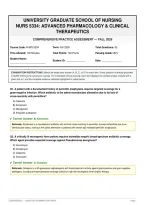
UNIVERSITY GRADUATE SCHOOL OF NURSING
NURS 5334: ADVANCED PHARMACOLOGY & CLINICAL
THERAPEUTICS
COMPREHENSIVE PRACTICE ASSESSMENT — FALL 2026
Course Code: NURS 5334 Term: Fall 2026 Total Questions: 50
Time Allowed: 100 Minutes Total Points: 100 Points Passing Grade: 80%
Student Name:
Student ID: _______________ Date: _______________
___________________________
EXAMINATION INSTRUCTIONS: Select the single best answer (A, B, C, or D) for each item. Every question is directly grounded
in NURS 5334 course curriculum sources. For immediate clinical learning, each item displays the verified answer marked with a
green tick (✔) and the complete evidence rationale highlighted in yellow below.
Q1. A patient with a documented history of penicillin anaphylaxis requires targeted coverage for a
gram-negative infection. Which antibiotic is the safest monobactam alternative due to its lack of
cross-reactivity with penicillins?
A) Cefazolin
B) Aztreonam
C) Meropenem
D) Ampicillin-sulbactam
✔ Correct Answer: B) Aztreonam
Rationale: Aztreonam is a monobactam antibiotic with minimal cross-reactivity to penicillins (except ceftazidime due to an
identical side chain), making it the safest alternative in patients with severe IgE-mediated penicillin anaphylaxis.
Q2. A critically ill neutropenic fever patient requires immediate empiric broad-spectrum antibiotic coverage.
Which agent provides essential coverage against Pseudomonas aeruginosa?
A) Vancomycin
B) Clindamycin
C) Cefepime
D) Amoxicillin
✔ Correct Answer: C) Cefepime
Rationale: Cefepime is a 4th-generation cephalosporin with broad-spectrum activity against gram-positive and gram-negative
pathogens, including anti-pseudomonal coverage critical for high-risk neutropenic fever empiric therapy.
CONFIDENTIAL — NURS 5334 EXAMINATION PAPER Page 1
,NURS 5334: ADVANCED PHARMACOLOGY & CLINICAL THERAPEUTICS — EXAM FALL 2026
Q3. What is the primary molecular mechanism conferring methicillin resistance in Methicillin-Resistant
Staphylococcus aureus (MRSA)?
A) Altered penicillin-binding proteins (PBP2a)
B) Plasmid-mediated beta-lactamase production
C) Efflux pump overactivity
D) Decreased outer membrane porin permeability
✔ Correct Answer: A) Altered penicillin-binding proteins (PBP2a)
Rationale: MRSA acquires the mecA gene, which encodes an altered penicillin-binding protein (PBP2a) with low binding affinity
for beta-lactam antibiotics, conferring resistance across penicillins and most cephalosporins.
Q4. Azole antifungals (e.g., fluconazole, voriconazole) exert their therapeutic antifungal activity primarily
through which cellular mechanism?
A) Direct binding and disruption of the fungal cell membrane
B) Competitive inhibition of squalene epoxidase
C) Non-competitive inhibition of glucan synthesis
D) Inhibition of ergosterol synthesis via 14α-demethylase block
✔ Correct Answer: D) Inhibition of ergosterol synthesis via 14α-demethylase block
Rationale: Azole antifungals selectively inhibit fungal lanosterol 14α-demethylase, a cytochrome P450 enzyme required to
convert lanosterol into ergosterol, impairing fungal cell membrane integrity.
Q5. A 40-year-old female presents with a severe urinary tract infection caused by Extended-Spectrum
Beta-Lactamase (ESBL)-producing Escherichia coli. Which antibiotic class is first-line?
A) Third-generation cephalosporins (Ceftriaxone)
B) Trimethoprim-sulfamethoxazole
C) Carbapenems (Meropenem)
D) Oral Nitrofurantoin
✔ Correct Answer: C) Carbapenems (Meropenem)
Rationale: Carbapenems (e.g., meropenem, ertapenem) remain the drug class of choice for serious infections caused by
ESBL-producing Enterobacteriaceae because ESBL enzymes hydrolyze penicillins, cephalosporins, and monobactams.
CONFIDENTIAL — NURS 5334 EXAMINATION PAPER Page 2
, NURS 5334: ADVANCED PHARMACOLOGY & CLINICAL THERAPEUTICS — EXAM FALL 2026
Q6. Which major black box warning is associated with systemic fluoroquinolone therapy (e.g., ciprofloxacin,
levofloxacin)?
A) Tendonitis and tendon rupture
B) Fulminant hepatic necrosis
C) Severe agranulocytosis
D) Nephrolithiasis and crystal nephropathy
✔ Correct Answer: A) Tendonitis and tendon rupture
Rationale: Fluoroquinolones carry FDA black box warnings for disabling and potentially irreversible serious adverse reactions,
including tendonitis and tendon rupture (Achilles tendon most common), peripheral neuropathy, and CNS effects.
Q7. Which antibiotic is most strongly linked to the disruption of normal intestinal flora and subsequent
Clostridioides difficile pseudomembranous colitis?
A) Metronidazole
B) Clindamycin
C) Vancomycin
D) Doxycycline
✔ Correct Answer: B) Clindamycin
Rationale: Clindamycin markedly alters gut microbiota, creating a favorable niche for Clostridioides difficile proliferation and toxin
production leading to pseudomembranous colitis.
Q8. Co-administration of linezolid with selective serotonin reuptake inhibitors (SSRIs) requires intense
monitoring due to the risk of which toxic interaction?
A) Severe QT interval prolongation
B) Nephrotoxicity and ototoxicity
C) Serotonin syndrome
D) Acute hepatic failure
✔ Correct Answer: C) Serotonin syndrome
Rationale: Linezolid is a non-selective, reversible monoamine oxidase inhibitor (MAOI). When combined with serotonergic
agents like SSRIs, it can cause accumulation of serotonin, resulting in life-threatening serotonin syndrome.
CONFIDENTIAL — NURS 5334 EXAMINATION PAPER Page 3
NURS 5334: ADVANCED PHARMACOLOGY & CLINICAL
THERAPEUTICS
COMPREHENSIVE PRACTICE ASSESSMENT — FALL 2026
Course Code: NURS 5334 Term: Fall 2026 Total Questions: 50
Time Allowed: 100 Minutes Total Points: 100 Points Passing Grade: 80%
Student Name:
Student ID: _______________ Date: _______________
___________________________
EXAMINATION INSTRUCTIONS: Select the single best answer (A, B, C, or D) for each item. Every question is directly grounded
in NURS 5334 course curriculum sources. For immediate clinical learning, each item displays the verified answer marked with a
green tick (✔) and the complete evidence rationale highlighted in yellow below.
Q1. A patient with a documented history of penicillin anaphylaxis requires targeted coverage for a
gram-negative infection. Which antibiotic is the safest monobactam alternative due to its lack of
cross-reactivity with penicillins?
A) Cefazolin
B) Aztreonam
C) Meropenem
D) Ampicillin-sulbactam
✔ Correct Answer: B) Aztreonam
Rationale: Aztreonam is a monobactam antibiotic with minimal cross-reactivity to penicillins (except ceftazidime due to an
identical side chain), making it the safest alternative in patients with severe IgE-mediated penicillin anaphylaxis.
Q2. A critically ill neutropenic fever patient requires immediate empiric broad-spectrum antibiotic coverage.
Which agent provides essential coverage against Pseudomonas aeruginosa?
A) Vancomycin
B) Clindamycin
C) Cefepime
D) Amoxicillin
✔ Correct Answer: C) Cefepime
Rationale: Cefepime is a 4th-generation cephalosporin with broad-spectrum activity against gram-positive and gram-negative
pathogens, including anti-pseudomonal coverage critical for high-risk neutropenic fever empiric therapy.
CONFIDENTIAL — NURS 5334 EXAMINATION PAPER Page 1
,NURS 5334: ADVANCED PHARMACOLOGY & CLINICAL THERAPEUTICS — EXAM FALL 2026
Q3. What is the primary molecular mechanism conferring methicillin resistance in Methicillin-Resistant
Staphylococcus aureus (MRSA)?
A) Altered penicillin-binding proteins (PBP2a)
B) Plasmid-mediated beta-lactamase production
C) Efflux pump overactivity
D) Decreased outer membrane porin permeability
✔ Correct Answer: A) Altered penicillin-binding proteins (PBP2a)
Rationale: MRSA acquires the mecA gene, which encodes an altered penicillin-binding protein (PBP2a) with low binding affinity
for beta-lactam antibiotics, conferring resistance across penicillins and most cephalosporins.
Q4. Azole antifungals (e.g., fluconazole, voriconazole) exert their therapeutic antifungal activity primarily
through which cellular mechanism?
A) Direct binding and disruption of the fungal cell membrane
B) Competitive inhibition of squalene epoxidase
C) Non-competitive inhibition of glucan synthesis
D) Inhibition of ergosterol synthesis via 14α-demethylase block
✔ Correct Answer: D) Inhibition of ergosterol synthesis via 14α-demethylase block
Rationale: Azole antifungals selectively inhibit fungal lanosterol 14α-demethylase, a cytochrome P450 enzyme required to
convert lanosterol into ergosterol, impairing fungal cell membrane integrity.
Q5. A 40-year-old female presents with a severe urinary tract infection caused by Extended-Spectrum
Beta-Lactamase (ESBL)-producing Escherichia coli. Which antibiotic class is first-line?
A) Third-generation cephalosporins (Ceftriaxone)
B) Trimethoprim-sulfamethoxazole
C) Carbapenems (Meropenem)
D) Oral Nitrofurantoin
✔ Correct Answer: C) Carbapenems (Meropenem)
Rationale: Carbapenems (e.g., meropenem, ertapenem) remain the drug class of choice for serious infections caused by
ESBL-producing Enterobacteriaceae because ESBL enzymes hydrolyze penicillins, cephalosporins, and monobactams.
CONFIDENTIAL — NURS 5334 EXAMINATION PAPER Page 2
, NURS 5334: ADVANCED PHARMACOLOGY & CLINICAL THERAPEUTICS — EXAM FALL 2026
Q6. Which major black box warning is associated with systemic fluoroquinolone therapy (e.g., ciprofloxacin,
levofloxacin)?
A) Tendonitis and tendon rupture
B) Fulminant hepatic necrosis
C) Severe agranulocytosis
D) Nephrolithiasis and crystal nephropathy
✔ Correct Answer: A) Tendonitis and tendon rupture
Rationale: Fluoroquinolones carry FDA black box warnings for disabling and potentially irreversible serious adverse reactions,
including tendonitis and tendon rupture (Achilles tendon most common), peripheral neuropathy, and CNS effects.
Q7. Which antibiotic is most strongly linked to the disruption of normal intestinal flora and subsequent
Clostridioides difficile pseudomembranous colitis?
A) Metronidazole
B) Clindamycin
C) Vancomycin
D) Doxycycline
✔ Correct Answer: B) Clindamycin
Rationale: Clindamycin markedly alters gut microbiota, creating a favorable niche for Clostridioides difficile proliferation and toxin
production leading to pseudomembranous colitis.
Q8. Co-administration of linezolid with selective serotonin reuptake inhibitors (SSRIs) requires intense
monitoring due to the risk of which toxic interaction?
A) Severe QT interval prolongation
B) Nephrotoxicity and ototoxicity
C) Serotonin syndrome
D) Acute hepatic failure
✔ Correct Answer: C) Serotonin syndrome
Rationale: Linezolid is a non-selective, reversible monoamine oxidase inhibitor (MAOI). When combined with serotonergic
agents like SSRIs, it can cause accumulation of serotonin, resulting in life-threatening serotonin syndrome.
CONFIDENTIAL — NURS 5334 EXAMINATION PAPER Page 3


