
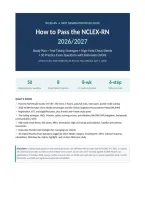
NCLEX-RN • NEXT GENERATION NCLEX (NGN)
How to Pass the NCLEX-RN
2026/2027
Study Plan + Test-Taking Strategies + High-Yield Cheat Sheets
+ 50 Practice Exam Questions with Rationales (NGN)
Written to the 2026 NCSBN NCLEX-RN Test Plan (effective April 1, 2026)
50 8 8-wk 6-step
Original practice questions Client Needs categories + 4-week study plans NGN case study
WHAT'S INSIDE
✓ How the NGN NCLEX works: CAT (85–150 items, 5 hours), pass/fail rules, item types, partial-credit scoring
✓ 2026 NCSBN test plan Client Needs percentages and the Clinical Judgment Measurement Model (NCJMM)
✓ Registration, ATT, and eligibility basics, plus 8-week and 4-week study plans
✓ Test-taking strategies: ABCs, Maslow, safety, nursing process, prioritization, RN/LPN/UAP delegation, therapeutic
communication, SATA
✓ High-yield cheat sheets: lab values, ABGs, electrolytes, high-alert drugs and antidotes, isolation precautions,
mnemonics
✓ Exam-day checklist and strategies for managing test anxiety
✓ 50 original Practice Exam questions tagged by Client Needs category, including MC, SATA, ordered response,
calculations, NGN bow-tie, matrix, highlight, and a 6-item NGN case study
Disclaimer: Original study guide for educational purposes; not affiliated with or endorsed by NCSBN, ATI, HESI, or Kaplan.
All content and practice questions were written from scratch. Exam facts were checked against NCSBN/NCLEX.com
publications in October 2026; always confirm current rules on NCLEX.com and with your nursing regulatory body. NCLEX,
NCLEX-RN, and NGN are registered trademarks of NCSBN.
, How to Pass the NCLEX-RN 2026/2027 | Study Guide + 50 Practice Exam Questions
Table of Contents
Parts, practice exam sections, and page locations
Contents Page
Part 1 How the NGN NCLEX-RN Works 3
Part 2 8-Week and 4-Week Study Plans 6
Part 3 Test-Taking Strategies 7
Part 4 High-Yield Cheat Sheets 10
Part 5 Exam Day and Managing Test Anxiety 13
Part 6 Practice Exam: 50 Questions with Rationales 15
Q1–7 Management of Care 15
Q8–14 Safety and Infection Prevention and Control 17
Q15–19 Health Promotion and Maintenance 20
Q20–24 Psychosocial Integrity 22
Q25–28 Basic Care and Comfort 24
Q29–36 Pharmacological and Parenteral Therapies 26
Q37–40 Reduction of Risk Potential 29
Q41–44 Physiological Adaptation 31
Q45–50 NGN Unfolding Case Study: Sepsis (6 Items) 33
Quick-Reference Answer Key and Score Tracker 36
How to Use This Guide
• Read Parts 1–3 first so you understand how the exam measures clinical judgment before you start drilling content.
• Use the Part 4 cheat sheets for daily active recall. Cover the right column and quiz yourself.
• Take the 50-question Practice Exam under timed conditions (about 1–1.5 minutes per standalone item). Commit to
an answer before you read the rationale.
• Every question is tagged with its 2026 Client Needs category. Use the score tracker on the last page to find weak
areas, then go back to the study plan.
Note: Original study guide for educational purposes; not affiliated with or endorsed by NCSBN, ATI, HESI, or Kaplan. Lab
reference ranges vary slightly by laboratory and textbook. Use your program's references on school exams. This guide
does not replace clinical judgment, facility protocols, or provider prescriptions.
Original study guide for educational purposes; not affiliated with or endorsed by NCSBN, ATI, HESI, or Kaplan. • Page 2
, How to Pass the NCLEX-RN 2026/2027 | Study Guide + 50 Practice Exam Questions
PART 1
How the NGN NCLEX-RN Works
Format, CAT, scoring, item types, and registration, verified against the 2026 NCSBN NCLEX-RN Test Plan
Exam at a Glance
Feature What you need to know (2026 NCLEX-RN)
Length Minimum 85, maximum 150 items. Exam length varies by candidate, so the number of items you
get does not tell you whether you passed.
Time limit 5 hours total, including all breaks (tutorial and optional breaks count toward the 5 hours).
Minimum-length exam 52 Client Needs items + 18 case study items (3 case studies × 6 items) + 15 unscored pretest
items = 85. You cannot tell which items are pretest items.
Clinical judgment Measured by 3 case studies (18 items) plus about 10% stand-alone NGN items (bow-tie and trend
items).
Delivery Computerized adaptive testing (CAT) at Pearson VUE Professional Centers. One item at a time;
you cannot go back after you click Next. Every item must be answered.
Tools provided On-screen calculator and an erasable note board with marker.
Test plan 2026 NCLEX-RN Test Plan, effective April 1, 2026 through March 31, 2029. The format and Client
Needs percentages match the 2023 plan; 'Safety and Infection Control' was renamed 'Safety and
Infection Prevention and Control.'
How Computerized Adaptive Testing (CAT) Decides Pass/Fail
After every response, the CAT algorithm re-estimates your ability and chooses the next item from the needed content
area at a difficulty you have about a 50% chance of answering correctly. Getting harder questions is normal. Most
candidates feel unsure through much of the exam.
Stopping rule How it works
1. 95% Confidence Interval Rule (most After the minimum of 85 items, the exam stops once the computer is 95% certain your
common) ability is clearly above or clearly below the passing standard.
2. Maximum-Length Exam If your ability stays close to the passing standard, you continue to 150 items. The final
ability estimate decides: at or above the standard = pass.
3. Run-Out-of-Time (R.O.O.T.) If time expires before you answer the minimum number of items, the result is a fail. If
you answered at least the minimum, the final ability estimate from all completed
items decides the result.
Strategy: Keep a steady pace (about 1–2 minutes per item). Running out of time is the only way your own pacing can
decide the outcome, so do not spend 10 minutes on one item.
2026 Client Needs Categories (NCSBN Test Plan)
Client Needs category / subcategory % of items High-yield examples
Safe and Effective Care Environment: Management of 15–21% Prioritization, delegation, assignment, consent, advance
Care directives, ethics, confidentiality, advocacy, case
management
Original study guide for educational purposes; not affiliated with or endorsed by NCSBN, ATI, HESI, or Kaplan. • Page 3
, How to Pass the NCLEX-RN 2026/2027 | Study Guide + 50 Practice Exam Questions
Client Needs category / subcategory % of items High-yield examples
Safe and Effective Care Environment: Safety and 10–16% Isolation precautions, falls, restraints, emergency response,
Infection Prevention and Control error prevention, handling hazardous materials
Health Promotion and Maintenance 6–12% Pregnancy and newborn care, growth and development,
screenings, immunizations, health teaching
Psychosocial Integrity 6–12% Therapeutic communication, crisis and suicide, abuse,
substance use and withdrawal, grief, mental health
disorders
Physiological Integrity: Basic Care and Comfort 6–12% Mobility, skin integrity, nutrition, elimination, sleep,
nonpharmacologic comfort
Physiological Integrity: Pharmacological and Parenteral 13–19% High-alert medications, adverse effects, dosage calculations,
Therapies IV therapy, blood products
Physiological Integrity: Reduction of Risk Potential 9–15% Lab values, diagnostic procedures, vital-sign trends,
preventing complications
Physiological Integrity: Physiological Adaptation 11–17% Acute and chronic illness, fluid and electrolyte imbalances,
emergencies, hemodynamics, medical emergencies
Integrated processes that appear across all categories: Nursing Process (Clinical Judgment), Caring, Communication and
Documentation, Teaching/Learning, and Culture and Spirituality.
The NCSBN Clinical Judgment Measurement Model (NCJMM)
Each 6-item case study tests the six steps in order. Learn the questions each step is really asking:
Step What it asks you to do Typical item wording
1. Recognize cues Identify relevant, important data (history, vital 'Which findings require immediate follow-up?'
signs, labs)
2. Analyze cues Connect cues to the client's condition 'The client is most likely experiencing ___ as
evidenced by ___.'
3. Prioritize hypotheses Rank problems by urgency, likelihood, and risk 'The client is at highest risk for ___.'
4. Generate solutions Identify expected outcomes and interventions 'Which prescriptions should the nurse
anticipate?'
5. Take action Carry out the highest-priority interventions 'Which action should the nurse take first?'
6. Evaluate outcomes Compare observed outcomes with expected 'Which findings indicate that treatment is
outcomes effective?'
NGN Item Types You Will See
Item type How it looks Scoring
Multiple choice (MC) One best answer from 4 options 0/1
Multiple response: Select All That Apply Choose every correct option from 5–10 choices Plus/minus (+/–)
(SATA)
Multiple response: Select N / Extended Choose a stated number of options, or select all from a longer list 0/1 (Select N) or +/–
multiple response
Matrix / grid A table: mark each row (e.g., indicated vs. contraindicated, or 0/1 per row, or +/–
effective vs. ineffective)
Drop-down (cloze, rationale, table) Choose a word or phrase from drop-down menus inside a 0/1 or rationale
sentence or table
Original study guide for educational purposes; not affiliated with or endorsed by NCSBN, ATI, HESI, or Kaplan. • Page 4


