
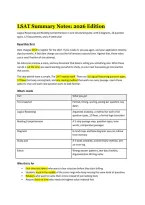
LSAT Summary Notes: 2026 Edition
Logical Reasoning and Reading Comprehension in one structured guide, with 6 diagrams, 16 question
types, 12 flaw patterns, and a 4-week plan
Read this first
LSAC charges $253 to register for the LSAT. If you retake it, you pay again, and your application timeline
slips by months. A late date change can cost the full amount a second time. Against that, these notes
cost a small fraction of one attempt.
No notes can promise a score, and any document that does is selling you something else. What these
can do is cut the time you spend working out what to study, so your next few weeks go into practice
that counts.
The idea behind them is simple. The LSAT repeats itself. There are 16 Logical Reasoning question types,
12 flaws that keep coming back, and one reading method that works on every passage. Learn those
patterns once and each new question starts to look familiar.
What's inside
Part What you get
Test snapshot Format, timing, scoring, pacing per question, key
dates
Logical Reasoning Argument anatomy, a method for each of 16
question types, 12 flaws, a formal logic translator
Reading Comprehension A 5-step passage map, question types, tone
words, comparative passages
Diagrams 6 mind maps and flow diagrams you can redraw
from memory
Study plan A 4-week schedule, a blind review method, and
an error log
Extras Wrong-answer patterns, test-day checklist,
Argumentative Writing notes
Who this is for
• First-time test takers who want a clear structure before they start drilling
• Students stuck in the middle of the score range who keep missing the same kinds of questions
• Retakers who want to name their errors instead of just redoing tests
• Anyone short on time who needs the highest-value material first
,Who this isn't for
If you want thousands of practice questions, this isn't a question bank, and you'll still need official
practice tests. If you want a guaranteed score jump, no honest document offers one.
Why smart people plateau
They read for content. The LSAT rewards reading for structure: what's the conclusion, what's the
evidence, and what's missing between them.
They treat every question as new. Most questions are one of a small set of types, and each type has a
standard approach.
They review wrong answers without naming the cause. "I missed it" isn't a diagnosis. "I confused a
necessary condition with a sufficient one" is, and you can fix that.
These notes are built around those three problems. Pattern first, then practice, then a named cause for
every miss.
Try it before you decide: one argument, four questions
Last year the town added streetlights to Maple Avenue. This year burglaries there fell
30%. Therefore, the streetlights deterred burglars.
Give yourself 60 seconds, then check the next page.
1. What does the argument assume?
2. What new fact would strengthen it?
3. What new fact would weaken it?
4. What flaw does it commit?
Answers
• Assumption: nothing else explains the drop, and burglars didn't simply move to other streets.
• Strengthen: burglaries fell only after dark, only on lit blocks, and stayed flat on blocks with no
new lights.
• Weaken: burglaries fell about 30% across the whole town, including streets that got no new
lights. Or the town also doubled police patrols on Maple Avenue.
• Flaw: it treats one event that followed another as the cause, and it ignores other explanations.
Notice what just happened. One argument produced four different question types, and all four came
from the same gap. Finding that gap is the central skill on this test, and section 2 teaches it step by step.
How to use these notes
1. Read sections 1 to 4 once. Plan about 90 minutes.
2. Practice one question family at a time. Do 10 timed questions, then review them blind (section 9
explains how).
3. Log every miss with a named cause, using the error log in section 9.
, Write down your plan now. People who commit in writing are more likely to follow through.
My target score My test date Study hours per week The question type I
miss most
1. Test Snapshot
Feature Details
Test window November 11 to 14, 2026. Registration closed
October 1, 2026.
Format Digital. Check LSAC for the delivery options
available on your date.
Sections Four 35-minute sections: two Logical Reasoning,
one Reading Comprehension, and one unscored
section that can be either type. You won't be told
which one is unscored.
Scored questions Roughly 75
Score scale 120 to 180. There is no penalty for wrong
answers, so answer everything.
Break 10 minutes, midway through
Argumentative Writing A separate online task, unscored but sent to law
schools. It opens November 3 for this test, and
first-time test takers must complete it before
their score is released.
Score release About three weeks after the test. LSAC publishes
the exact date.
Registration fee $253
Pacing per question
Section Time Average pace
Logical Reasoning 35 minutes, about 25 questions About 84 seconds per question
Reading Comprehension 35 minutes, 4 passages About 8 minutes 45 seconds per
passage, including its questions
Logical Reasoning and Reading Comprehension in one structured guide, with 6 diagrams, 16 question
types, 12 flaw patterns, and a 4-week plan
Read this first
LSAC charges $253 to register for the LSAT. If you retake it, you pay again, and your application timeline
slips by months. A late date change can cost the full amount a second time. Against that, these notes
cost a small fraction of one attempt.
No notes can promise a score, and any document that does is selling you something else. What these
can do is cut the time you spend working out what to study, so your next few weeks go into practice
that counts.
The idea behind them is simple. The LSAT repeats itself. There are 16 Logical Reasoning question types,
12 flaws that keep coming back, and one reading method that works on every passage. Learn those
patterns once and each new question starts to look familiar.
What's inside
Part What you get
Test snapshot Format, timing, scoring, pacing per question, key
dates
Logical Reasoning Argument anatomy, a method for each of 16
question types, 12 flaws, a formal logic translator
Reading Comprehension A 5-step passage map, question types, tone
words, comparative passages
Diagrams 6 mind maps and flow diagrams you can redraw
from memory
Study plan A 4-week schedule, a blind review method, and
an error log
Extras Wrong-answer patterns, test-day checklist,
Argumentative Writing notes
Who this is for
• First-time test takers who want a clear structure before they start drilling
• Students stuck in the middle of the score range who keep missing the same kinds of questions
• Retakers who want to name their errors instead of just redoing tests
• Anyone short on time who needs the highest-value material first
,Who this isn't for
If you want thousands of practice questions, this isn't a question bank, and you'll still need official
practice tests. If you want a guaranteed score jump, no honest document offers one.
Why smart people plateau
They read for content. The LSAT rewards reading for structure: what's the conclusion, what's the
evidence, and what's missing between them.
They treat every question as new. Most questions are one of a small set of types, and each type has a
standard approach.
They review wrong answers without naming the cause. "I missed it" isn't a diagnosis. "I confused a
necessary condition with a sufficient one" is, and you can fix that.
These notes are built around those three problems. Pattern first, then practice, then a named cause for
every miss.
Try it before you decide: one argument, four questions
Last year the town added streetlights to Maple Avenue. This year burglaries there fell
30%. Therefore, the streetlights deterred burglars.
Give yourself 60 seconds, then check the next page.
1. What does the argument assume?
2. What new fact would strengthen it?
3. What new fact would weaken it?
4. What flaw does it commit?
Answers
• Assumption: nothing else explains the drop, and burglars didn't simply move to other streets.
• Strengthen: burglaries fell only after dark, only on lit blocks, and stayed flat on blocks with no
new lights.
• Weaken: burglaries fell about 30% across the whole town, including streets that got no new
lights. Or the town also doubled police patrols on Maple Avenue.
• Flaw: it treats one event that followed another as the cause, and it ignores other explanations.
Notice what just happened. One argument produced four different question types, and all four came
from the same gap. Finding that gap is the central skill on this test, and section 2 teaches it step by step.
How to use these notes
1. Read sections 1 to 4 once. Plan about 90 minutes.
2. Practice one question family at a time. Do 10 timed questions, then review them blind (section 9
explains how).
3. Log every miss with a named cause, using the error log in section 9.
, Write down your plan now. People who commit in writing are more likely to follow through.
My target score My test date Study hours per week The question type I
miss most
1. Test Snapshot
Feature Details
Test window November 11 to 14, 2026. Registration closed
October 1, 2026.
Format Digital. Check LSAC for the delivery options
available on your date.
Sections Four 35-minute sections: two Logical Reasoning,
one Reading Comprehension, and one unscored
section that can be either type. You won't be told
which one is unscored.
Scored questions Roughly 75
Score scale 120 to 180. There is no penalty for wrong
answers, so answer everything.
Break 10 minutes, midway through
Argumentative Writing A separate online task, unscored but sent to law
schools. It opens November 3 for this test, and
first-time test takers must complete it before
their score is released.
Score release About three weeks after the test. LSAC publishes
the exact date.
Registration fee $253
Pacing per question
Section Time Average pace
Logical Reasoning 35 minutes, about 25 questions About 84 seconds per question
Reading Comprehension 35 minutes, 4 passages About 8 minutes 45 seconds per
passage, including its questions


