
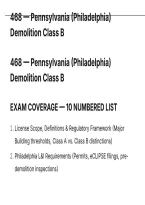
468 — Pennsylvania (Philadelphia)
Demolition Class B
468 — Pennsylvania (Philadelphia)
Demolition Class B
EXAM COVERAGE — 10 NUMBERED LIST
1. License Scope, Definitions & Regulatory Framework (Major
Building thresholds, Class A vs. Class B distinctions)
2. Philadelphia L&I Requirements (Permits, eCLIPSE filings, pre-
demolition inspections)
,3. Demolition Safety & OSHA Compliance (29 CFR 1926 Subpart T,
competent person, PPE)
4. Pre-Demolition Planning & Structural Assessment (Engineering
surveys, utility disconnection)
5. Environmental & Hazardous Material Management (Asbestos
NESHAP, lead, dust suppression)
6. Structural Considerations & Adjacent Property Protection (Party
walls, shoring, fall protection)
7. Tools, Equipment & Demolition Techniques (Mechanical,
manual, selective demolition)
8. Waste Management, Recycling & Post-Demolition (C&D debris,
disposal requirements)
, 9. Professional Practice, Insurance & Bonding (License bonds,
liability coverage, tax compliance)
10. Philadelphia Code & Administrative Provisions (Title 4,
notification requirements, renewals)
468 — Pennsylvania (Philadelphia)
Demolition Class B
200 MULTIPLE-CHOICE QUESTIONS WITH
ANSWERS AND RATIONALES
, 1. According to the Philadelphia Administrative Code, what
specific dimensional threshold classifies a structure as a "Major
Building" requiring Class A licensure?
A) More than 2 stories, 30 feet tall, or 5,000 square feet
B) More than 3 stories, 40 feet tall, or 10,000 square feet
C) More than 4 stories, 50 feet tall, or 15,000 square feet
D) More than 5 stories, 60 feet tall, or 20,000 square feet
Answer: B
Rationale: The Philadelphia Code defines a Major Building as any
structure exceeding 3 stories, 40 feet in height, OR 10,000 square
feet of lot space. Meeting any single threshold triggers the Major
Building classification 3 8 .
Demolition Class B
468 — Pennsylvania (Philadelphia)
Demolition Class B
EXAM COVERAGE — 10 NUMBERED LIST
1. License Scope, Definitions & Regulatory Framework (Major
Building thresholds, Class A vs. Class B distinctions)
2. Philadelphia L&I Requirements (Permits, eCLIPSE filings, pre-
demolition inspections)
,3. Demolition Safety & OSHA Compliance (29 CFR 1926 Subpart T,
competent person, PPE)
4. Pre-Demolition Planning & Structural Assessment (Engineering
surveys, utility disconnection)
5. Environmental & Hazardous Material Management (Asbestos
NESHAP, lead, dust suppression)
6. Structural Considerations & Adjacent Property Protection (Party
walls, shoring, fall protection)
7. Tools, Equipment & Demolition Techniques (Mechanical,
manual, selective demolition)
8. Waste Management, Recycling & Post-Demolition (C&D debris,
disposal requirements)
, 9. Professional Practice, Insurance & Bonding (License bonds,
liability coverage, tax compliance)
10. Philadelphia Code & Administrative Provisions (Title 4,
notification requirements, renewals)
468 — Pennsylvania (Philadelphia)
Demolition Class B
200 MULTIPLE-CHOICE QUESTIONS WITH
ANSWERS AND RATIONALES
, 1. According to the Philadelphia Administrative Code, what
specific dimensional threshold classifies a structure as a "Major
Building" requiring Class A licensure?
A) More than 2 stories, 30 feet tall, or 5,000 square feet
B) More than 3 stories, 40 feet tall, or 10,000 square feet
C) More than 4 stories, 50 feet tall, or 15,000 square feet
D) More than 5 stories, 60 feet tall, or 20,000 square feet
Answer: B
Rationale: The Philadelphia Code defines a Major Building as any
structure exceeding 3 stories, 40 feet in height, OR 10,000 square
feet of lot space. Meeting any single threshold triggers the Major
Building classification 3 8 .


