
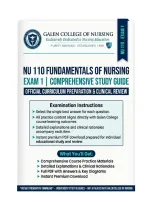
,NU 110 Exam 1 | Integrated Human Sciences
(2026/2027) PDF | Nursing | Galen College
1. Which of the following best describes the primary purpose of the nursing
process?
A) To ensure all patients receive identical care regardless of individual needs
B) To provide a systematic, problem-solving framework for delivering
individualized nursing care
C) To prioritize medical tasks over nursing interventions
D) To document patient outcomes after discharge
Correct Answer: To provide a systematic, problem-solving framework for
delivering individualized nursing care
Rationale: The nursing process (ADPIE) is a critical thinking method that guides
assessment, diagnosis, planning, implementation, and evaluation. It ensures
care is tailored to each patient's unique needs, not a one-size-fits-all approach,
and forms the foundation of clinical decision-making.
2. What is the primary function of the assessment phase in the nursing process?
A) To establish patient goals and expected outcomes
B) To systematically collect and analyze patient data
C) To implement nursing interventions based on evidence
D) To evaluate the effectiveness of nursing care
,Correct Answer: To systematically collect and analyze patient data
Rationale: The assessment phase is the first step of the nursing process,
involving the systematic collection of subjective and objective data through
history taking, physical examination, and diagnostic testing. This data forms the
foundation for identifying patient problems and planning care.
3. A nurse is caring for a patient who develops a fever and productive cough.
Before contacting the health care provider, what should the nurse do first?
A) Administer an antipyretic
B) Assess the patient's vital signs and oxygen saturation
C) Notify the charge nurse
D) Document the symptoms in the chart
Correct Answer: Assess the patient's vital signs and oxygen saturation
Rationale: A comprehensive assessment, including vital signs and oxygen
saturation, provides objective data needed to report the situation accurately.
The nurse must gather all relevant information before communicating with the
provider to support timely clinical decisions.
4. A nursing student asks the instructor to explain "objective data." The
instructor's best response is that objective data are
A) Information the patient shares about feelings and perceptions
B) The patient's description of pain and anxiety
, C) Observable and measurable findings collected through physical examination
and diagnostic tests
D) Family history provided by the patient
Correct Answer: Observable and measurable findings collected through physical
examination and diagnostic tests
Rationale: Objective data can be seen, felt, heard, or measured, such as vital
signs, lung sounds, and laboratory values. Subjective data are the patient's own
descriptions of symptoms, including pain, nausea, or anxiety, which are not
directly observable.
5. Which of the following nursing interventions requires an order from a health
care provider?
A) Repositioning a patient every 2 hours
B) Teaching deep breathing and coughing exercises
C) Providing oral care with a sponge toothette
D) Administering an intravenous antibiotic
Correct Answer: Administering an intravenous antibiotic
Rationale: Independent nursing interventions, such as repositioning, teaching,
and mouth care, do not require a provider's order. Dependent interventions,
like administering medications or initiating IV therapy, require a prescription
from a licensed provider.
(2026/2027) PDF | Nursing | Galen College
1. Which of the following best describes the primary purpose of the nursing
process?
A) To ensure all patients receive identical care regardless of individual needs
B) To provide a systematic, problem-solving framework for delivering
individualized nursing care
C) To prioritize medical tasks over nursing interventions
D) To document patient outcomes after discharge
Correct Answer: To provide a systematic, problem-solving framework for
delivering individualized nursing care
Rationale: The nursing process (ADPIE) is a critical thinking method that guides
assessment, diagnosis, planning, implementation, and evaluation. It ensures
care is tailored to each patient's unique needs, not a one-size-fits-all approach,
and forms the foundation of clinical decision-making.
2. What is the primary function of the assessment phase in the nursing process?
A) To establish patient goals and expected outcomes
B) To systematically collect and analyze patient data
C) To implement nursing interventions based on evidence
D) To evaluate the effectiveness of nursing care
,Correct Answer: To systematically collect and analyze patient data
Rationale: The assessment phase is the first step of the nursing process,
involving the systematic collection of subjective and objective data through
history taking, physical examination, and diagnostic testing. This data forms the
foundation for identifying patient problems and planning care.
3. A nurse is caring for a patient who develops a fever and productive cough.
Before contacting the health care provider, what should the nurse do first?
A) Administer an antipyretic
B) Assess the patient's vital signs and oxygen saturation
C) Notify the charge nurse
D) Document the symptoms in the chart
Correct Answer: Assess the patient's vital signs and oxygen saturation
Rationale: A comprehensive assessment, including vital signs and oxygen
saturation, provides objective data needed to report the situation accurately.
The nurse must gather all relevant information before communicating with the
provider to support timely clinical decisions.
4. A nursing student asks the instructor to explain "objective data." The
instructor's best response is that objective data are
A) Information the patient shares about feelings and perceptions
B) The patient's description of pain and anxiety
, C) Observable and measurable findings collected through physical examination
and diagnostic tests
D) Family history provided by the patient
Correct Answer: Observable and measurable findings collected through physical
examination and diagnostic tests
Rationale: Objective data can be seen, felt, heard, or measured, such as vital
signs, lung sounds, and laboratory values. Subjective data are the patient's own
descriptions of symptoms, including pain, nausea, or anxiety, which are not
directly observable.
5. Which of the following nursing interventions requires an order from a health
care provider?
A) Repositioning a patient every 2 hours
B) Teaching deep breathing and coughing exercises
C) Providing oral care with a sponge toothette
D) Administering an intravenous antibiotic
Correct Answer: Administering an intravenous antibiotic
Rationale: Independent nursing interventions, such as repositioning, teaching,
and mouth care, do not require a provider's order. Dependent interventions,
like administering medications or initiating IV therapy, require a prescription
from a licensed provider.


