
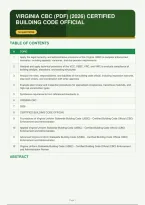
VIRGINIA CBC (PDF) (2026) CERTIFIED
BUILDING CODE OFFICIAL
50 QUESTIONS
TABLE OF CONTENTS
# TOPIC
1 Apply the legal hierarchy and administrative provisions of the Virginia USBC to complex enforcement
scenarios, including appeals, variances, and due process requirements
2 Interpret and apply technical provisions of the VCC, VEBC, VRC, and VMC to evaluate compliance of
building designs, alterations, and existing structures
3 Analyze the roles, responsibilities, and liabilities of the building code official, including inspection warrants,
stop work orders, and coordination with other agencies
4 Evaluate plan review and inspection procedures for specialized occupancies, hazardous materials, and
high-risk construction types
5 Synthesize requirements from referenced standards (e
6 VIRGINIA CBC
7 2026
8 CERTIFIED BUILDING CODE OFFICIAL
9 Foundations of Virginia Uniform Statewide Building Code (USBC) - Certified Building Code Official (CBO)
Enforcement and Administration
10 Applied Virginia Uniform Statewide Building Code (USBC) - Certified Building Code Official (CBO)
Enforcement and Administration
11 Advanced Virginia Uniform Statewide Building Code (USBC) - Certified Building Code Official (CBO)
Enforcement and Administration
12 Virginia Uniform Statewide Building Code (USBC) - Certified Building Code Official (CBO) Enforcement
and Administration Review
ABSTRACT
Page 1
,This study document brings together 50 carefully worded exam questions drawn from VIRGINIA
CBC (PDF) (2026) CERTIFIED BUILDING CODE OFFICIAL, with the strongest emphasis placed
on Apply the legal hierarchy and administrative provisions of the Virginia USBC to complex
enforcement scenarios, including appeals, variances, and due process requirements, Interpret and
apply technical provisions of the VCC, VEBC, VRC, and VMC to evaluate compliance of building
designs, alterations, and existing structures, Analyze the roles, responsibilities, and liabilities of the
building code official, including inspection warrants, stop work orders and and coordination with
other agencies. Every item follows the wording style and level of reasoning you meet in the real
paper, and each one is paired with a clear rationale so the correct choice is never a guess. Work
through the set at your own pace, mark the questions that slow you down, then come back to them
until the reasoning feels automatic. Learners who revise this way walk into the exam room
recognising the pattern behind the questions instead of meeting them for the first time. Keep going
- steady, honest practice is what turns a difficult paper into a comfortable pass.
Q1 APPLY THE LEGAL HIERARCHY AND ADMINISTRATIVE PROVISIONS OF THE VIRGINIA
USBC TO COMPLEX ENFORCEMENT SCENARIOS, INCLUDING APPEALS, VARIANCES, AND
DUE PROCESS REQUIREMENTS
A building code official (BCO) issues a written notice of violation to a property
owner for an unsafe structure. The owner requests a hearing before the local
board of appeals. Under the Virginia USBC, which of the following best describes
the BCO's authority pending the appeal?
A. The BCO must immediately rescind the notice until the appeal is resolved.
B. The BCO may continue to enforce the notice unless the appellant obtains a stay from the
board or a court. CORRECT
C. The BCO must suspend all enforcement actions and cannot take further action until the board
renders a decision.
D. The BCO must refer the matter directly to the circuit court for a de novo hearing.
RATIONALE: Under the Virginia USBC, filing an appeal does not automatically stay enforcement
unless the board or a court grants a stay. The BCO retains authority to enforce the notice to
protect public safety. Options A and C incorrectly imply automatic suspension, and D misstates
the appeal process.
Page 2
, Q2 APPLY THE LEGAL HIERARCHY AND ADMINISTRATIVE PROVISIONS OF THE VIRGINIA
USBC TO COMPLEX ENFORCEMENT SCENARIOS, INCLUDING APPEALS, VARIANCES, AND
DUE PROCESS REQUIREMENTS
During plan review of a proposed 6-story mixed-use building, the designer
proposes an atrium connecting three floors. Which section of the Virginia
Construction Code (VCC) primarily governs the smoke control requirements for
this atrium?
A. VCC Section 404 (Atriums)
B. VCC Section 707 (Shaft Enclosures)
C. VCC Section 909 (Smoke Control Systems) CORRECT
D. VCC Section 1009 (Means of Egress)
RATIONALE: VCC Section 909 specifically addresses smoke control systems, including those
required for atriums under Section 404. While Section 404 defines atrium requirements, the
technical smoke control provisions are in Section 909. Options B and D address different aspects
of egress and shaft enclosures.
Q3 APPLY THE LEGAL HIERARCHY AND ADMINISTRATIVE PROVISIONS OF THE VIRGINIA
USBC TO COMPLEX ENFORCEMENT SCENARIOS, INCLUDING APPEALS, VARIANCES, AND
DUE PROCESS REQUIREMENTS
A BCO is reviewing a permit application for the alteration of a historic building.
The applicant proposes to use the Virginia Rehabilitation Code (VRC) instead of
the VCC. Which of the following conditions must be met for the VRC to apply?
A. The building must be listed on the Virginia Landmarks Register or eligible for such listing.
CORRECT
B. The building must be at least 50 years old and located in a historic district.
C. The applicant must obtain a certificate of appropriateness from the local historic review board.
D. The building must be structurally unsafe and beyond repair under the VCC.
RATIONALE: The VRC applies to buildings that are individually listed or contributing to a district
listed on the Virginia Landmarks Register or the National Register of Historic Places. Age alone
(B) or local design review (C) does not trigger VRC applicability. Option D is incorrect because
the VRC is for rehabilitation, not just unsafe structures.
Page 3


