
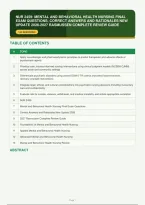
NUR 2459: MENTAL AND BEHAVIORAL HEALTH NURSING FINAL
EXAM QUESTIONS, CORRECT ANSWERS AND RATIONALES NEW
UPDATE 2026-2027 RASMUSSEN COMPLETE REVIEW GUIDE
144 QUESTIONS
TABLE OF CONTENTS
# TOPIC
1 Apply neurobiologic and pharmacodynamic principles to predict therapeutic and adverse effects of
psychotropic agents
2 Prioritize safe, trauma-informed nursing interventions using clinical judgment models (NCSBN CJMM)
across acute and community settings
3 Differentiate psychiatric disorders using current DSM-5-TR criteria and select least-restrictive,
recovery-oriented interventions
4 Integrate legal, ethical, and cultural considerations into psychiatric nursing decisions including involuntary
care and confidentiality
5 Evaluate risk for suicide, violence, withdrawal, and medical instability and initiate appropriate escalation
6 NUR 2459
7 Mental and Behavioral Health Nursing Final Exam Questions
8 Correct Answers and Rationales New Update 2026
9 2027 Rasmussen Complete Review Guide
10 Foundations of Mental and Behavioral Health Nursing
11 Applied Mental and Behavioral Health Nursing
12 Advanced Mental and Behavioral Health Nursing
13 Mental and Behavioral Health Nursing Review
ABSTRACT
Page 1
,This study document brings together 144 carefully worded exam questions drawn from NUR 2459:
Mental and Behavioral Health Nursing Final Exam Questions, Correct Answers and Rationales
New Update 2026-2027 Rasmussen Complete Review Guide, with the strongest emphasis placed
on Apply neurobiologic and pharmacodynamic principles to predict therapeutic and adverse effects
of psychotropic agents, Prioritize safe, trauma-informed nursing interventions using clinical
judgment models (NCSBN CJMM) across acute and community settings, Differentiate psychiatric
disorders using current DSM-5-TR criteria and select least-restrictive and recovery-oriented
interventions. Every item follows the wording style and level of reasoning you meet in the real
paper, and each one is paired with a clear rationale so the correct choice is never a guess. Work
through the set at your own pace, mark the questions that slow you down, then come back to them
until the reasoning feels automatic. Learners who revise this way walk into the exam room
recognising the pattern behind the questions instead of meeting them for the first time. Keep going
- steady, honest practice is what turns a difficult paper into a comfortable pass.
Q1 APPLY NEUROBIOLOGIC AND PHARMACODYNAMIC PRINCIPLES TO PREDICT
THERAPEUTIC AND ADVERSE EFFECTS OF PSYCHOTROPIC AGENTS
A patient started on clozapine 6 weeks ago presents with fever, tachycardia, and a
diffuse erythematous rash. Which laboratory finding would most strongly confirm
the priority life-threatening complication?
A. Absolute neutrophil count 0.4 × 10^9/L CORRECT
B. Serum clozapine level 350 ng/mL
C. Creatine kinase 900 U/L
D. Eosinophil count 0.6 × 10^9/L
RATIONALE: Fever, tachycardia, and rash after clozapine initiation suggest severe
neutropenia/agranulocytosis, confirmed by ANC <0.5 × 10^9/L; clozapine must be held
immediately. Elevated clozapine level is not the defining criterion, CK elevation suggests NMS,
and eosinophilia is nonspecific.
Page 2
,Q2 APPLY NEUROBIOLOGIC AND PHARMACODYNAMIC PRINCIPLES TO PREDICT
THERAPEUTIC AND ADVERSE EFFECTS OF PSYCHOTROPIC AGENTS
Which nursing action best reflects trauma-informed care when a patient with PTSD
becomes hyperaroused during a routine assessment?
A. Continue the assessment to maintain structure and consistency.
B. Offer the patient control over pacing and seating, and validate their response. CORRECT
C. Move the patient to a quiet room and complete the assessment there.
D. Administer a PRN benzodiazepine before resuming the interview.
RATIONALE: Trauma-informed care prioritizes safety, choice, collaboration, and empowerment;
offering control and validation prevents retraumatization. Forcing completion, relocating without
consent, or sedating first undermines autonomy and can escalate distress.
Q3 APPLY NEUROBIOLOGIC AND PHARMACODYNAMIC PRINCIPLES TO PREDICT
THERAPEUTIC AND ADVERSE EFFECTS OF PSYCHOTROPIC AGENTS
A patient on lithium carbonate reports 3 days of vomiting and diarrhea. Which
finding requires the most immediate intervention?
A. Lithium level 1.4 mEq/L with coarse hand tremor
B. Lithium level 0.9 mEq/L with mild thirst
C. Lithium level 1.1 mEq/L with fine tremor
D. Lithium level 1.6 mEq/L with ataxia and confusion CORRECT
RATIONALE: Level >1.5 mEq/L with neurologic signs (ataxia, confusion) indicates
moderate-to-severe lithium toxicity requiring urgent intervention, often hemodialysis. The other
values are within or near therapeutic range (0.6-1.2 mEq/L) with expected or mild effects.
Page 3
, Q4 APPLY NEUROBIOLOGIC AND PHARMACODYNAMIC PRINCIPLES TO PREDICT
THERAPEUTIC AND ADVERSE EFFECTS OF PSYCHOTROPIC AGENTS
Which statement by a patient taking fluoxetine for major depressive disorder
indicates the most urgent need for follow-up?
A. "I've had a dry mouth since starting this medication."
B. "I feel more energized and I've been thinking about ways to end my life." CORRECT
C. "I take it every morning with breakfast."
D. "My sleep is improving and I feel less sad."
RATIONALE: Emerging energy with persistent suicidal ideation signals activation and elevated
suicide risk, a well-documented early SSRI phenomenon requiring immediate safety assessment.
Dry mouth is expected, morning dosing is correct, and improved mood/sleep are therapeutic.
Q5 APPLY NEUROBIOLOGIC AND PHARMACODYNAMIC PRINCIPLES TO PREDICT
THERAPEUTIC AND ADVERSE EFFECTS OF PSYCHOTROPIC AGENTS
A patient with anorexia nervosa restricting type has a BMI of 13.2 and refuses to
eat. Which nursing action best reflects current evidence-based refeeding
protocol?
A. Allow the patient to choose all foods to promote autonomy.
B. Initiate a low-calorie, slow-advancement feeding plan with electrolyte monitoring for refeeding
syndrome. CORRECT
C. Implement immediate high-calorie total parenteral nutrition.
D. Withhold all nutrition until the patient accepts treatment.
RATIONALE: Severe malnutrition requires cautious, gradual caloric advancement with close
monitoring of phosphate, potassium, and magnesium to prevent refeeding syndrome.
Unrestricted choice or immediate high-calorie/TPN increases risk; withholding nutrition violates
ethical and medical care.
Page 4


