
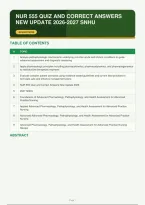
NUR 555 QUIZ AND CORRECT ANSWERS
NEW UPDATE 2026-2027 SNHU
48 QUESTIONS
TABLE OF CONTENTS
# TOPIC
1 Analyze pathophysiologic mechanisms underlying common acute and chronic conditions to guide
advanced assessment and diagnostic reasoning
2 Apply pharmacologic principles including pharmacokinetics, pharmacodynamics, and pharmacogenomics
to individualize therapeutic regimens
3 Evaluate complex patient scenarios using evidence-based guidelines and current best practices to
formulate safe and effective management plans
4 NUR 555 Quiz and Correct Answers New Update 2026
5 2027 SNHU
6 Foundations of Advanced Pharmacology, Pathophysiology, and Health Assessment for Advanced
Practice Nursing
7 Applied Advanced Pharmacology, Pathophysiology, and Health Assessment for Advanced Practice
Nursing
8 Advanced Advanced Pharmacology, Pathophysiology, and Health Assessment for Advanced Practice
Nursing
9 Advanced Pharmacology, Pathophysiology, and Health Assessment for Advanced Practice Nursing
Review
ABSTRACT
Page 1
,This study document brings together 48 carefully worded exam questions drawn from NUR 555
Quiz and Correct Answers New Update 2026-2027 SNHU, with the strongest emphasis placed on
Analyze pathophysiologic mechanisms underlying common acute and chronic conditions to guide
advanced assessment and diagnostic reasoning, Apply pharmacologic principles including
pharmacokinetics, pharmacodynamics, and pharmacogenomics to individualize therapeutic
regimens and Evaluate complex patient scenarios using evidence-based guidelines and current
best practices to formulate safe and effective management plans. Every item follows the wording
style and level of reasoning you meet in the real paper, and each one is paired with a clear
rationale so the correct choice is never a guess. Work through the set at your own pace, mark the
questions that slow you down, then come back to them until the reasoning feels automatic.
Learners who revise this way walk into the exam room recognising the pattern behind the
questions instead of meeting them for the first time. Keep going - steady, honest practice is what
turns a difficult paper into a comfortable pass.
Q1 ANALYZE PATHOPHYSIOLOGIC MECHANISMS UNDERLYING COMMON ACUTE AND
CHRONIC CONDITIONS TO GUIDE ADVANCED ASSESSMENT AND DIAGNOSTIC REASONING
A patient with heart failure and reduced ejection fraction is initiated on
sacubitril/valsartan. Which pharmacodynamic mechanism best explains the
combined therapeutic effect?
A. Inhibition of neprilysin increases natriuretic peptides, while valsartan blocks angiotensin II AT1
receptors. CORRECT
B. Sacubitril inhibits angiotensin-converting enzyme, and valsartan blocks aldosterone receptors.
C. Sacubitril enhances bradykinin degradation, and valsartan inhibits renin release.
D. Sacubitril blocks beta-adrenergic receptors, and valsartan dilates venous capacitance
vessels.
RATIONALE: Sacubitril inhibits neprilysin, increasing natriuretic peptides that promote
vasodilation and natriuresis. Valsartan blocks AT1 receptors, reducing vasoconstriction and
aldosterone effects. The other options misstate mechanisms: ACE inhibition is not sacubitril's
action, bradykinin is not degraded by neprilysin inhibition, and beta-blockade is unrelated.
Page 2
, Q2 ANALYZE PATHOPHYSIOLOGIC MECHANISMS UNDERLYING COMMON ACUTE AND
CHRONIC CONDITIONS TO GUIDE ADVANCED ASSESSMENT AND DIAGNOSTIC REASONING
A patient presents with sudden-onset severe abdominal pain, hypotension, and a
pulsatile abdominal mass. Which pathophysiologic process is most likely
responsible for these findings?
A. Acute mesenteric ischemia due to arterial embolism
B. Ruptured abdominal aortic aneurysm with retroperitoneal hemorrhage CORRECT
C. Perforated peptic ulcer with chemical peritonitis
D. Acute pancreatitis with systemic inflammatory response
RATIONALE: The triad of severe abdominal pain, hypotension, and a pulsatile mass is classic for
a ruptured abdominal aortic aneurysm, leading to retroperitoneal bleeding and hypovolemic
shock. Mesenteric ischemia typically presents with pain out of proportion to exam but without a
pulsatile mass. Perforated ulcer causes board-like rigidity, and pancreatitis usually has epigastric
pain radiating to the back with elevated lipase.
Q3 ANALYZE PATHOPHYSIOLOGIC MECHANISMS UNDERLYING COMMON ACUTE AND
CHRONIC CONDITIONS TO GUIDE ADVANCED ASSESSMENT AND DIAGNOSTIC REASONING
A patient with major depressive disorder has not responded to adequate trials of
two SSRIs. Which class of antidepressants is most appropriate to consider next
based on current evidence?
A. Tricyclic antidepressants (TCAs)
B. Monoamine oxidase inhibitors (MAOIs)
C. Serotonin-norepinephrine reuptake inhibitors (SNRIs) CORRECT
D. Atypical antipsychotics as monotherapy
RATIONALE: SNRIs are often considered next-line after SSRI failure due to their dual
mechanism and favorable evidence for treatment-resistant depression. TCAs and MAOIs are
older classes with more adverse effects and dietary restrictions, typically reserved for later.
Atypical antipsychotics are usually adjunctive, not monotherapy, for depression.
Page 3


