
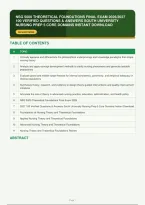
NSG 5000 THEORETICAL FOUNDATIONS FINAL EXAM 2026/2027
100 VERIFIED QUESTIONS & ANSWERS SOUTH UNIVERSITY
NURSING PREP 5 CORE DOMAINS INSTANT DOWNLOAD
98 QUESTIONS
TABLE OF CONTENTS
# TOPIC
1 Critically appraise and differentiate the philosophical underpinnings and knowledge paradigms that shape
nursing theory
2 Analyze and apply concept development methods to clarify nursing phenomena and generate testable
propositions
3 Evaluate grand and middle-range theories for internal consistency, parsimony, and empirical adequacy in
diverse populations
4 Synthesize theory, research, and evidence to design theory-guided interventions and quality improvement
initiatives
5 Articulate the role of theory in advanced nursing practice, education, administration, and health policy
6 NSG 5000 Theoretical Foundations Final Exam 2026
7 2027 100 Verified Questions & Answers South University Nursing Prep 5 Core Domains Instant Download
8 Foundations of Nursing Theory and Theoretical Foundations
9 Applied Nursing Theory and Theoretical Foundations
10 Advanced Nursing Theory and Theoretical Foundations
11 Nursing Theory and Theoretical Foundations Review
ABSTRACT
Page 1
,This study document brings together 98 carefully worded exam questions drawn from NSG 5000
Theoretical Foundations Final Exam 2026/2027 100 Verified Questions & Answers South
University Nursing Prep 5 Core Domains Instant Download, with the strongest emphasis placed on
Critically appraise and differentiate the philosophical underpinnings and knowledge paradigms that
shape nursing theory, Analyze and apply concept development methods to clarify nursing
phenomena and generate testable propositions, Evaluate grand and middle-range theories for
internal consistency, parsimony and and empirical adequacy in diverse populations. Every item
follows the wording style and level of reasoning you meet in the real paper, and each one is paired
with a clear rationale so the correct choice is never a guess. Work through the set at your own
pace, mark the questions that slow you down, then come back to them until the reasoning feels
automatic. Learners who revise this way walk into the exam room recognising the pattern behind
the questions instead of meeting them for the first time. Keep going - steady, honest practice is
what turns a difficult paper into a comfortable pass.
Q1 CRITICALLY APPRAISE AND DIFFERENTIATE THE PHILOSOPHICAL UNDERPINNINGS
AND KNOWLEDGE PARADIGMS THAT SHAPE NURSING THEORY
A nurse scholar is comparing the epistemological foundations of two nursing
theories: one grounded in critical social theory and another in postpositivism.
Which statement best captures the fundamental difference in how each theory
would approach the generation of nursing knowledge?
A. The critical social theory approach seeks universal, context-free laws, while the postpositivist
approach emphasizes emancipatory knowledge.
B. The critical social theory approach values subjective, situated knowledge and power analysis,
while the postpositivist approach seeks objective, generalizable truths through empirical
verification. CORRECT
C. Both approaches reject the notion of a single reality and prioritize participant co-construction
of meaning.
D. The postpositivist approach is primarily concerned with historical power imbalances, whereas
critical social theory focuses on falsifiable hypotheses.
RATIONALE: Critical social theory is rooted in emancipatory knowledge, power dynamics, and
situated subjectivity, while postpositivism assumes an objective reality that can be approximated
through rigorous, falsifiable methods. Option A reverses these commitments. Option C incorrectly
equates both as constructivist. Option D inverts the core concerns of each paradigm.
Page 2
,Q2 CRITICALLY APPRAISE AND DIFFERENTIATE THE PHILOSOPHICAL UNDERPINNINGS
AND KNOWLEDGE PARADIGMS THAT SHAPE NURSING THEORY
During a concept analysis of 'resilience' in family caregivers, a nurse researcher
uses the hybrid model. Which sequence of steps correctly reflects this method?
A. Theoretical phase, fieldwork phase, final analytic phase CORRECT
B. Concept selection, literature review, case vignettes, model case construction
C. Empirical phase, interpretive phase, synthesis phase
D. Phenomenological reduction, bracketing, textural description
RATIONALE: The hybrid model of concept development (Schwartz-Barcott & Kim) involves three
phases: theoretical, fieldwork, and final analytic. Option B describes Walker and Avant's
approach. Option C is not a recognized concept analysis method. Option D pertains to
phenomenological research, not concept analysis.
Q3 CRITICALLY APPRAISE AND DIFFERENTIATE THE PHILOSOPHICAL UNDERPINNINGS
AND KNOWLEDGE PARADIGMS THAT SHAPE NURSING THEORY
A middle-range theory of self-management in chronic illness is being evaluated for
its applicability to adolescents with type 1 diabetes. Which criterion is most critical
for determining the theory's empirical adequacy in this population?
A. The theory's parsimony and logical coherence
B. The theory's congruence with the nursing metaparadigm
C. The theory's ability to predict self-management behaviors and glycemic control in adolescents
CORRECT
D. The theory's alignment with Orem's self-care deficit theory
RATIONALE: Empirical adequacy refers to the theory's capacity to be tested and supported by
evidence in the target population; thus predictive ability for specific outcomes is paramount.
Parsimony and logical coherence address internal structure, not empirical adequacy.
Metaparadigm congruence is philosophical, and alignment with another theory is not an empirical
criterion.
Page 3
, Q4 CRITICALLY APPRAISE AND DIFFERENTIATE THE PHILOSOPHICAL UNDERPINNINGS
AND KNOWLEDGE PARADIGMS THAT SHAPE NURSING THEORY
A hospital is implementing a new fall prevention protocol based on the Theory of
Planned Behavior. Which intervention best reflects the theory's core constructs?
A. Providing financial incentives for nurses who report falls
B. Training nurses to improve their attitude, subjective norms, and perceived behavioral control
regarding fall prevention CORRECT
C. Mandating fall risk assessments every shift with electronic reminders
D. Conducting root cause analyses after every fall
RATIONALE: The Theory of Planned Behavior posits that intention is driven by attitudes,
subjective norms, and perceived behavioral control. Training that targets these constructs directly
applies the theory. Incentives address external motivation, mandates are structural, and root
cause analysis is retrospective and not theory-based.
Q5 CRITICALLY APPRAISE AND DIFFERENTIATE THE PHILOSOPHICAL UNDERPINNINGS
AND KNOWLEDGE PARADIGMS THAT SHAPE NURSING THEORY
A nurse educator is designing a simulation for graduate students to apply Meleis's
Transition Theory to a family experiencing migration. Which concept is most
essential to include in the debriefing to capture the theory's core?
A. Nature of the transition, conditions, and patterns of response CORRECT
B. Self-care agency and therapeutic self-care demand
C. Adaptation modes: physiologic, self-concept, role function, interdependence
D. Caring as a moral ideal and transpersonal relationship
RATIONALE: Meleis's Transition Theory focuses on the nature of transitions, transition
conditions, and patterns of response. Option B reflects Orem's Self-Care Deficit Theory. Option C
is Roy's Adaptation Model. Option D is Watson's Theory of Human Caring.
Page 4


