
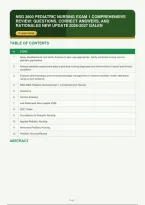
NSG 3600 PEDIATRIC NURSING EXAM 1 COMPREHENSIVE
REVIEW: QUESTIONS, CORRECT ANSWERS, AND
RATIONALES NEW UPDATE 2026-2027 GALEN
97 QUESTIONS
TABLE OF CONTENTS
# TOPIC
1 Apply developmental and family theories to plan age-appropriate, family-centered nursing care for
pediatric populations
2 Analyze pediatric assessment data to prioritize nursing diagnoses and interventions in acute and chronic
conditions
3 Evaluate pharmacologic and non-pharmacologic management of common pediatric health alterations
using current evidence
4 NSG 3600 Pediatric Nursing Exam 1 Comprehensive Review
5 Questions
6 Correct Answers
7 and Rationales New Update 2026
8 2027 Galen
9 Foundations of Pediatric Nursing
10 Applied Pediatric Nursing
11 Advanced Pediatric Nursing
12 Pediatric Nursing Review
ABSTRACT
Page 1
,This study document brings together 97 carefully worded exam questions drawn from NSG 3600
Pediatric Nursing Exam 1 Comprehensive Review: Questions, Correct Answers, and Rationales
New Update 2026-2027 Galen, with the strongest emphasis placed on Apply developmental and
family theories to plan age-appropriate, family-centered nursing care for pediatric populations,
Analyze pediatric assessment data to prioritize nursing diagnoses and interventions in acute and
chronic conditions and Evaluate pharmacologic and non-pharmacologic management of common
pediatric health alterations using current evidence. Every item follows the wording style and level of
reasoning you meet in the real paper, and each one is paired with a clear rationale so the correct
choice is never a guess. Work through the set at your own pace, mark the questions that slow you
down, then come back to them until the reasoning feels automatic. Learners who revise this way
walk into the exam room recognising the pattern behind the questions instead of meeting them for
the first time. Keep going - steady, honest practice is what turns a difficult paper into a comfortable
pass.
Q1 APPLY DEVELOPMENTAL AND FAMILY THEORIES TO PLAN AGE-APPROPRIATE,
FAMILY-CENTERED NURSING CARE FOR PEDIATRIC POPULATIONS
A nurse is assessing a pediatric patient with suspected increased intracranial
pressure (ICP). Which set of vital sign changes is most consistent with Cushing's
triad?
A. Tachycardia, hypotension, tachypnea
B. Bradycardia, hypertension, irregular respirations CORRECT
C. Tachycardia, hypertension, regular respirations
D. Bradycardia, hypotension, apnea
RATIONALE: Cushing's triad consists of bradycardia, systolic hypertension, and irregular
respirations, reflecting increased ICP and brainstem compression. Tachycardia and hypotension
(A, D) suggest shock, not Cushing's. Tachycardia with hypertension (C) is not typical for
Cushing's triad.
Page 2
,Q2 APPLY DEVELOPMENTAL AND FAMILY THEORIES TO PLAN AGE-APPROPRIATE,
FAMILY-CENTERED NURSING CARE FOR PEDIATRIC POPULATIONS
A pediatric patient with severe dehydration from gastroenteritis is prescribed oral
rehydration therapy (ORT). Which solution is most appropriate?
A. Sports drink
B. Apple juice
C. Commercial oral rehydration solution (ORS) CORRECT
D. Plain water
RATIONALE: Commercial ORS has the correct ratio of sodium, glucose, and water to promote
optimal absorption via sodium-glucose cotransport. Sports drinks and juice have high sugar and
low sodium, worsening diarrhea. Plain water lacks electrolytes and can cause hyponatremia.
Q3 APPLY DEVELOPMENTAL AND FAMILY THEORIES TO PLAN AGE-APPROPRIATE,
FAMILY-CENTERED NURSING CARE FOR PEDIATRIC POPULATIONS
A nurse is evaluating a pediatric patient for possible physical abuse. Which injury
pattern is most concerning for non-accidental trauma?
A. Bruises on the shins and knees
B. Forearm fracture after a fall from a bike
C. Immersion burns with a clear glove-and-stocking distribution CORRECT
D. Single bruise on the forehead after a fall
RATIONALE: Immersion burns with glove-and-stocking distribution suggest forced immersion, a
classic sign of abuse. Bruises on bony prominences and fractures from falls are common
accidental injuries. A single forehead bruise is typical for a toddler's fall.
Page 3
, Q4 APPLY DEVELOPMENTAL AND FAMILY THEORIES TO PLAN AGE-APPROPRIATE,
FAMILY-CENTERED NURSING CARE FOR PEDIATRIC POPULATIONS
A pediatric patient is receiving digoxin for heart failure. Which assessment finding
requires immediate intervention?
A. Heart rate of 70 beats/min
B. Serum potassium of 3.0 mEq/L CORRECT
C. Digoxin level of 1.0 ng/mL
D. Weight gain of 0.5 kg in 24 hours
RATIONALE: Hypokalemia (K+ < 3.5 mEq/L) increases the risk of digoxin toxicity. A heart rate of
70 is acceptable for many pediatric patients, digoxin level of 1.0 is therapeutic, and mild weight
gain may be expected. Hypokalemia requires correction to prevent arrhythmias.
Q5 APPLY DEVELOPMENTAL AND FAMILY THEORIES TO PLAN AGE-APPROPRIATE,
FAMILY-CENTERED NURSING CARE FOR PEDIATRIC POPULATIONS
A nurse is teaching a parent about administering inhaled corticosteroids to a child
with asthma. Which statement by the parent indicates correct understanding?
A. I will give the medication only when my child has wheezing.
B. I will rinse my child's mouth after each dose. CORRECT
C. I will use a spacer with the inhaler only during exacerbations.
D. I will stop the medication once symptoms improve.
RATIONALE: Rinsing the mouth after inhaled corticosteroids prevents oral candidiasis. Inhaled
corticosteroids are controller medications taken daily, not as needed. A spacer should be used
with every dose to improve delivery. Stopping the medication when symptoms improve can lead
to exacerbations.
Page 4


