
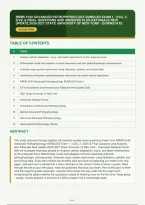
NRMS 5190 ADVANCED PATHOPHYSIOLOGY BUNDLED EXAM 1, 1(V2), 2,
2(V2) & FINAL QUESTIONS AND ANSWERS PLUS RATIONALE NEW
UPDATE 2026-2027 STATE UNIVERSITY OF NEW YORK - DOWNSTATE
49 QUESTIONS
TABLE OF CONTENTS
# TOPIC
1 Analyze cellular adaptation, injury, and death mechanisms at the molecular level
2 Differentiate innate and adaptive immune responses and their pathophysiologic consequences
3 Evaluate organ system dysfunction using laboratory, genetic, and clinical data
4 Synthesize multisystem pathophysiologic interactions to predict clinical trajectories
5 NRMS 5190 Advanced Pathophysiology BUNDLED Exam 1
6 & Final Questions and Answers plus Rationale New Update 2026
7 2027 State University Of New York
8 Downstate Medical Center
9 Foundations of Advanced Pathophysiology
10 Applied Advanced Pathophysiology
11 Advanced Advanced Pathophysiology
12 Advanced Pathophysiology Review
ABSTRACT
This study document brings together 49 carefully worded exam questions drawn from NRMS 5190
Advanced Pathophysiology BUNDLED Exam 1, 1(V2), 2, 2(V2) & Final Questions and Answers
plus Rationale New Update 2026-2027 State University Of New York - Downstate Medical Center,
with the strongest emphasis placed on Analyze cellular adaptation, injury, and death mechanisms
at the molecular level, Differentiate innate and adaptive immune responses and their
pathophysiologic consequences, Evaluate organ system dysfunction using laboratory, genetic and
and clinical data. Every item follows the wording style and level of reasoning you meet in the real
paper, and each one is paired with a clear rationale so the correct choice is never a guess. Work
through the set at your own pace, mark the questions that slow you down, then come back to them
until the reasoning feels automatic. Learners who revise this way walk into the exam room
recognising the pattern behind the questions instead of meeting them for the first time. Keep going
- steady, honest practice is what turns a difficult paper into a comfortable pass.
Page 1
,Q1 ANALYZE CELLULAR ADAPTATION, INJURY, AND DEATH MECHANISMS AT THE
MOLECULAR LEVEL
A cell exposed to prolonged hypoxia exhibits mitochondrial permeability
transition pore opening with cytochrome c release. Which downstream event most
directly commits this cell to irreversible injury?
A. Activation of caspase-9 within the apoptosome CORRECT
B. ATP depletion below 10% of normal
C. Influx of calcium via reverse-mode Na+/Ca2+ exchanger
D. Ribosomal detachment from the endoplasmic reticulum
RATIONALE: Cytochrome c release triggers apoptosome formation and caspase-9 activation,
which irreversibly commits the cell to apoptosis. ATP depletion and calcium influx are reversible
early events; ribosomal detachment is a reversible ultrastructural change.
Q2 ANALYZE CELLULAR ADAPTATION, INJURY, AND DEATH MECHANISMS AT THE
MOLECULAR LEVEL
In a patient with septic shock, which pattern of cytokine elevation best
distinguishes the hyperinflammatory from the immunosuppressive phase?
A. Persistent TNF- and IL-6 elevation with low IL-10
B. Early IL-10 elevation with subsequent TNF- decline and monocyte HLA-DR downregulation
CORRECT
C. Sustained IL-1 elevation with normal HLA-DR expression
D. Elevated IL-17 with suppressed IL-10 throughout
RATIONALE: The immunosuppressive phase is characterized by IL-10 dominance, reduced
TNF-, and monocyte HLA-DR downregulation, reflecting immune paralysis. Persistent TNF- and
IL-6 indicate ongoing hyperinflammation; IL-17 patterns suggest autoimmune rather than septic
profiles.
Page 2
, Q3 ANALYZE CELLULAR ADAPTATION, INJURY, AND DEATH MECHANISMS AT THE
MOLECULAR LEVEL
A patient with chronic kidney disease has an eGFR of 25 mL/min/1.73m². Which
acid-base disturbance is most likely and what is the primary compensatory
mechanism?
A. Metabolic alkalosis; hypoventilation
B. High anion gap metabolic acidosis; hyperventilation
C. Normal anion gap metabolic acidosis; hyperventilation CORRECT
D. Respiratory acidosis; renal bicarbonate retention
RATIONALE: CKD causes normal anion gap metabolic acidosis due to impaired ammonium
excretion and bicarbonate loss. Respiratory compensation via hyperventilation lowers PaCO2;
high anion gap acidosis is more typical of advanced renal failure with retained acids.
Q4 ANALYZE CELLULAR ADAPTATION, INJURY, AND DEATH MECHANISMS AT THE
MOLECULAR LEVEL
Which molecular alteration best explains the constitutive activation of the
JAK2-STAT pathway in polycythemia vera?
A. BCR-ABL1 fusion gene
B. JAK2 V617F point mutation CORRECT
C. CALR frameshift mutation
D. Mpl receptor overexpression
RATIONALE: The JAK2 V617F mutation confers constitutive kinase activity, driving
erythropoiesis independent of erythropoietin. BCR-ABL1 is linked to CML; CALR mutations occur
in essential thrombocythemia and primary myelofibrosis.
Page 3


