
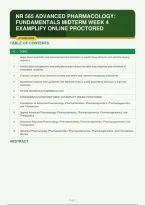
NR 565 ADVANCED PHARMACOLOGY:
FUNDAMENTALS MIDTERM WEEK 4
EXAMPLIFY ONLINE PROCTORED
97 QUESTIONS
TABLE OF CONTENTS
# TOPIC
1 Apply pharmacokinetic and pharmacodynamic principles to predict drug behavior and optimize dosing
regimens
2 Analyze pharmacogenomic and pathophysiologic factors that alter drug response and contribute to
interpatient variability
3 Evaluate complex drug interaction profiles and select safe, effective therapeutic alternatives
4 Synthesize evidence from guidelines and landmark trials to justify prescribing decisions in high-risk
scenarios
5 NR 565 ADVANCED PHARMACOLOGY
6 FUNDAMENTALS MIDTERM WEEK 4 EXAMPLIFY ONLINE PROCTORED
7 Foundations of Advanced Pharmacology: Pharmacokinetics, Pharmacodynamics, Pharmacogenomics,
and Therapeutics
8 Applied Advanced Pharmacology: Pharmacokinetics, Pharmacodynamics, Pharmacogenomics, and
Therapeutics
9 Advanced Advanced Pharmacology: Pharmacokinetics, Pharmacodynamics, Pharmacogenomics, and
Therapeutics
10 Advanced Pharmacology: Pharmacokinetics, Pharmacodynamics, Pharmacogenomics, and Therapeutics
Review
ABSTRACT
Page 1
,This study document brings together 97 carefully worded exam questions drawn from NR 565
ADVANCED PHARMACOLOGY: FUNDAMENTALS MIDTERM WEEK 4 EXAMPLIFY ONLINE
PROCTORED, with the strongest emphasis placed on Apply pharmacokinetic and
pharmacodynamic principles to predict drug behavior and optimize dosing regimens, Analyze
pharmacogenomic and pathophysiologic factors that alter drug response and contribute to
interpatient variability, Evaluate complex drug interaction profiles and select safe and effective
therapeutic alternatives. Every item follows the wording style and level of reasoning you meet in
the real paper, and each one is paired with a clear rationale so the correct choice is never a guess.
Work through the set at your own pace, mark the questions that slow you down, then come back to
them until the reasoning feels automatic. Learners who revise this way walk into the exam room
recognising the pattern behind the questions instead of meeting them for the first time. Keep going
- steady, honest practice is what turns a difficult paper into a comfortable pass.
Q1 APPLY PHARMACOKINETIC AND PHARMACODYNAMIC PRINCIPLES TO PREDICT DRUG
BEHAVIOR AND OPTIMIZE DOSING REGIMENS
A patient with a history of opioid use disorder is initiated on
buprenorphine/naloxone. Which statement best explains why the sublingual route
is preferred over oral administration for this combination?
A. Sublingual administration bypasses first-pass metabolism, enhancing buprenorphine
bioavailability while naloxone undergoes extensive first-pass metabolism, minimizing systemic
opioid antagonism. CORRECT
B. Oral naloxone is poorly absorbed, but sublingual naloxone provides rapid antagonism to deter
misuse.
C. Sublingual buprenorphine has a longer half-life than oral buprenorphine, allowing once-daily
dosing.
D. Oral buprenorphine is inactivated by gastric acid, necessitating sublingual administration for
any therapeutic effect.
RATIONALE: Sublingual buprenorphine avoids first-pass metabolism, increasing bioavailability.
Naloxone has poor sublingual absorption and undergoes first-pass metabolism if swallowed, so
systemic antagonism is minimal when used as prescribed. Options B, C, and D misstate
pharmacokinetic properties.
Page 2
,Q2 APPLY PHARMACOKINETIC AND PHARMACODYNAMIC PRINCIPLES TO PREDICT DRUG
BEHAVIOR AND OPTIMIZE DOSING REGIMENS
A patient stabilized on warfarin (CYP2C9 substrate) is prescribed fluconazole
(CYP2C9 inhibitor). Which parameter is most critical to monitor and why?
A. INR, because fluconazole inhibits warfarin metabolism, increasing bleeding risk. CORRECT
B. aPTT, because fluconazole induces warfarin metabolism, reducing anticoagulant effect.
C. Platelet count, because fluconazole causes thrombocytopenia.
D. Warfarin level, because fluconazole alters warfarin protein binding.
RATIONALE: Fluconazole inhibits CYP2C9, reducing warfarin clearance and elevating INR,
which increases bleeding risk. aPTT is not used for warfarin monitoring. Fluconazole does not
typically cause thrombocytopenia or significantly alter protein binding.
Q3 APPLY PHARMACOKINETIC AND PHARMACODYNAMIC PRINCIPLES TO PREDICT DRUG
BEHAVIOR AND OPTIMIZE DOSING REGIMENS
A patient with heart failure and reduced ejection fraction is started on
sacubitril/valsartan. Which mechanism best accounts for its superiority over
enalapril in reducing cardiovascular death?
A. Simultaneous neprilysin inhibition and angiotensin receptor blockade enhance natriuresis and
reduce vasoconstriction without bradykinin accumulation. CORRECT
B. Sacubitril inhibits neprilysin, increasing bradykinin, which mediates vasodilation and
cardioprotection.
C. Valsartan inhibits neprilysin, while sacubitril blocks angiotensin II receptors, providing dual
renin-angiotensin system suppression.
D. Sacubitril/valsartan increases angiotensin II levels, which improves renal perfusion and
reduces heart failure symptoms.
RATIONALE: Sacubitril inhibits neprilysin, increasing natriuretic peptides, while valsartan blocks
angiotensin II receptors. This dual mechanism reduces vasoconstriction and sodium retention
without bradykinin-mediated cough or angioedema. Options B, C, and D mischaracterize the
mechanisms.
Page 3
, Q4 APPLY PHARMACOKINETIC AND PHARMACODYNAMIC PRINCIPLES TO PREDICT DRUG
BEHAVIOR AND OPTIMIZE DOSING REGIMENS
A patient with major depressive disorder and a history of poor response to SSRIs
is prescribed vortioxetine. Which receptor activity profile most distinguishes
vortioxetine from standard SSRIs?
A. Serotonin transporter inhibition plus 5-HT3, 5-HT7, and 5-HT1D receptor antagonism, and
5-HT1A agonism. CORRECT
B. Selective serotonin reuptake inhibition with no significant activity at other serotonin receptors.
C. Serotonin and norepinephrine reuptake inhibition with weak dopamine reuptake blockade.
D. Serotonin transporter inhibition and 5-HT2C antagonism, enhancing norepinephrine and
dopamine release.
RATIONALE: Vortioxetine is a serotonin modulator and stimulator: it inhibits SERT and
modulates multiple 5-HT receptors (antagonism at 5-HT3, 5-HT7, 5-HT1D; agonism at 5-HT1A).
This multimodal profile differs from pure SSRIs. Options B, C, and D describe other
antidepressants.
Q5 APPLY PHARMACOKINETIC AND PHARMACODYNAMIC PRINCIPLES TO PREDICT DRUG
BEHAVIOR AND OPTIMIZE DOSING REGIMENS
A patient with type 2 diabetes and chronic kidney disease (eGFR 35 mL/min/1.73
m²) is on metformin. Which action is most appropriate according to current FDA
labeling?
A. Discontinue metformin immediately due to high risk of lactic acidosis.
B. Continue metformin at a reduced dose, with close monitoring of renal function. CORRECT
C. Continue metformin at the current dose, as eGFR >30 is acceptable.
D. Switch to a sulfonylurea, as metformin is contraindicated in CKD.
RATIONALE: Metformin is contraindicated if eGFR <30 mL/min/1.73 m². For eGFR 30-45,
initiating metformin is not recommended, but continuation with dose reduction and monitoring is
acceptable. Immediate discontinuation or switching to sulfonylurea is not required at eGFR 35.
Page 4


