
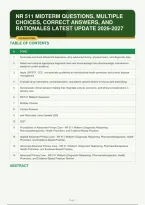
NR 511 MIDTERM QUESTIONS, MULTIPLE
CHOICES, CORRECT ANSWERS, AND
RATIONALES LATEST UPDATE 2026-2027
100 QUESTIONS
TABLE OF CONTENTS
# TOPIC
1 Formulate prioritized differential diagnoses using advanced history, physical exam, and diagnostic data
2 Select and interpret appropriate diagnostic tests and pharmacologic/non-pharmacologic interventions
based on current evidence
3 Apply USPSTF, CDC, and specialty guidelines to individualized health promotion and chronic disease
management
4 Evaluate drug interactions, contraindications, and patient-specific factors to ensure safe prescribing
5 Demonstrate clinical decision-making that integrates cultural, economic, and ethical considerations in
primary care
6 NR 511 Midterm Questions
7 Multiple Choices
8 Correct Answers
9 and Rationales Latest Update 2026
10 2027
11 Foundations of Advanced Primary Care - NR 511 Midterm (Diagnostic Reasoning,
Pharmacotherapeutics, Health Promotion, and Evidence-Based Practice)
12 Applied Advanced Primary Care - NR 511 Midterm (Diagnostic Reasoning, Pharmacotherapeutics, Health
Promotion, and Evidence-Based Practice)
13 Advanced Advanced Primary Care - NR 511 Midterm (Diagnostic Reasoning, Pharmacotherapeutics,
Health Promotion, and Evidence-Based Practice)
14 Advanced Primary Care - NR 511 Midterm (Diagnostic Reasoning, Pharmacotherapeutics, Health
Promotion, and Evidence-Based Practice) Review
ABSTRACT
Page 1
,This study document brings together 100 carefully worded exam questions drawn from NR 511
Midterm Questions, Multiple Choices, Correct Answers, and Rationales Latest Update 2026-2027,
with the strongest emphasis placed on Formulate prioritized differential diagnoses using advanced
history, physical exam, and diagnostic data, Select and interpret appropriate diagnostic tests and
pharmacologic/non-pharmacologic interventions based on current evidence, Apply USPSTF, CDC
and and specialty guidelines to individualized health promotion and chronic disease management.
Every item follows the wording style and level of reasoning you meet in the real paper, and each
one is paired with a clear rationale so the correct choice is never a guess. Work through the set at
your own pace, mark the questions that slow you down, then come back to them until the
reasoning feels automatic. Learners who revise this way walk into the exam room recognising the
pattern behind the questions instead of meeting them for the first time. Keep going - steady, honest
practice is what turns a difficult paper into a comfortable pass.
Q1 FORMULATE PRIORITIZED DIFFERENTIAL DIAGNOSES USING ADVANCED HISTORY,
PHYSICAL EXAM, AND DIAGNOSTIC DATA
A patient presents with a 3-day history of unilateral headache, scalp tenderness,
and jaw claudication. Erythrocyte sedimentation rate is 78 mm/hr. Which of the
following is the most appropriate immediate action?
A. Start high-dose oral prednisone and schedule temporal artery biopsy within 2 weeks.
B. Initiate high-dose intravenous corticosteroids immediately and arrange urgent temporal artery
biopsy. CORRECT
C. Prescribe sumatriptan and obtain outpatient MRI of the brain.
D. Administer intramuscular ketorolac and refer to neurology for elective evaluation.
RATIONALE: This presentation is highly suspicious for giant cell arteritis (GCA) with impending
vision loss; high-dose IV corticosteroids should be started immediately, and temporal artery
biopsy should be performed urgently (within 1-2 weeks) but must not delay treatment. Oral
prednisone is insufficient for acute severe GCA, and triptans or NSAIDs do not address the
vasculitic process. Immediate IV steroids are standard of care to prevent irreversible blindness.
Page 2
,Q2 FORMULATE PRIORITIZED DIFFERENTIAL DIAGNOSES USING ADVANCED HISTORY,
PHYSICAL EXAM, AND DIAGNOSTIC DATA
Which of the following best describes the mechanism by which SGLT2 inhibitors
confer cardiorenal protection in patients with type 2 diabetes and heart failure?
A. They increase insulin secretion from pancreatic beta cells, reducing glucotoxicity.
B. They inhibit sodium-glucose cotransport in the proximal tubule, promoting natriuresis and
reducing intraglomerular pressure. CORRECT
C. They activate PPAR-gamma receptors, improving insulin sensitivity and reducing
inflammation.
D. They block hepatic gluconeogenesis and enhance peripheral glucose uptake.
RATIONALE: SGLT2 inhibitors reduce glucose reabsorption in the proximal tubule, leading to
glycosuria, natriuresis, and decreased intraglomerular pressure, which contributes to cardiorenal
protection. They do not primarily increase insulin secretion (sulfonylureas), activate
PPAR-gamma (thiazolidinediones), or block hepatic gluconeogenesis (metformin). This
mechanism underlies their benefit in heart failure and chronic kidney disease.
Q3 FORMULATE PRIORITIZED DIFFERENTIAL DIAGNOSES USING ADVANCED HISTORY,
PHYSICAL EXAM, AND DIAGNOSTIC DATA
A 45-year-old patient with no prior history of cardiovascular disease asks about
aspirin for primary prevention. Based on the latest USPSTF recommendations,
which statement is most accurate?
A. Aspirin should be routinely recommended for all adults aged 40-59 to prevent myocardial
infarction.
B. Aspirin is not recommended for primary prevention in adults aged 60 or older due to increased
bleeding risk. CORRECT
C. Aspirin is recommended for primary prevention in all adults regardless of age, with bleeding
risk being negligible.
D. Aspirin should be initiated only in patients with a 10-year risk of cardiovascular disease
greater than 20%.
RATIONALE: The USPSTF 2022 recommendation states that for adults aged 60 years or older,
aspirin should not be initiated for primary prevention of cardiovascular disease due to lack of net
benefit and increased bleeding risk. For adults aged 40-59 with higher risk, the decision should
be individualized. Routine use in all adults or based solely on a >20% risk threshold is not
supported by current evidence.
Page 3
, Q4 FORMULATE PRIORITIZED DIFFERENTIAL DIAGNOSES USING ADVANCED HISTORY,
PHYSICAL EXAM, AND DIAGNOSTIC DATA
A patient with asthma is prescribed a low-dose inhaled corticosteroid (ICS) but
reports frequent rescue inhaler use. Which of the following is the most appropriate
next step according to current GINA guidelines?
A. Add a long-acting beta-agonist (LABA) to the ICS. CORRECT
B. Switch to a leukotriene receptor antagonist (LTRA) monotherapy.
C. Increase the ICS dose to medium and reassess in 4-6 weeks.
D. Recommend a short-acting beta-agonist (SABA) only as needed and avoid controller therapy.
RATIONALE: For patients with uncontrolled asthma on low-dose ICS, GINA recommends adding
a LABA to the ICS as the preferred step-up therapy. LTRA monotherapy is less effective than
ICS-LABA. Increasing ICS to medium dose is an alternative but adding LABA is preferred for
most adults. SABA-only therapy is not recommended for persistent asthma.
Q5 FORMULATE PRIORITIZED DIFFERENTIAL DIAGNOSES USING ADVANCED HISTORY,
PHYSICAL EXAM, AND DIAGNOSTIC DATA
Which of the following findings on a peripheral blood smear is most characteristic
of iron deficiency anemia?
A. Macrocytosis with hypersegmented neutrophils
B. Microcytic hypochromic red blood cells with anisocytosis CORRECT
C. Normocytic normochromic red blood cells with schistocytes
D. Macrocytic anemia with target cells and Howell-Jolly bodies
RATIONALE: Iron deficiency anemia typically presents with microcytic, hypochromic red blood
cells and increased anisocytosis (variation in size). Macrocytosis with hypersegmented
neutrophils suggests B12 or folate deficiency. Schistocytes suggest hemolysis or
microangiopathy. Target cells and Howell-Jolly bodies are seen in asplenia or
hemoglobinopathies.
Page 4


