
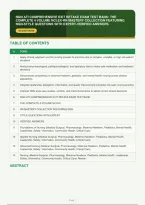
NGN ATI COMPREHENSIVE EXIT RETAKE EXAM TEST BANK: THE
COMPLETE 4 VOLUME NCLEX-RN MASTERY COLLECTION FEATURING
NGN-STYLE QUESTIONS WITH EXPERT-VERIFIED ANSWERS
48 QUESTIONS
TABLE OF CONTENTS
# TOPIC
1 Apply clinical judgment and the nursing process to prioritize care in complex, unstable, or high-risk patient
situations
2 Analyze pharmacological, pathophysiological, and laboratory data to make safe medication and treatment
decisions
3 Demonstrate competency in maternal-newborn, pediatric, and mental health nursing across diverse
populations
4 Integrate leadership, delegation, informatics, and quality improvement principles into safe nursing practice
5 Interpret NGN-style case studies, exhibits, and matrix/trend items to select correct clinical decisions
6 NGN ATI COMPREHENSIVE EXIT RETAKE EXAM TEST BANK
7 THE COMPLETE 4 VOLUME NCLEX
8 RN MASTERY COLLECTION FEATURING NGN
9 STYLE QUESTIONS WITH EXPERT
10 VERIFIED ANSWERS
11 Foundations of Nursing (Medical-Surgical, Pharmacology, Maternal-Newborn, Pediatrics, Mental Health,
Leadership, Safety, Informatics, Community Health, Critical Care)
12 Applied Nursing (Medical-Surgical, Pharmacology, Maternal-Newborn, Pediatrics, Mental Health,
Leadership, Safety, Informatics, Community Health, Critical Care)
13 Advanced Nursing (Medical-Surgical, Pharmacology, Maternal-Newborn, Pediatrics, Mental Health,
Leadership, Safety, Informatics, Community Health, Critical Care)
14 Nursing (Medical-Surgical, Pharmacology, Maternal-Newborn, Pediatrics, Mental Health, Leadership,
Safety, Informatics, Community Health, Critical Care) Review
ABSTRACT
Page 1
,This study document brings together 48 carefully worded exam questions drawn from NGN ATI
COMPREHENSIVE EXIT RETAKE EXAM TEST BANK: THE COMPLETE 4 VOLUME NCLEX-RN
MASTERY COLLECTION FEATURING NGN-STYLE QUESTIONS WITH EXPERT-VERIFIED
ANSWERS, with the strongest emphasis placed on Apply clinical judgment and the nursing
process to prioritize care in complex, unstable, or high-risk patient situations, Analyze
pharmacological, pathophysiological, and laboratory data to make safe medication and treatment
decisions, Demonstrate competency in maternal-newborn, pediatric and and mental health nursing
across diverse populations. Every item follows the wording style and level of reasoning you meet in
the real paper, and each one is paired with a clear rationale so the correct choice is never a guess.
Work through the set at your own pace, mark the questions that slow you down, then come back to
them until the reasoning feels automatic. Learners who revise this way walk into the exam room
recognising the pattern behind the questions instead of meeting them for the first time. Keep going
- steady, honest practice is what turns a difficult paper into a comfortable pass.
Q1 APPLY CLINICAL JUDGMENT AND THE NURSING PROCESS TO PRIORITIZE CARE IN
COMPLEX, UNSTABLE, OR HIGH-RISK PATIENT SITUATIONS
A patient receiving continuous IV heparin for venous thromboembolism has an
aPTT of 98 seconds (therapeutic range 60-80 seconds) and new hematuria. Which
action should the nurse anticipate as the priority?
A. Administer vitamin K 10 mg IV push
B. Stop the heparin infusion and prepare to administer protamine sulfate CORRECT
C. Continue the infusion and recheck aPTT in 6 hours
D. Administer fresh frozen plasma and continue heparin at a reduced rate
RATIONALE: An aPTT of 98 seconds with bleeding indicates supratherapeutic heparin
anticoagulation; the infusion must be stopped and protamine sulfate (the antidote) given. Vitamin
K reverses warfarin, not heparin. Continuing heparin or reducing the rate without stopping would
worsen bleeding risk. FFP is not first-line for heparin reversal.
Page 2
, Q2 APPLY CLINICAL JUDGMENT AND THE NURSING PROCESS TO PRIORITIZE CARE IN
COMPLEX, UNSTABLE, OR HIGH-RISK PATIENT SITUATIONS
A laboring patient at 39 weeks gestation has a Category III fetal heart tracing with
recurrent late decelerations, minimal variability, and a baseline of 170 bpm. After
initiating intrauterine resuscitation, which action should the nurse take next?
A. Continue monitoring and reassess in 30 minutes
B. Prepare for an immediate cesarean birth CORRECT
C. Administer a tocolytic to stop contractions
D. Perform a fetal scalp stimulation to assess acidemia
RATIONALE: A Category III tracing with recurrent late decelerations and minimal variability
indicates fetal hypoxemia/acidemia and requires immediate delivery, typically by cesarean.
Continued monitoring or scalp stimulation delays definitive management. Tocolytic therapy is not
indicated for Category III tracings.
Q3 APPLY CLINICAL JUDGMENT AND THE NURSING PROCESS TO PRIORITIZE CARE IN
COMPLEX, UNSTABLE, OR HIGH-RISK PATIENT SITUATIONS
A patient with schizophrenia is prescribed clozapine. Which laboratory value must
be monitored weekly for the first 6 months of therapy to detect a life-threatening
adverse effect?
A. Serum sodium
B. Absolute neutrophil count CORRECT
C. Liver function tests
D. Serum creatinine
RATIONALE: Clozapine carries a black box warning for severe neutropenia/agranulocytosis;
ANC must be monitored weekly for 6 months, then biweekly, then monthly. Sodium, LFTs, and
creatinine are not the primary monitoring parameters for clozapine's life-threatening risk.
Page 3


