
A+ VERIFIED
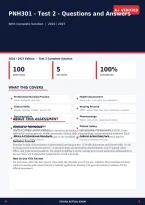
PNH301 - Test 2 - Questions and Answers
With Complete Solution |
Edition · Test 2 Complete Solution
100 5 100%
QUESTIONS SECTIONS RATIONALES
WHAT THIS COVERS
Professional Nursing Practice Health Assessment
Scope, standards, and roles Head-to-toe, vital signs, documentation
Clinical Skills Nursing Process
Asepsis, hygiene, mobility, wound care ADPIE: assess, diagnose, plan, implement, evaluate
Documentation Pharmacology
ABOUT THIS ASSESSMENT
SOAP, DAR, electronic health records Rights, calculations, drug classifications
Medication
Purpose Administration
of This Review Patient Safety
Routes,
This TestIV2therapy, adversefoundational
review covers reactions Falls, restraints,
concepts in professional nursing practice infection control
as assessed in PNH301. Items
address the nursing process, health assessment, clinical skills, pharmacology, and professional standards. Each
Ethics &explains
rationale Professional Standards
the underlying principle so the candidate can Cultural & Spiritual Care
transfer understanding to clinical practice.
Code of Ethics, HIPAA, advocacy Culturally competent nursing
Domains Covered
Domains include (1) foundations of professional nursing practice, (2) health assessment and clinical skills, (3) the
nursing process and documentation, (4) pharmacology and medication administration, and (5) patient safety,
ethics, and professional standards. The largest weighting is on the nursing process and medication administration
because these are foundational competencies tested repeatedly.
How to Use This Review
For each item, select the best answer, then study the rationale even if you are confident. The rationales reinforce
clinical reasoning and connect theory to bedside application. Passing at 80 percent indicates readiness for the
official assessment.
STUVIA ACTUAL EXAM
,PNH301 | Test 2 - Questions & Answers Edition
SECTION 1: FOUNDATIONS OF PROFESSIONAL NURSING PRACTICE
This section reviews the scope, standards, and historical foundations of professional nursing.
1. Which theorist is best known for defining nursing as "assisting the individual, sick or well, in the
performance of those activities contributing to health"?
A. Virginia Henderson
B. Martha Rogers
C. Dorothea Orem
D. Imogene King
✓ Correct Answer: A
Rationale: Virginia Henderson defined nursing as assisting individuals (sick or well) in activities
contributing to health that they would perform unaided if they had the strength, will, or knowledge. Her
Need Theory remains influential.
2. Which phrase best describes the metaparadigm of nursing?
A. Person, environment, health, and nursing
B. Nurse, physician, hospital, disease
C. Patient, family, community, society
D. Theory, research, practice, education
✓ Correct Answer: A
Rationale: The nursing metaparadigm comprises four concepts: person (client), environment, health, and
nursing. These four concepts frame every nursing theory and curriculum.
3. Which nursing theorist is associated with the Self-Care Deficit Theory?
A. Dorothea Orem
B. Sister Callista Roy
C. Betty Neuman
D. Jean Watson
✓ Correct Answer: A
Rationale: Dorothea Orem developed the Self-Care Deficit Theory, which holds that patients benefit from
nursing when they cannot meet their own self-care needs.
4. Which best describes the primary goal of the American Nurses Association (ANA) Code of
Ethics?
A. To articulate ethical obligations and duties of the nursing profession
B. To enforce hospital policies
C. To regulate nursing licensure
D. To negotiate nurse salaries
✓ Correct Answer: A
Rationale: The ANA Code of Ethics articulates the ethical obligations, duties, and ideals of the nursing
profession. It guides moral decision-making and patient advocacy in clinical practice.
STUVIA ACTUAL EXAM Page 1
, PNH301 | Test 2 - Questions & Answers Edition
5. A nurse who uses evidence-based practice (EBP) integrates which three elements?
A. Best research evidence, clinical expertise, and patient values
B. Tradition, intuition, and experience
C. Textbook knowledge, supervisor preference, and cost
D. Physician orders, hospital policy, and protocol
✓ Correct Answer: A
Rationale: Evidence-based practice integrates the best available research evidence, the nurses clinical
expertise, and patient values/preferences. All three are required for genuine EBP.
6. The nurse practice act for each state is primarily responsible for which function?
A. Defining the scope of nursing practice and licensure requirements
B. Setting hospital budgets
C. Approving drug prescriptions
D. Establishing nurse-to-patient ratios nationally
✓ Correct Answer: A
Rationale: Each states Nurse Practice Act legally defines the scope of nursing practice, licensure
requirements, and grounds for disciplinary action. Boards of Nursing enforce the Act.
7. Which nursing role focuses on coordinating care across multiple settings and patient
populations?
A. Case manager
B. Circulating nurse
C. Charge nurse
D. scrub nurse
✓ Correct Answer: A
Rationale: The case manager coordinates care across settings, ensures continuity, and optimizes resource
use. This role emphasizes outcomes and cost-effective care delivery.
8. Which historical figure is credited with establishing the first organized training school for
nurses?
A. Florence Nightingale
B. Clara Barton
C. Lillian Wald
D. Mary Mahoney
✓ Correct Answer: A
Rationale: Florence Nightingale founded the first secular nursing school at St. Thomas Hospital in London in
1860. Her work established nursing as a recognized profession.
9. Which level of Maslow hierarchy must be addressed first in patient care?
A. Self-actualization
B. Esteem
C. Love and belonging
D. Physiologic needs
✓ Correct Answer: D
Rationale: Physiologic needs (air, water, food, shelter, sleep) must be met before higher-level needs. In
clinical practice, ABCs (airway, breathing, circulation) take priority.
STUVIA ACTUAL EXAM Page 2
PNH301 - Test 2 - Questions and Answers
With Complete Solution |
Edition · Test 2 Complete Solution
100 5 100%
QUESTIONS SECTIONS RATIONALES
WHAT THIS COVERS
Professional Nursing Practice Health Assessment
Scope, standards, and roles Head-to-toe, vital signs, documentation
Clinical Skills Nursing Process
Asepsis, hygiene, mobility, wound care ADPIE: assess, diagnose, plan, implement, evaluate
Documentation Pharmacology
ABOUT THIS ASSESSMENT
SOAP, DAR, electronic health records Rights, calculations, drug classifications
Medication
Purpose Administration
of This Review Patient Safety
Routes,
This TestIV2therapy, adversefoundational
review covers reactions Falls, restraints,
concepts in professional nursing practice infection control
as assessed in PNH301. Items
address the nursing process, health assessment, clinical skills, pharmacology, and professional standards. Each
Ethics &explains
rationale Professional Standards
the underlying principle so the candidate can Cultural & Spiritual Care
transfer understanding to clinical practice.
Code of Ethics, HIPAA, advocacy Culturally competent nursing
Domains Covered
Domains include (1) foundations of professional nursing practice, (2) health assessment and clinical skills, (3) the
nursing process and documentation, (4) pharmacology and medication administration, and (5) patient safety,
ethics, and professional standards. The largest weighting is on the nursing process and medication administration
because these are foundational competencies tested repeatedly.
How to Use This Review
For each item, select the best answer, then study the rationale even if you are confident. The rationales reinforce
clinical reasoning and connect theory to bedside application. Passing at 80 percent indicates readiness for the
official assessment.
STUVIA ACTUAL EXAM
,PNH301 | Test 2 - Questions & Answers Edition
SECTION 1: FOUNDATIONS OF PROFESSIONAL NURSING PRACTICE
This section reviews the scope, standards, and historical foundations of professional nursing.
1. Which theorist is best known for defining nursing as "assisting the individual, sick or well, in the
performance of those activities contributing to health"?
A. Virginia Henderson
B. Martha Rogers
C. Dorothea Orem
D. Imogene King
✓ Correct Answer: A
Rationale: Virginia Henderson defined nursing as assisting individuals (sick or well) in activities
contributing to health that they would perform unaided if they had the strength, will, or knowledge. Her
Need Theory remains influential.
2. Which phrase best describes the metaparadigm of nursing?
A. Person, environment, health, and nursing
B. Nurse, physician, hospital, disease
C. Patient, family, community, society
D. Theory, research, practice, education
✓ Correct Answer: A
Rationale: The nursing metaparadigm comprises four concepts: person (client), environment, health, and
nursing. These four concepts frame every nursing theory and curriculum.
3. Which nursing theorist is associated with the Self-Care Deficit Theory?
A. Dorothea Orem
B. Sister Callista Roy
C. Betty Neuman
D. Jean Watson
✓ Correct Answer: A
Rationale: Dorothea Orem developed the Self-Care Deficit Theory, which holds that patients benefit from
nursing when they cannot meet their own self-care needs.
4. Which best describes the primary goal of the American Nurses Association (ANA) Code of
Ethics?
A. To articulate ethical obligations and duties of the nursing profession
B. To enforce hospital policies
C. To regulate nursing licensure
D. To negotiate nurse salaries
✓ Correct Answer: A
Rationale: The ANA Code of Ethics articulates the ethical obligations, duties, and ideals of the nursing
profession. It guides moral decision-making and patient advocacy in clinical practice.
STUVIA ACTUAL EXAM Page 1
, PNH301 | Test 2 - Questions & Answers Edition
5. A nurse who uses evidence-based practice (EBP) integrates which three elements?
A. Best research evidence, clinical expertise, and patient values
B. Tradition, intuition, and experience
C. Textbook knowledge, supervisor preference, and cost
D. Physician orders, hospital policy, and protocol
✓ Correct Answer: A
Rationale: Evidence-based practice integrates the best available research evidence, the nurses clinical
expertise, and patient values/preferences. All three are required for genuine EBP.
6. The nurse practice act for each state is primarily responsible for which function?
A. Defining the scope of nursing practice and licensure requirements
B. Setting hospital budgets
C. Approving drug prescriptions
D. Establishing nurse-to-patient ratios nationally
✓ Correct Answer: A
Rationale: Each states Nurse Practice Act legally defines the scope of nursing practice, licensure
requirements, and grounds for disciplinary action. Boards of Nursing enforce the Act.
7. Which nursing role focuses on coordinating care across multiple settings and patient
populations?
A. Case manager
B. Circulating nurse
C. Charge nurse
D. scrub nurse
✓ Correct Answer: A
Rationale: The case manager coordinates care across settings, ensures continuity, and optimizes resource
use. This role emphasizes outcomes and cost-effective care delivery.
8. Which historical figure is credited with establishing the first organized training school for
nurses?
A. Florence Nightingale
B. Clara Barton
C. Lillian Wald
D. Mary Mahoney
✓ Correct Answer: A
Rationale: Florence Nightingale founded the first secular nursing school at St. Thomas Hospital in London in
1860. Her work established nursing as a recognized profession.
9. Which level of Maslow hierarchy must be addressed first in patient care?
A. Self-actualization
B. Esteem
C. Love and belonging
D. Physiologic needs
✓ Correct Answer: D
Rationale: Physiologic needs (air, water, food, shelter, sleep) must be met before higher-level needs. In
clinical practice, ABCs (airway, breathing, circulation) take priority.
STUVIA ACTUAL EXAM Page 2


