
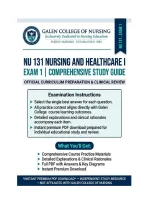
,NU 131 Exam 1 | Nursing and Healthcare I (2026/2027) PDF |
Nursing | Galen College
1. Which of the following best describes the primary purpose of the nursing
process?
A) To diagnose and treat medical diseases independently
B) To provide a systematic framework for delivering individualized patient care
C) To prescribe medications and treatments without provider orders
D) To replace the need for clinical judgment in nursing practice
Correct Answer: To provide a systematic framework for delivering individualized
patient care
Rationale: The nursing process is a systematic, five-step framework
(assessment, diagnosis, planning, implementation, evaluation) that guides
nurses in delivering holistic, patient-centered care. It promotes clinical
reasoning and individualized interventions rather than rigid standardization. It
does not diagnose medical diseases, prescribe treatments independently, or
replace clinical judgment.
2. What is the primary function of the assessment phase in the nursing process?
A) To establish patient goals and expected outcomes
B) To systematically collect and analyze patient data
C) To implement nursing interventions based on evidence
D) To evaluate the effectiveness of nursing care
,Correct Answer: To systematically collect and analyze patient data
Rationale: The assessment phase is the first step of the nursing process,
involving the systematic collection of subjective and objective data through
history taking, physical examination, and diagnostic testing. This data forms the
foundation for identifying patient problems and planning care. Goal setting
occurs during planning, implementation involves carrying out interventions, and
evaluation determines whether outcomes were met.
3. According to the NCSBN Clinical Judgment Measurement Model, which layer
immediately follows "Analyze Cues"?
A) Take Actions
B) Recognize Cues
C) Prioritize Hypotheses
D) Evaluate Outcomes
Correct Answer: Prioritize Hypotheses
Rationale: The NCSBN CJMM consists of six layers: Recognize Cues, Analyze
Cues, Prioritize Hypotheses, Generate Solutions, Take Actions, and Evaluate
Outcomes. After analyzing cues, the nurse prioritizes hypotheses to determine
which patient problems are most urgent. Taking actions and evaluating
outcomes occur later in the model.
4. Who is considered the founder of modern nursing?
, A) Clara Barton
B) Florence Nightingale
C) Lillian Wald
D) Dorothea Dix
Correct Answer: Florence Nightingale
Rationale: Florence Nightingale is widely recognized as the founder of modern
nursing. Her pioneering work in sanitation and patient care during the Crimean
War profoundly influenced healthcare practices and established nursing as a
respected profession. Clara Barton founded the American Red Cross, Lillian
Wald founded public health nursing, and Dorothea Dix advocated for the
mentally ill.
5. Which organization was founded by Clara Barton?
A) The Henry Street Settlement
B) The American Red Cross
C) The first school of nursing
D) The National League for Nursing
Correct Answer: The American Red Cross
Rationale: Clara Barton is recognized for establishing the American Red Cross,
an organization dedicated to providing assistance during times of crisis and
Nursing | Galen College
1. Which of the following best describes the primary purpose of the nursing
process?
A) To diagnose and treat medical diseases independently
B) To provide a systematic framework for delivering individualized patient care
C) To prescribe medications and treatments without provider orders
D) To replace the need for clinical judgment in nursing practice
Correct Answer: To provide a systematic framework for delivering individualized
patient care
Rationale: The nursing process is a systematic, five-step framework
(assessment, diagnosis, planning, implementation, evaluation) that guides
nurses in delivering holistic, patient-centered care. It promotes clinical
reasoning and individualized interventions rather than rigid standardization. It
does not diagnose medical diseases, prescribe treatments independently, or
replace clinical judgment.
2. What is the primary function of the assessment phase in the nursing process?
A) To establish patient goals and expected outcomes
B) To systematically collect and analyze patient data
C) To implement nursing interventions based on evidence
D) To evaluate the effectiveness of nursing care
,Correct Answer: To systematically collect and analyze patient data
Rationale: The assessment phase is the first step of the nursing process,
involving the systematic collection of subjective and objective data through
history taking, physical examination, and diagnostic testing. This data forms the
foundation for identifying patient problems and planning care. Goal setting
occurs during planning, implementation involves carrying out interventions, and
evaluation determines whether outcomes were met.
3. According to the NCSBN Clinical Judgment Measurement Model, which layer
immediately follows "Analyze Cues"?
A) Take Actions
B) Recognize Cues
C) Prioritize Hypotheses
D) Evaluate Outcomes
Correct Answer: Prioritize Hypotheses
Rationale: The NCSBN CJMM consists of six layers: Recognize Cues, Analyze
Cues, Prioritize Hypotheses, Generate Solutions, Take Actions, and Evaluate
Outcomes. After analyzing cues, the nurse prioritizes hypotheses to determine
which patient problems are most urgent. Taking actions and evaluating
outcomes occur later in the model.
4. Who is considered the founder of modern nursing?
, A) Clara Barton
B) Florence Nightingale
C) Lillian Wald
D) Dorothea Dix
Correct Answer: Florence Nightingale
Rationale: Florence Nightingale is widely recognized as the founder of modern
nursing. Her pioneering work in sanitation and patient care during the Crimean
War profoundly influenced healthcare practices and established nursing as a
respected profession. Clara Barton founded the American Red Cross, Lillian
Wald founded public health nursing, and Dorothea Dix advocated for the
mentally ill.
5. Which organization was founded by Clara Barton?
A) The Henry Street Settlement
B) The American Red Cross
C) The first school of nursing
D) The National League for Nursing
Correct Answer: The American Red Cross
Rationale: Clara Barton is recognized for establishing the American Red Cross,
an organization dedicated to providing assistance during times of crisis and


