TABLE OF CONTENTS
Nursing for Wellness in Older Adults | Original Practice Test Bank • 1
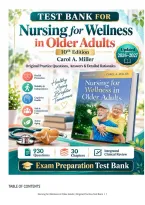
,Nursing for Wellness in Older Adults, 10th Edition
Carol A. Miller
Original Exam Preparation Test Bank | 930 Questions Across 30 Chapters | Answers & Detailed Rationales | Updated 2026-
2027
PART 1 - OLDER ADULTS AND WELLNESS
1. Chapter 1: Seeing Older Adults Through the Eyes of Wellness
2. Chapter 2: Advancing Health Equity Through Culturally Responsive Care
3. Chapter 3: Applying a Nursing Model for Promoting Wellness in Older Adults
4. Chapter 4: Theoretical Perspectives on Aging Well
5. Chapter 5: Gerontological Nursing and Health Promotion
6. Chapter 6: Care Priorities for Older Adults
7. Chapter 7: Health Care for Older Adults in Various Settings
8. Chapter 8: Assessment of Health and Functioning
9. Chapter 9: Medications and Other Bioactive Substances
10. Chapter 10: Legal and Ethical Concerns
PART 2 - CONSIDERATIONS FOR PROVIDING AGE-FRIENDLY NURSING CARE
11. Chapter 11: Elder Abuse and Neglect
12. Chapter 12: Cognitive Wellness
13. Chapter 13: Psychosocial Wellness
14. Chapter 14: Psychosocial Assessment
15. Chapter 15: Impaired Cognitive Function: Delirium and Dementia
Nursing for Wellness in Older Adults | Original Practice Test Bank • 2
, 16. Chapter 16: Impaired Affective Function: Depression and Suicide
PART 3 - PROMOTING PSYCHOSOCIAL WELLNESS
17. Chapter 17: Hearing
18. Chapter 18: Vision
19. Chapter 19: Digestion and Nutrition
20. Chapter 20: Urinary Wellness
21. Chapter 21: Cardiovascular Wellness
22. Chapter 22: Respiratory Wellness
23. Chapter 23: Safe Mobility
PART 4 - PROMOTING WELLNESS IN PHYSICAL FUNCTION
24. Chapter 24: Integumentary Wellness
25. Chapter 25: Sleep and Rest
26. Chapter 26: Thermoregulation
27. Chapter 27: Sexual Wellness
PART 5 - PROMOTING WELLNESS DURING ILLNESS AND TRANSITIONS IN CARE
28. Chapter 28: Caring for Older Adults During Illness
29. Chapter 29: Caring for Older Adults Experiencing Pain
30. Chapter 30: Caring for Older Adults at the End of Life
Nursing for Wellness in Older Adults | Original Practice Test Bank • 3
,Chapter 1: Seeing Older Adults Through the Eyes of Wellness
❓ Question 1
At a wellness visit, an older adult with stable chronic conditions explains, “I feel well
when I can tend my plants and attend my community group.” What is the best
response when establishing nursing goals?
A. Base the goals primarily on the number of diagnosed conditions.
B. Explore what supports participation in these personally meaningful activities.
C. Recommend replacing community activities with home activities because of age.
D. Postpone wellness goals until all chronic conditions have resolved.
✅ Correct Answer: B. Explore what supports participation in these personally
meaningful activities.
🧠 Rationale:
Wellness includes the person’s experience of well-being, meaningful participation,
and ability to function.
Chronic conditions can coexist with wellness, so their presence does not eliminate
opportunities for health promotion.
Exploring supports and barriers helps establish individualized, achievable goals.
Diagnosis counts alone, age-based restrictions, and waiting for complete recovery
overlook the person’s priorities.
🔑 Keywords: Person-centered care; meaningful activity; functional ability;
wellness.
🩺 Clinical Pearl: Ask what the older adult wants to maintain or regain when
identifying care priorities.
🎯 Exam Strategy: Favor the response that explores individual goals and abilities
before imposing restrictions.
Nursing for Wellness in Older Adults | Original Practice Test Bank • 4
,❓ Question 2
The strongest definition of wellness in later life emphasizes:
A. The absence of all diagnosed medical conditions.
B. Complete independence from other people.
C. Physical performance equal to that of younger adults.
D. An individualized process of pursuing well-being and meaningful functioning.
✅ Correct Answer: D. An individualized process of pursuing well-being and
meaningful functioning.
🧠 Rationale:
Wellness involves physical, emotional, social, and other personally meaningful
dimensions of life.
It remains possible when chronic conditions or functional limitations are present.
Neither complete independence nor youthful physical performance is required for
well-being.
Assessment therefore considers the individual’s goals, abilities, resources, and
experience.
🔑 Keywords: Wellness; holistic health; individual goals.
🩺 Clinical Pearl: An older adult’s own description of a good day can reveal valuable
wellness priorities.
🎯 Exam Strategy: Avoid definitions that make wellness dependent on perfection or
freedom from disease.
❓ Question 3
Chronological age provides the most direct information about:
A. The number of years a person has lived.
B. The person’s ability to manage daily activities.
C. The level of support the person requires.
D. The person’s readiness to learn new skills.
✅ Correct Answer: A. The number of years a person has lived.
Nursing for Wellness in Older Adults | Original Practice Test Bank • 5
,🧠 Rationale:
Chronological age measures elapsed time since birth.
It does not independently establish functional ability, learning capacity, or care
needs.
People of the same age can differ substantially in health, resources, and daily
performance.
Individual assessment is necessary before making decisions about support.
🔑 Keywords: Chronological age; individual variation; assessment.
🩺 Clinical Pearl: Age is one assessment detail, not a substitute for assessing the
person.
🎯 Exam Strategy: Distinguish a demographic measurement from conclusions
about capability.
❓ Question 4
Select the statement that most clearly demonstrates ageism.
A. “Let us assess whether the information is accessible to this person.”
B. “Previous experience may influence how someone approaches learning.”
C. “Older adults generally cannot learn to use unfamiliar technology.”
D. “People may need different amounts of practice when learning a skill.”
✅ Correct Answer: C. “Older adults generally cannot learn to use unfamiliar
technology.”
🧠 Rationale:
Ageism includes stereotypes, prejudice, or discrimination based on age.
Assuming that older adults cannot learn technology assigns a limitation to an entire
age group.
Learning should be assessed individually, including experience, interest, and
accessibility needs.
The other statements allow for individual differences without presuming incapacity.
🔑 Keywords: Ageism; stereotypes; learning.
Nursing for Wellness in Older Adults | Original Practice Test Bank • 6
,🩺 Clinical Pearl: Ask about technology experience before deciding how much
instruction someone needs.
🎯 Exam Strategy: Watch for broad claims that assign the same limitation to all
older adults.
❓ Question 5 — Table Interpretation
Review the following findings.
Older
Diagnosed conditions Daily functioning and personal report
adult
Two stable chronic Participates in valued activities and reports
Person 1
conditions satisfaction
No known chronic
Person 2 Reports loneliness and loss of purpose
conditions
One stable chronic Uses assistance to continue a valued
Person 3
condition community role
The table best supports what conclusion?
A. Person 2 necessarily has the highest level of wellness.
B. Diagnosis counts alone do not establish overall wellness.
C. Receiving assistance prevents a person from experiencing wellness.
D. Personal satisfaction makes physical health assessment unnecessary.
✅ Correct Answer: B. Diagnosis counts alone do not establish overall wellness.
🧠 Rationale:
The findings show that disease burden and experienced well-being are related but
distinct.
People with chronic conditions may retain purpose, participation, and satisfaction.
Someone without a known diagnosis may still have important unmet psychosocial
needs.
Comprehensive assessment combines physical findings with function and personal
experience.
Nursing for Wellness in Older Adults | Original Practice Test Bank • 7
,🔑 Keywords: Multidimensional wellness; participation; disease burden.
🩺 Clinical Pearl: Include questions about connection and purpose even when
physical findings are reassuring.
🎯 Exam Strategy: Compare all columns rather than relying on the number of
diagnoses.
❓ Question 6
When identifying wellness goals, the best opening question is:
A. “What activities or relationships matter most to you?”
B. “What goals has your family selected for you?”
C. “How soon can you become completely independent?”
D. “Would you agree that physical health should be your main concern?”
✅ Correct Answer: A. “What activities or relationships matter most to you?”
🧠 Rationale:
An open question about what matters invites the older adult to define meaningful
priorities.
Those priorities provide a foundation for collaborative and realistic goals.
Family perspectives can contribute with the person’s agreement, but should not
automatically replace their preferences.
Prescribing independence or physical health as the main goal may overlook other
values.
🔑 Keywords: Person-centered assessment; priorities; collaboration.
🩺 Clinical Pearl: Record meaningful goals in the older adult’s own words when
possible.
🎯 Exam Strategy: Choose the question that explores preferences without
suggesting the desired answer.
Nursing for Wellness in Older Adults | Original Practice Test Bank • 8
,❓ Question 7
The distinction between autonomy and independence is best expressed by:
A. Autonomy concerns mobility, whereas independence concerns memory.
B. Autonomy requires the ability to perform every task without assistance.
C. Independence gives relatives authority to make personal decisions.
D. Autonomy concerns self-direction, whereas independence concerns performing
activities without assistance.
✅ Correct Answer: D. Autonomy concerns self-direction, whereas independence
concerns performing activities without assistance.
🧠 Rationale:
Autonomy refers to directing one’s life and participating in personal decisions.
Independence describes the ability to carry out activities without another person’s
help.
An older adult may require substantial physical assistance while retaining decision-
making ability.
Support should preserve self-direction rather than equating dependence with
incapacity.
🔑 Keywords: Autonomy; independence; self-direction.
🩺 Clinical Pearl: Needing assistance with dressing does not establish inability to
choose clothing or daily routines.
🎯 Exam Strategy: Separate “making the decision” from “performing the task.”
❓ Question 8
Strengths-based assessment primarily seeks to identify:
A. Reasons the individual should avoid challenging activities.
B. Deficits that justify transferring responsibility to others.
C. Abilities, relationships, and resources that can support personal goals.
D. Evidence that formal support services are unnecessary.
✅ Correct Answer: C. Abilities, relationships, and resources that can support
personal goals.
Nursing for Wellness in Older Adults | Original Practice Test Bank • 9
,🧠 Rationale:
Strengths-based assessment identifies assets that can contribute to well-being and
goal achievement.
These assets may include practical skills, motivation, supportive relationships, and
community resources.
Recognizing strengths complements assessment of difficulties and does not
eliminate the need for services.
The purpose is to build an individualized plan that uses available capabilities.
🔑 Keywords: Strengths-based care; assets; resources.
🩺 Clinical Pearl: Ask both “What is difficult?” and “What helps you manage?”
🎯 Exam Strategy: Select the response that identifies useful capabilities without
ignoring needs.
❓ Question 9
An older adult who needs help preparing meals wishes to continue planning the
weekly menu. The most appropriate response is to:
A. Preserve menu planning while arranging the assistance needed for preparation.
B. Transfer all food-related decisions to the helper for consistency.
C. Require independent cooking before allowing menu choices.
D. Select a standard menu without discussing preferences.
✅ Correct Answer: A. Preserve menu planning while arranging the assistance
needed for preparation.
🧠 Rationale:
The need for practical assistance does not remove the person’s role in decisions.
Separating menu selection from meal preparation allows support to address the
actual limitation.
Maintaining meaningful involvement can preserve identity, control, and satisfaction.
Taking over every related activity provides more restriction than the situation
requires.
🔑 Keywords: Supported autonomy; participation; individualized assistance.
Nursing for Wellness in Older Adults | Original Practice Test Bank • 10