
7B Section Problems Fall 2025 Week 1: math, temperature, and thermal expansion
Week 1 Discussion Solutions
Math Review
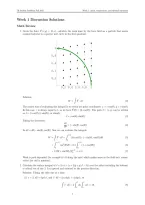
1. Given the force Fω (x, y) = (0, x), calculate the work done by the force field on a particle that moves
counterclockwise in a quarter unit circle in the first quadrant.
Solution: !
W = Fω · dωs (2)
The easiest way of evaluating this integral is to switch use polar coordinates: x = r cos(ε), y = r sin(ε).
In this case, r is always equal to 1, so we have Fω (ε) = (0, cos(ε)). The path ωs = (x, y) can be written
as ωs = (r cos(ε), (r sin(ε)), or simply:
ωs = (cos(ε), sin(ε)) (3)
Taking the derivative:
dωs
= (→ sin(ε), cos(ε)) (4)
dε
So dωs = dε(→ sin(ε), cos(ε)) Now we can evaluate the integral:
! ! ω/2
W = Fω · dωs = (0, cos(ε)) · (→ sin(ε), cos(ε))dε (5)
0
! ω/2 ! ω/2
= cos2 (ε)dε = 0.5 (1 + cos(2ε)) (6)
0 0
ω/2
= 1/2[ε + sin(2ε)/2]0 = ϑ/4 (7)
Work is path depended (for example it’s 0 along the axis) which makes sense as the field isn’t conser-
vative (its curl is nonzero).
2. Calculate the surface integral of ωv = 2xz x̂ + (x + 2)ŷ + y(z 2 → 3)ẑ over five sides (excluding the bottom)
a cubical box of size 2. Let upward and outward be the positive direction.
Solution: Taking the sides one at a time:
(i) x = 2, dωa = dydz x̂, and ωv · dωa = 2xzdydz = 4zdydz, so
! ! 2 ! 2
ωv · dωa = 4 dy zdz = 16. (8)
0 0
3
, 7B Section Problems Fall 2025 Week 1: math, temperature, and thermal expansion
(ii) x = 0, dωa = →dydz x̂, and v · dωa = →2xzdydz = 0, so
!
ωv · dωa = 0. (9)
(iii) y = 2, dωa = dxdz ŷ, and ωv · dωa = (x + 2)dxdz, so
! ! 2 ! 2
ωv · dωa = (x + 2)dx dz = 12. (10)
0 0
(iv) y = 0, dωa = →dxdz ŷ, and ωv · dωa = →(x + 2)dxdz, so
! ! 2 ! 2
ωv · dωa = → (x + 2)dx dz = →12. (11)
0 0
(v) z = 2, dωa = dxdyẑ, and ωv · dωa = y(z 2 → 3)dxdy = ydxdy, so
! ! 2 ! 2
ωv · dωa = dx ydy = 4. (12)
0 0
Total flux = 16 + 0 + 12 - 12 + 4 = 20
3. (a) Choose parameterization ϖ(t) = (t, y0 t) for t ↑ [0, 1]. ϖ → (t) = (1, y0 ), so the integral is
! 1 " #
→ky0 t 1
W = (→k, ) · (1, y0 )dt = →k 1 + y0 (13)
0 y0 2
(b) ϖ(t) = (sin t, y0 sin t) for t ↑ [0, ϑ/2] ↓ ϖ → (t) = (cos t, y0 cos t), so the integral is
! ω/2 " #
→ky0 sin t 1
W = (→k, ) · (cos t, y0 cos t)dt = →k 1 + y0 (14)
0 y0 2
ω , where U = kx + ky 2
[Note: This vector field is conservative, i.e., Fω = →→U 2y0 . Therefore any path
between these two points should give the same answer.]
Thermodynamics
4. Hot water. To remove the lid, we want the metal to expand more than the glass does, which can be
achieved by increasing the temperature.
5. The volume expansion formula is
V (T ) = V0 + !V = V0 (1 + ϱ(!T )), (15)
where ϱ is the volume expansion coe”cient. Using the linear expansion formula, show ϱ = 3ς, where ς
is the linear expansion coe”cient in each linear direction (assume the material expands homogeneously).
Solution: The equation for linear expansion is given by
L(T ) = L0 (1 + ς!T ), (16)
and so the volume expansion formula may be rewritten
V (T ) = L(T )3 = L0 (1 + ς!T ) ↔ L0 (1 + ς!T ) ↔ L0 (1 + ς!T )
(17)
= V0 (1 + 3ς!T + 3ς2 !T 2 + ς3 !T 3 ).
Matching terms, and ignoring terms order !T 2 and higher, we obtain the result.
4
Week 1 Discussion Solutions
Math Review
1. Given the force Fω (x, y) = (0, x), calculate the work done by the force field on a particle that moves
counterclockwise in a quarter unit circle in the first quadrant.
Solution: !
W = Fω · dωs (2)
The easiest way of evaluating this integral is to switch use polar coordinates: x = r cos(ε), y = r sin(ε).
In this case, r is always equal to 1, so we have Fω (ε) = (0, cos(ε)). The path ωs = (x, y) can be written
as ωs = (r cos(ε), (r sin(ε)), or simply:
ωs = (cos(ε), sin(ε)) (3)
Taking the derivative:
dωs
= (→ sin(ε), cos(ε)) (4)
dε
So dωs = dε(→ sin(ε), cos(ε)) Now we can evaluate the integral:
! ! ω/2
W = Fω · dωs = (0, cos(ε)) · (→ sin(ε), cos(ε))dε (5)
0
! ω/2 ! ω/2
= cos2 (ε)dε = 0.5 (1 + cos(2ε)) (6)
0 0
ω/2
= 1/2[ε + sin(2ε)/2]0 = ϑ/4 (7)
Work is path depended (for example it’s 0 along the axis) which makes sense as the field isn’t conser-
vative (its curl is nonzero).
2. Calculate the surface integral of ωv = 2xz x̂ + (x + 2)ŷ + y(z 2 → 3)ẑ over five sides (excluding the bottom)
a cubical box of size 2. Let upward and outward be the positive direction.
Solution: Taking the sides one at a time:
(i) x = 2, dωa = dydz x̂, and ωv · dωa = 2xzdydz = 4zdydz, so
! ! 2 ! 2
ωv · dωa = 4 dy zdz = 16. (8)
0 0
3
, 7B Section Problems Fall 2025 Week 1: math, temperature, and thermal expansion
(ii) x = 0, dωa = →dydz x̂, and v · dωa = →2xzdydz = 0, so
!
ωv · dωa = 0. (9)
(iii) y = 2, dωa = dxdz ŷ, and ωv · dωa = (x + 2)dxdz, so
! ! 2 ! 2
ωv · dωa = (x + 2)dx dz = 12. (10)
0 0
(iv) y = 0, dωa = →dxdz ŷ, and ωv · dωa = →(x + 2)dxdz, so
! ! 2 ! 2
ωv · dωa = → (x + 2)dx dz = →12. (11)
0 0
(v) z = 2, dωa = dxdyẑ, and ωv · dωa = y(z 2 → 3)dxdy = ydxdy, so
! ! 2 ! 2
ωv · dωa = dx ydy = 4. (12)
0 0
Total flux = 16 + 0 + 12 - 12 + 4 = 20
3. (a) Choose parameterization ϖ(t) = (t, y0 t) for t ↑ [0, 1]. ϖ → (t) = (1, y0 ), so the integral is
! 1 " #
→ky0 t 1
W = (→k, ) · (1, y0 )dt = →k 1 + y0 (13)
0 y0 2
(b) ϖ(t) = (sin t, y0 sin t) for t ↑ [0, ϑ/2] ↓ ϖ → (t) = (cos t, y0 cos t), so the integral is
! ω/2 " #
→ky0 sin t 1
W = (→k, ) · (cos t, y0 cos t)dt = →k 1 + y0 (14)
0 y0 2
ω , where U = kx + ky 2
[Note: This vector field is conservative, i.e., Fω = →→U 2y0 . Therefore any path
between these two points should give the same answer.]
Thermodynamics
4. Hot water. To remove the lid, we want the metal to expand more than the glass does, which can be
achieved by increasing the temperature.
5. The volume expansion formula is
V (T ) = V0 + !V = V0 (1 + ϱ(!T )), (15)
where ϱ is the volume expansion coe”cient. Using the linear expansion formula, show ϱ = 3ς, where ς
is the linear expansion coe”cient in each linear direction (assume the material expands homogeneously).
Solution: The equation for linear expansion is given by
L(T ) = L0 (1 + ς!T ), (16)
and so the volume expansion formula may be rewritten
V (T ) = L(T )3 = L0 (1 + ς!T ) ↔ L0 (1 + ς!T ) ↔ L0 (1 + ς!T )
(17)
= V0 (1 + 3ς!T + 3ς2 !T 2 + ς3 !T 3 ).
Matching terms, and ignoring terms order !T 2 and higher, we obtain the result.
4


