
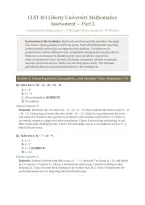
CLST 103 Liberty University Mathematics
Assessment — Part 2
Comprehensive Examination · 65 Multiple-Choice Questions · 90 Minutes
Instructions to the Candidate: Read each question carefully and select the single
best answer. Each question is worth one point. Show all mathematical reasoning
in the rationale section that accompanies each problem. Calculator use is
permitted for routine arithmetic only; all algebraic manipulation must be shown.
Distractors are designed to identify specific misconceptions (sign errors,
order-of-operations errors, incorrect factoring, extraneous-solution acceptance,
and unit-conversion errors). Mark your selected option clearly. The rationale
provided doubles as an instructional reference for remediation.
Section 1: Linear Equations, Inequalities, and Absolute Value (Questions 1–8)
Q1. Solve for x: 3(x − 4) + 2x = 5x − 12.
A. x = 0
B. x = −4
C. All real numbers [CORRECT]
D. No solution
Correct Answer: C
Rationale: Distribute the 3 to obtain 3x − 12 + 2x = 5x − 12, then combine like terms to get 5x − 12
= 5x − 12. Subtracting 5x from both sides yields −12 = −12, which is a true statement for every
real value of x; therefore the equation is an identity with solution set (choice C). Choice A
incorrectly assumes a single root after cancellation. Choice B arises from subtracting 5x and
then erroneously dividing by zero. Choice D would apply only to a contradiction such as 0 = 1,
which did not occur.
Q2. Solve for x: 4x − 7 = 2x + 9.
A. x = 1
B. x = 2
C. x = 8 [CORRECT]
D. x = 16
Correct Answer: C
Rationale: Subtract 2x from both sides to get 2x − 7 = 9, then add 7 to obtain 2x = 16, and divide
by 2 to reach x = 8 (choice C). Choice A results from subtracting 7 instead of adding it after
isolating 2x. Choice B comes from dividing 16 by 8 rather than by 2. Choice D represents the
un-divided numerator 16, forgetting the final division step.
,Q3. Solve the literal equation A = (1/2)h(b +b ) for b .
A. b = 2A/h − b [CORRECT]
B. b = 2A/h + b
C. b = (2A − b )/h
D. b = A/(2h) − b
Correct Answer: A
Rationale: Multiply both sides by 2 to clear the fraction: 2A = h(b + b ). Divide both sides by
h to obtain b + b = 2A/h. Finally subtract b from both sides to isolate b = 2A/h − b
(choice A). Choice B reverses the sign on b , a common error when moving terms across the
equals. Choice C incorrectly leaves b inside the numerator before dividing by h. Choice D
forgets to multiply A by 2 when clearing the fraction.
Q4. Solve the inequality −3x + 5 ≥ −7 and express the solution in interval notation.
A. (−∞, 4] [CORRECT]
B. [4, ∞)
C. (−∞, −4]
D. [−4, ∞)
Correct Answer: A
Rationale: Subtract 5 from both sides to get −3x ≥ −12. Divide by −3, remembering to reverse
the inequality symbol, giving x ≤ 4. In interval notation this is (−∞, 4] (choice A). Choice B
forgets to reverse the inequality when dividing by a negative. Choice C reverses both the
inequality and the sign of the constant. Choice D reverses the inequality and shifts the constant
to −4 incorrectly.
Q5. Solve the compound inequality: −5 ≤ 2x − 1 < 7.
A. [−2, 4]
B. [−2, 4) [CORRECT]
C. (−2, 4]
D. (−3, 3]
Correct Answer: B
Rationale: Add 1 to all three parts: −4 ≤ 2x < 8. Divide each part by 2 to obtain −2 ≤ x < 4,
written in interval notation as [−2, 4) (choice B). Choice A incorrectly closes the right bracket.
Choice C opens the left bracket when it should be closed because −2 is included. Choice D
misapplies the arithmetic, subtracting 1 from the constants instead of adding.
, Q6. Solve for x: |2x − 3| = 7.
A. x = 5 only
B. x = −2 only
C. x = 5 or x = −2 [CORRECT]
D. x = 2 or x = 5
Correct Answer: C
Rationale: An absolute value equation |A| = k with k > 0 splits into A = k or A = −k. Setting 2x − 3
= 7 gives 2x = 10, so x = 5. Setting 2x − 3 = −7 gives 2x = −4, so x = −2. The complete solution set is
{5, −2} (choice C). Choice A captures only the positive branch. Choice B captures only the
negative branch. Choice D arises from solving 2x − 3 = 7 incorrectly and substituting an
extraneous value.
Q7. Solve the absolute value inequality: |x + 4| < 3.
A. x < −7 or x < −1
B. (−7, −1) [CORRECT]
C. (−∞, −7) ∪ (−1, ∞)
D. [−7, −1]
Correct Answer: B
Rationale: The inequality |A| < k with k > 0 translates into a compound inequality −k < A < k.
Here −3 < x + 4 < 3. Subtract 4 from each part to obtain −7 < x < −1, which in interval notation is
(−7, −1) (choice B). Choice A uses a disjunction instead of a conjunction, misapplying the rule
for <. Choice C applies the rule for |A| > k (greater-than) instead of less-than. Choice D
incorrectly closes the endpoints that should be excluded.
Q8. A car rental company charges a flat fee of $35 plus $0.25 per mile driven. If a
customer's budget is at most $80, what is the maximum number of miles she can drive?
A. 140 miles
B. 180 miles [CORRECT]
C. 220 miles
D. 320 miles
Correct Answer: B
Rationale: Translate the scenario into the inequality 35 + 0.25m ≤ 80. Subtract 35 to get 0.25m
≤ 45, then divide by 0.25 to obtain m ≤ 180 (choice B). Choice A divides 35 by 0.25 instead of
the remaining budget. Choice C subtracts 25 instead of 0.25m from the budget. Choice D
divides 80 (the total budget) by 0.25 without first subtracting the flat fee.
Section 2: Graphing Linear Equations and Functions (Questions 9–16)
Assessment — Part 2
Comprehensive Examination · 65 Multiple-Choice Questions · 90 Minutes
Instructions to the Candidate: Read each question carefully and select the single
best answer. Each question is worth one point. Show all mathematical reasoning
in the rationale section that accompanies each problem. Calculator use is
permitted for routine arithmetic only; all algebraic manipulation must be shown.
Distractors are designed to identify specific misconceptions (sign errors,
order-of-operations errors, incorrect factoring, extraneous-solution acceptance,
and unit-conversion errors). Mark your selected option clearly. The rationale
provided doubles as an instructional reference for remediation.
Section 1: Linear Equations, Inequalities, and Absolute Value (Questions 1–8)
Q1. Solve for x: 3(x − 4) + 2x = 5x − 12.
A. x = 0
B. x = −4
C. All real numbers [CORRECT]
D. No solution
Correct Answer: C
Rationale: Distribute the 3 to obtain 3x − 12 + 2x = 5x − 12, then combine like terms to get 5x − 12
= 5x − 12. Subtracting 5x from both sides yields −12 = −12, which is a true statement for every
real value of x; therefore the equation is an identity with solution set (choice C). Choice A
incorrectly assumes a single root after cancellation. Choice B arises from subtracting 5x and
then erroneously dividing by zero. Choice D would apply only to a contradiction such as 0 = 1,
which did not occur.
Q2. Solve for x: 4x − 7 = 2x + 9.
A. x = 1
B. x = 2
C. x = 8 [CORRECT]
D. x = 16
Correct Answer: C
Rationale: Subtract 2x from both sides to get 2x − 7 = 9, then add 7 to obtain 2x = 16, and divide
by 2 to reach x = 8 (choice C). Choice A results from subtracting 7 instead of adding it after
isolating 2x. Choice B comes from dividing 16 by 8 rather than by 2. Choice D represents the
un-divided numerator 16, forgetting the final division step.
,Q3. Solve the literal equation A = (1/2)h(b +b ) for b .
A. b = 2A/h − b [CORRECT]
B. b = 2A/h + b
C. b = (2A − b )/h
D. b = A/(2h) − b
Correct Answer: A
Rationale: Multiply both sides by 2 to clear the fraction: 2A = h(b + b ). Divide both sides by
h to obtain b + b = 2A/h. Finally subtract b from both sides to isolate b = 2A/h − b
(choice A). Choice B reverses the sign on b , a common error when moving terms across the
equals. Choice C incorrectly leaves b inside the numerator before dividing by h. Choice D
forgets to multiply A by 2 when clearing the fraction.
Q4. Solve the inequality −3x + 5 ≥ −7 and express the solution in interval notation.
A. (−∞, 4] [CORRECT]
B. [4, ∞)
C. (−∞, −4]
D. [−4, ∞)
Correct Answer: A
Rationale: Subtract 5 from both sides to get −3x ≥ −12. Divide by −3, remembering to reverse
the inequality symbol, giving x ≤ 4. In interval notation this is (−∞, 4] (choice A). Choice B
forgets to reverse the inequality when dividing by a negative. Choice C reverses both the
inequality and the sign of the constant. Choice D reverses the inequality and shifts the constant
to −4 incorrectly.
Q5. Solve the compound inequality: −5 ≤ 2x − 1 < 7.
A. [−2, 4]
B. [−2, 4) [CORRECT]
C. (−2, 4]
D. (−3, 3]
Correct Answer: B
Rationale: Add 1 to all three parts: −4 ≤ 2x < 8. Divide each part by 2 to obtain −2 ≤ x < 4,
written in interval notation as [−2, 4) (choice B). Choice A incorrectly closes the right bracket.
Choice C opens the left bracket when it should be closed because −2 is included. Choice D
misapplies the arithmetic, subtracting 1 from the constants instead of adding.
, Q6. Solve for x: |2x − 3| = 7.
A. x = 5 only
B. x = −2 only
C. x = 5 or x = −2 [CORRECT]
D. x = 2 or x = 5
Correct Answer: C
Rationale: An absolute value equation |A| = k with k > 0 splits into A = k or A = −k. Setting 2x − 3
= 7 gives 2x = 10, so x = 5. Setting 2x − 3 = −7 gives 2x = −4, so x = −2. The complete solution set is
{5, −2} (choice C). Choice A captures only the positive branch. Choice B captures only the
negative branch. Choice D arises from solving 2x − 3 = 7 incorrectly and substituting an
extraneous value.
Q7. Solve the absolute value inequality: |x + 4| < 3.
A. x < −7 or x < −1
B. (−7, −1) [CORRECT]
C. (−∞, −7) ∪ (−1, ∞)
D. [−7, −1]
Correct Answer: B
Rationale: The inequality |A| < k with k > 0 translates into a compound inequality −k < A < k.
Here −3 < x + 4 < 3. Subtract 4 from each part to obtain −7 < x < −1, which in interval notation is
(−7, −1) (choice B). Choice A uses a disjunction instead of a conjunction, misapplying the rule
for <. Choice C applies the rule for |A| > k (greater-than) instead of less-than. Choice D
incorrectly closes the endpoints that should be excluded.
Q8. A car rental company charges a flat fee of $35 plus $0.25 per mile driven. If a
customer's budget is at most $80, what is the maximum number of miles she can drive?
A. 140 miles
B. 180 miles [CORRECT]
C. 220 miles
D. 320 miles
Correct Answer: B
Rationale: Translate the scenario into the inequality 35 + 0.25m ≤ 80. Subtract 35 to get 0.25m
≤ 45, then divide by 0.25 to obtain m ≤ 180 (choice B). Choice A divides 35 by 0.25 instead of
the remaining budget. Choice C subtracts 25 instead of 0.25m from the budget. Choice D
divides 80 (the total budget) by 0.25 without first subtracting the flat fee.
Section 2: Graphing Linear Equations and Functions (Questions 9–16)


